Project duration: February 2024 – February 2028
Principal college: Central Saint Martins
Project summary
Maternal Machines: Design Speculations about Fantasies of Care is a design research project funded by Wellcome and led by research fellow Dr Paulina Yurman. It is hosted at Central Saint Martins, University of the Arts London.
Speculative design has made useful contributions through critical interrogations of technology and its implications in society. While notions of family and reproduction are changing, dominant representations in design and technology still depict conventional and idealised situations. As AI and related technologies increasingly become entangled in spaces of care, it becomes particularly important to explore ways in which they might address diversely complex and subjective experiences and to consider the imagined scenarios, fears and expectations (real or unreal) held by a diversity of affected stakeholders.
This research will carry out a series of workshops and activities with new parents and with researchers and practitioners from design and technology, AI and ethics, medical humanities and maternal health. It will use the design practices of drawing, multidisciplinary collaboration, speculative design ideation and affected users’ participation to explore imaginaries, implications and design opportunities that might lead to diverse forms of wellbeing.
Aims of the research
- To explore understandings of care through interrogations of designs and technologies in collaboration with stakeholders from design, maternal health, human-computer-interaction, AI and ethics and medical humanities.
- To visualise new parents’ imaginaries around emergent technologies, including those from underrepresented groups.
- To speculate about the design opportunities and implications of artificially intelligent and related technologies in spaces related to maternal and infant care.
- To speculate, design or visualise design opportunities that might lead to the wellbeing of relevant stakeholders.

-
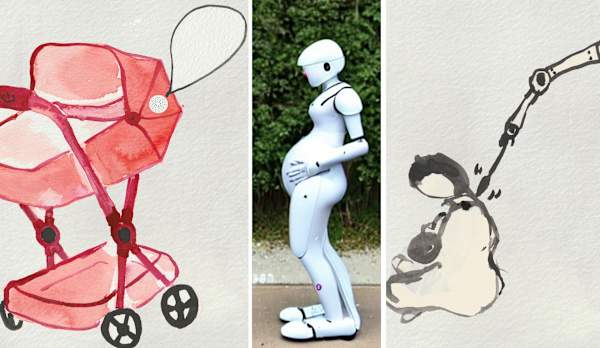
l to r: Pram drawing by Paulina Yurman; AI generated image of 'maternal robot'. Drawing of a robot arm interacting with a human and child by Paulina Yurman.
Imaginaries of machines, the maternal and infant care
Ideations of humanoid robotic nannies, maternal Alexas, smart cots, self-driving prams or constructed substitute mothers belong to a long history of aspirations to deploy designed technologies within spaces of reproduction, childbirth and care. Such conceived technologies often mirror society’s dreams, fears and desires about care and about how we would like technology to look after us.
Ideas about technology are, like ideas about the maternal, parenthood, reproduction or infants, spaces containing socially constructed meanings about health, care, the natural and the artificial, the biologic and the machinic. They are influential carriers of notions about machines as authorities of knowledge and about idealised forms of care that reflect ways in which we view those already engaged in activities of care, affected by intersectional issues of gender, race and class. -
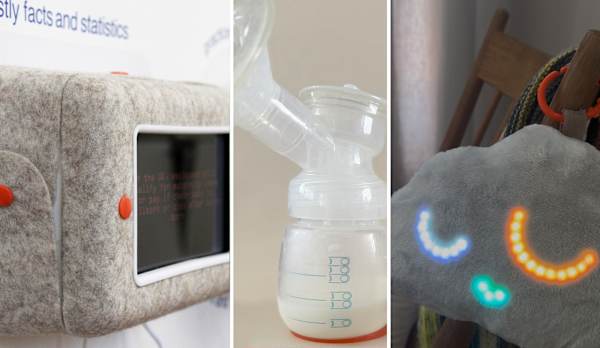
Design and illustration credit: Paulina Yurman
Exploring wellbeing opportunities through design speculation
By critically interrogating imaginaries, ideations and narratives from a design perspective, this research aims to explore alternative ways in which we could imagine how technology could support diverse forms of wellbeing in experiences related to maternal and infant care, whilst also acknowledging spaces where technological interventions might not be desirable.
Speculative design can make useful contributions through critical interrogations of technology and its implications in society. As AI and related technologies increasingly become entangled in everyday situations of care, it becomes particularly important to explore ways in which they might address diversely complex and subjective experiences and to consider the imagined scenarios, fears and expectations held by a diversity of affected stakeholders. Through participatory workshops and activities, and the design practices of drawing, making, multidisciplinary collaboration, speculative design ideation and affected users’ participation, this research explores opportunities with design and emerging technologies that might lead to diverse forms of wellbeing.
News and highlights
-

V&A Digital Design weekend
Digital Design Weekend 2026: V&A South Kensington (18-20 Sept)
Soothing Sounds Show & Tell + Installations at the V&A's Digital Design Weekend: an interactive activity exploring the sound strategies that parents and caregivers develop to soothe a baby. This work examines the implications, opportunities and imaginaries through designs and technologies for maternal and infant care.
-

Photo courtesy of the research team.
ACM Creativity & Cognition 2026 Conference at CSM, London
This year CSM hosted the ACM Creativity & Cognition conference, a gathering of researchers and creative practitioners working in human-computer interaction, AI, design, craft, creative practices, cognition and more. Dr Paulina Yurman presented her pictorial paper 'Bodies that Measure and are Measured' in the context of perinatal care, in the paper track Embodied Cycles and Intimate Health. [See: Publications].
-

Photo courtesy of the research team.
Workshop keynote at the International Conference on Social Robotics 2026, London
July 2026: Paulina Yurman gave a keynote presentation called 'Navigating Uncertainty, Ethics and Speculation in Maternal Machines', at the workshop Ethical Design in Human-Robot Interaction: Current State, Challenges, and Future Directions of the International Conference on Social Robotics. The workshop focussed on critical thinking in robotic design.
-
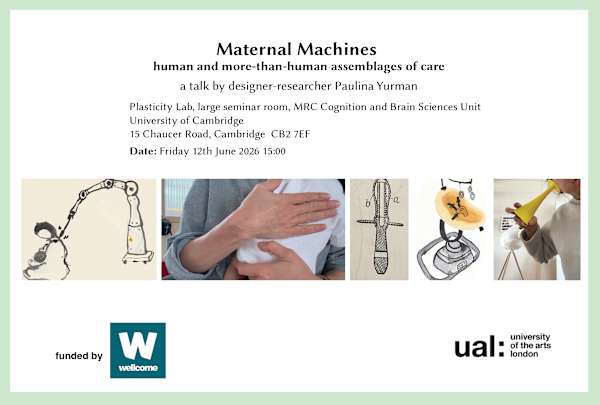
Plasticity Lab promo graphic, Paulina Yurman
Presenting to the Plasticity Lab, MRC Cognition and Brain Sciences Unit, University of Cambridge
June 2026: A presentation of Maternal Machines to researchers at the Plasticity Lab (MRC Cognition and Brain Sciences Unit) at the University of Cambridge. Paulina Yurman shared thoughts and reflections from her research-through-design work, exploring human and technology driven practices of care.
-
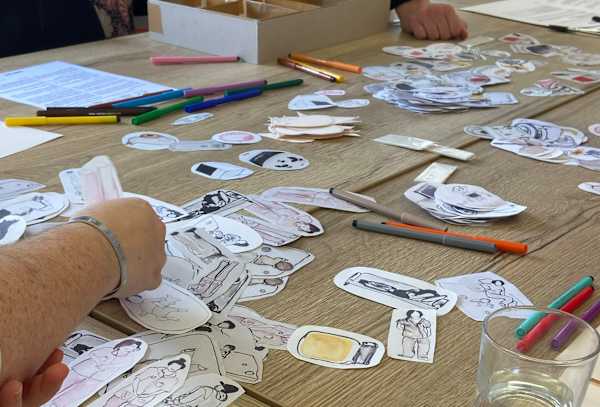
Leverhulme workshop materials. Credit: Paulina Yurman
Visiting scholar, Leverhulme Centre for the Future of Intelligence, University of Cambridge
As Visiting Scholar from June 2026, Paulina Yurman will use the semi-functioning prototypes, drawings and design ideations developed during Maternal Machines as conversational starters for discussions in seminars and workshops with scholars of AI and ethics. She will work with Dr Eleanor Drage (co-host of The Good Robot podcast).
-
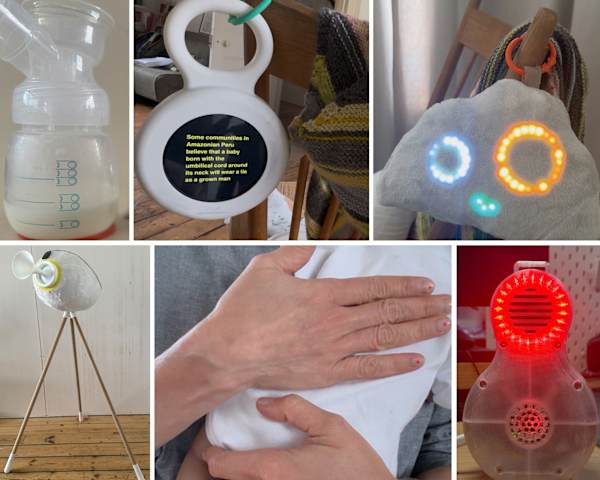
Credit: Paulina Yurman.
Prototypes, design explorations, speculations
Maternal Machines is a research-through-design project. This means that much of the production of new knowledge happens through the experimentation, testing of ideas and speculative design explorations. Semi-functioning prototypes with physical computing and analogue designs are being developed to explore human and more-than human assemblages of care.
-
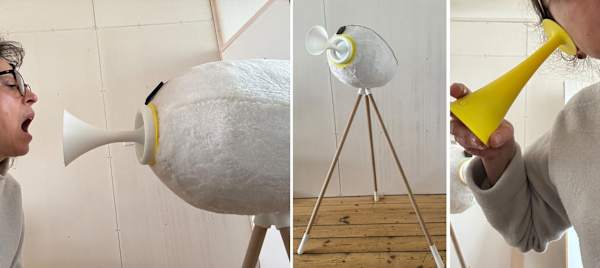
Credit: Paulina Yurman
Invitation to share your soothing sounds
Are you a parent or caregiver? How do you soothe your baby? Do you shush, hum, sing, play white noise or the shipping forecast? Share your soothing strategies with us and be part of our research! Please contact p.yurman@csm.arts.ac.uk or m.park@arts.ac.uk for more information.
-
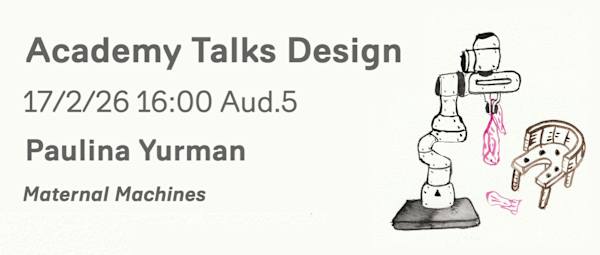
Illustration by Paulina Yurman.
Visit to Det Kongelige Akademi (Royal Danish Academy), Copenhagen
In February 2026 Paulina Yurman visited the Royal Danish Academy in Copenhagen and presented her research to design students and colleagues.
-
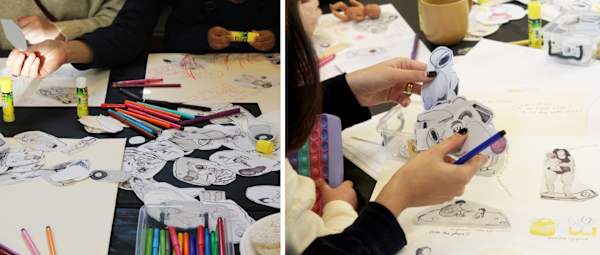
Photo: Max Park
Workshop with parents: Chats Palace, Hackney, London.
In a workshop held in Hackney in December 2025, parents and caregivers shared their thoughts, experiences, fears and fantasies about designs and technologies for maternal and infant care, using drawing and collage-making. Participants also shared sounds and strategies they use for soothing their babies to sleep.
-

Credit: Paulina Yurman.
Patting Machines
Patting Machines is a collaborative exploration of what constitutes a pat in the context of maternal and infant care, merging the expertise of design, robotics, speculative and critical design, haptics and affective touch. With Paulina Yurman (UAL), Caroline Yan Zheng (Nottingham University), Elia Gatti (UCL) and Matt Malpass (UAL).
Using dolls, props, our bodies, baby blankets, soft fabrics, and existing commercial products that are framed as patting machines for babies, we are doing an embodied exploration of what might constitute a caring pat, either machinic or human, for both babies and their carers. We are critically exploring specific situations where artificial patting might or might not be desirable.
-

Drawings by Paulina Yurman
Researching through drawing
Drawing has long been recognised as a practice for discovery and knowledge production in design and research, and is also used in other disciplines, such as medicine, mathematics, physics and biology. Paulina Yurman uses watercolour drawing as a practice in her research to generate interpretations and speculations about relations with and between technologies and bodies.
The fluidity of watercolour challenges usual representations of technological artefacts (often perceived as embodiments of objective precision), and brings ambiguity, defamiliarization and critical reflection. In Maternal Machines, drawing is also used during workshops with parents, midwives, health visitors, HCI researchers, AI and ethics scholars in this research to visualise experiences with designs technologies for care (both existing and imagined). See more drawings on Instagram @fluid_speculations and in Publications [below] -

Courtesy of Design Research Observatory
Design Research Observatory
Maternal Machines is included in the Design Research Observatory, a curated collection of design research examples intended to provide a route into understanding the value of design research for newcomers and experts. Design Research Observatory is part of Design Research Works, whose mission is to show the world what it can gain from Design Research.
-

Paulina presenting at the Wellcome Discovery Researcher Meeting
Wellcome Discovery Researcher Meeting
Dr Paulina Yurman presented highlights of her research at a gathering of Wellcome-funded researchers, London. It brought together researchers working across a broad range of fields: bioinformatics, AI and medical imaging, medical anthropology, stem cell research, bacteriology, bioengineering, medical humanities, patient safety and inequalities in care. Outlining the key questions guiding her work, approaches, methods and emerging insights, Dr Yurman presented her research on design and imaginaries and opportunities with technologies for maternal and infant care.
-

Facing the Mirror Postpartum, credit Paulina Yurman.
Facing the Mirror Postpartum:
with curiosity and without fearA workshop at London's Vagina Museum with designers, researchers and practitioners of midwifery, sexual health and maternal/perinatal care. It addressed the fears, anxieties, care and curiosities new mothers might encounter towards the postpartum body. We explored design to support bodily ways of self-knowing, without fear and with curiosity. Designer Laetitia de Allegri drew design configurations of chairs, mirrors or related objects that responded to the issues discussed. These drawings may later be developed, refined or left as they are for public display.
-

Dr Paulina Yurman at the CHI Conference, 2025
Workshop: 2025 CHI Conference on Human Computer Interaction
Dr Paulina Yurman took part in CHI 2025 in Yokohama, Japan.
CHI hosted the 1-day workshop ‘Maternal Machines: Imagining Experiences in Perinatal Care’ co-organised by Paulina Yurman with Maria Luce Lupetti, Madeline Balaam, Caroline Yan Zheng, Yoav Luft, Matt Malpass and Celine Mougenot. In this workshop, we explored imagined scenarios of care during the perinatal period, to cultivate critical discussions about practical, ethical and conceptual questions implicated in technologies for care. We particularly explored two interrelated themes: non-numerical forms of knowledge and touch-related experiences. -

CHI 2025 Paper, Paulina Yurman
Paper presentation: 2025 CHI Conference on Human Computer Interaction
Dr Paulina Yurman took part in CHI 2025 in Yokohama, Japan. She presented her paper Drawing Maternal Machines and other Fantasies of Care , an account of her use of drawing as a form of research in Maternal Machines.
-

2025 STS Italia Conference
2025 STS Italia Conference, Politecnico di Milano
Dr Yurman took part in STS Italia, Panel 38: Entangled Theories and Practices: Navigating Relational Ontologies In and Through Design, HCI, STS, and Philosophy of Technology. Her contribution ‘Constellations of Knowing/Not Knowing in Perinatal Care’ [Publications] addresses multiple ways of knowing, uncertainty and the attribution to technology as an authority of knowledge in perinatal care.
-

Alternative Perspectives on Digital healthcare
Alternative Perspectives on Digital Healthcare, University of Applied Sciences and Arts of Southern Switzerland
Dr Paulina Yurman visited the seminar “Alternative Perspectives on Digital Healthcare”, organised by MAKEAWARE!-Spearhead. The event gathered an international community of healthcare researchers to identify possible research directions. Organised by Serena Cangiano, Ginevra Terenghi, with Teresa Almeida, Arthi Manohar, Aylin Yildirim Tschoepe, Laura Ferrarello, Sara Levati and Matteo Subet.
-

IMAGIning health visiting workshop
Imagining Health Visiting Workshop: City, University of London
In the UK, health visitors usually visit parents and their newborns at their home during the first weeks after birth. In this design-led workshop with postgraduate health visiting students (with backgrounds in midwifery, nursing and mental health support), we discussed scenarios during postnatal care and collaboratively speculated about design interventions. We made plasticine objects, descriptive collages with drawings and magazine cutouts and created fictional dialogues with technologies.
-

Photos: Katie Harris
Imagining Machines, the Maternal and Care multidisciplinary workshop at CSM, London
This 1-day design-led workshop invited researchers and practitioners working in design research, Human Computer Interaction, AI and ethics, maternal/infant care and medical humanities to discuss, interrogate and speculate about imaginaries (historical and contemporary), designs and opportunities with technologies related to maternal and infant care.
The goal was to collaboratively interrogate, speculate and discuss possible design scenarios in postpartum situations with experts from various multidisciplinary perspectives; and develop a research network. -

Photo: Nadia Campo Woytuk
Imagining Perinatal Care, Machines and non-numerical Bodily Knowledge: KTH, Royal Institute of Technology, Stockholm
Workshop and presentation of Maternal Machines. 'Imagining Perinatal Care, Machines and Non-Numerical Bodily Knowledge' was a workshop with researchers working in intimate technologies and soma design. We drew and discussed scenarios where non-numerical and sensorial forms of bodily knowledge coexist with technologies in perinatal care. Paulina Yurman also gave a talk about her Maternal Machines research.
-

Photos: Katie Harris.
Visit to the Leverhulme Centre for the Future of Intelligence, University of Cambridge
A presentation of Maternal Machines, and speculative drawing workshop with researchers working in AI and ethics was held at The Leverhulme Centre for the Future of Intelligence (LCFI) at the University of Cambridge in May 2024.
People
-
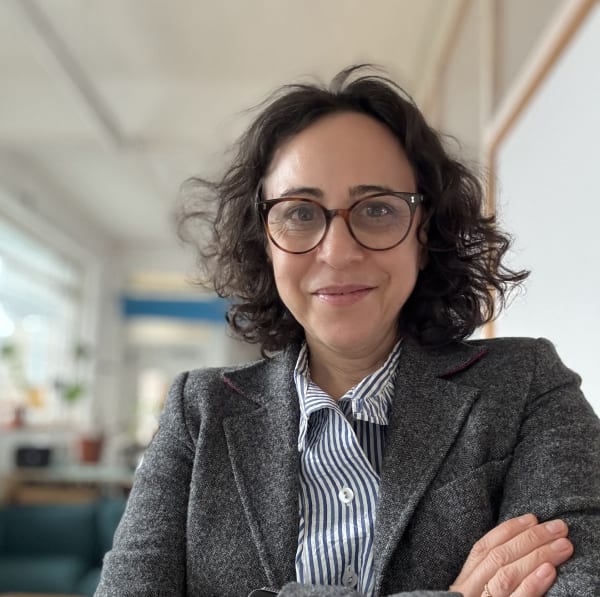
Dr Paulina Yurman.
Dr Paulina Yurman
Principal Investigator, Wellcome Early Career grant holder
-

Max Park.
Max Park
Research Assistant
Steering Committee
-

Maria Luce. Politecnico di Torino
Dr Maria Luce Lupetti
Politecnico di Torino, Design Ethics, AI and Robotics
-

Joseph Lindley, Lancaster University
Dr Joe Lindley
Lancaster University, Design Research Practices
-

Matt Malpass, Central Saint Martins, UAL
Dr Matt Malpass
University of the Arts London: Central Saint Martins: Professor (Designate) of Critical Design Practice
-

Victoria Bates, University of Bristol
Dr Victoria Bates
University of Bristol, Medical Humanities and Design
Publications
Papers deposited on UAL Research Online and/or presented internationally, 2024-2028.
Funded by 