Last week, the MA Art Interim Show brought together work from over 100 first-year postgraduate students across MA Art and Science, MA Contemporary Photography, MA Fine Art, MA Fine Art Digital and MRes Art.
Titled Subject to Change, the exhibition spanned installation, performance, moving image, sculpture, painting, photography and digital practice, exploring themes of uncertainty, transformation and experimentation.
We spoke to 2 participating students to learn more about the ideas and processes behind their work.
-
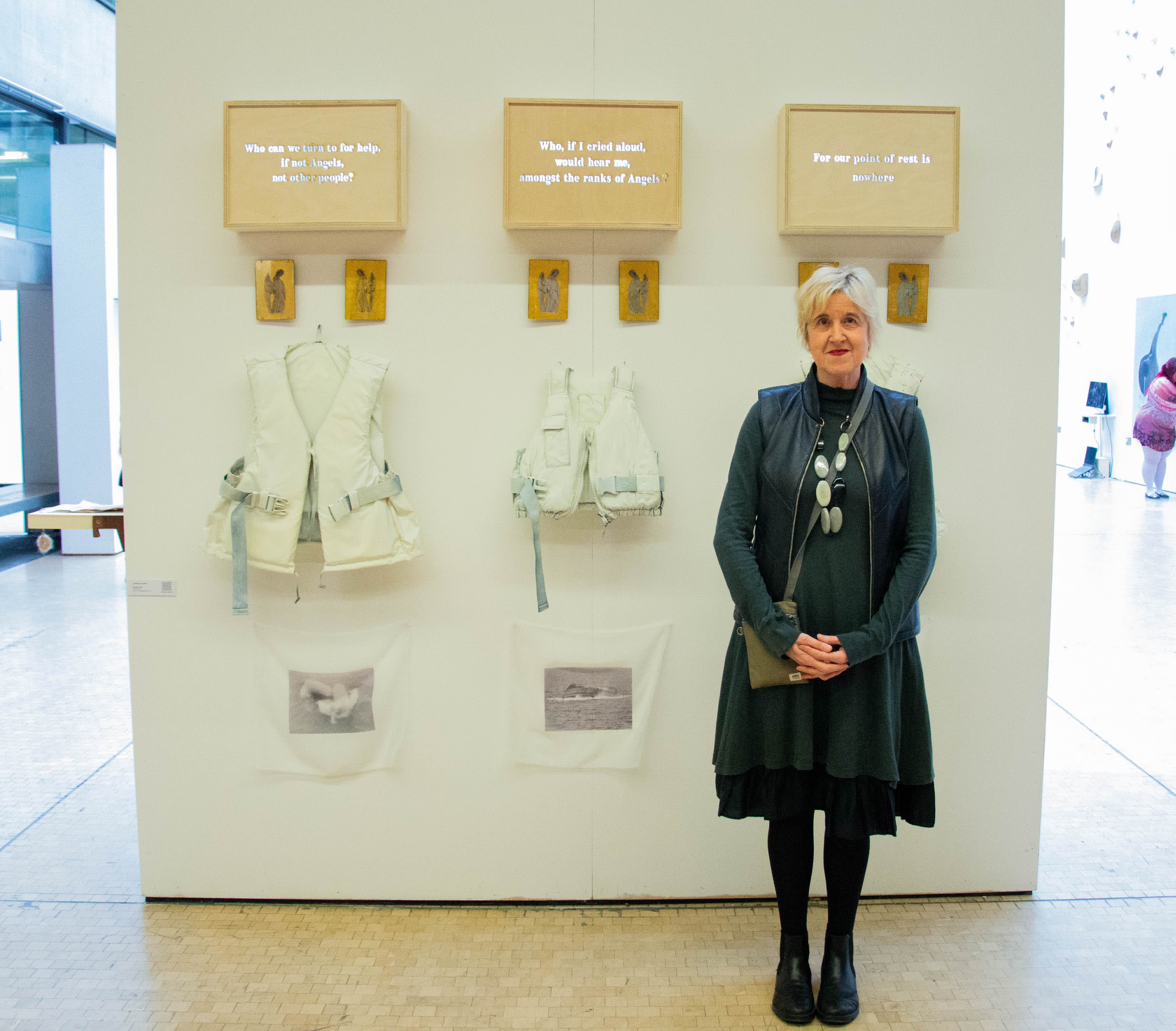
Mayday 2026 by Christine Gordon, MA Fine Art. Photo by Joy Kirigo.
-
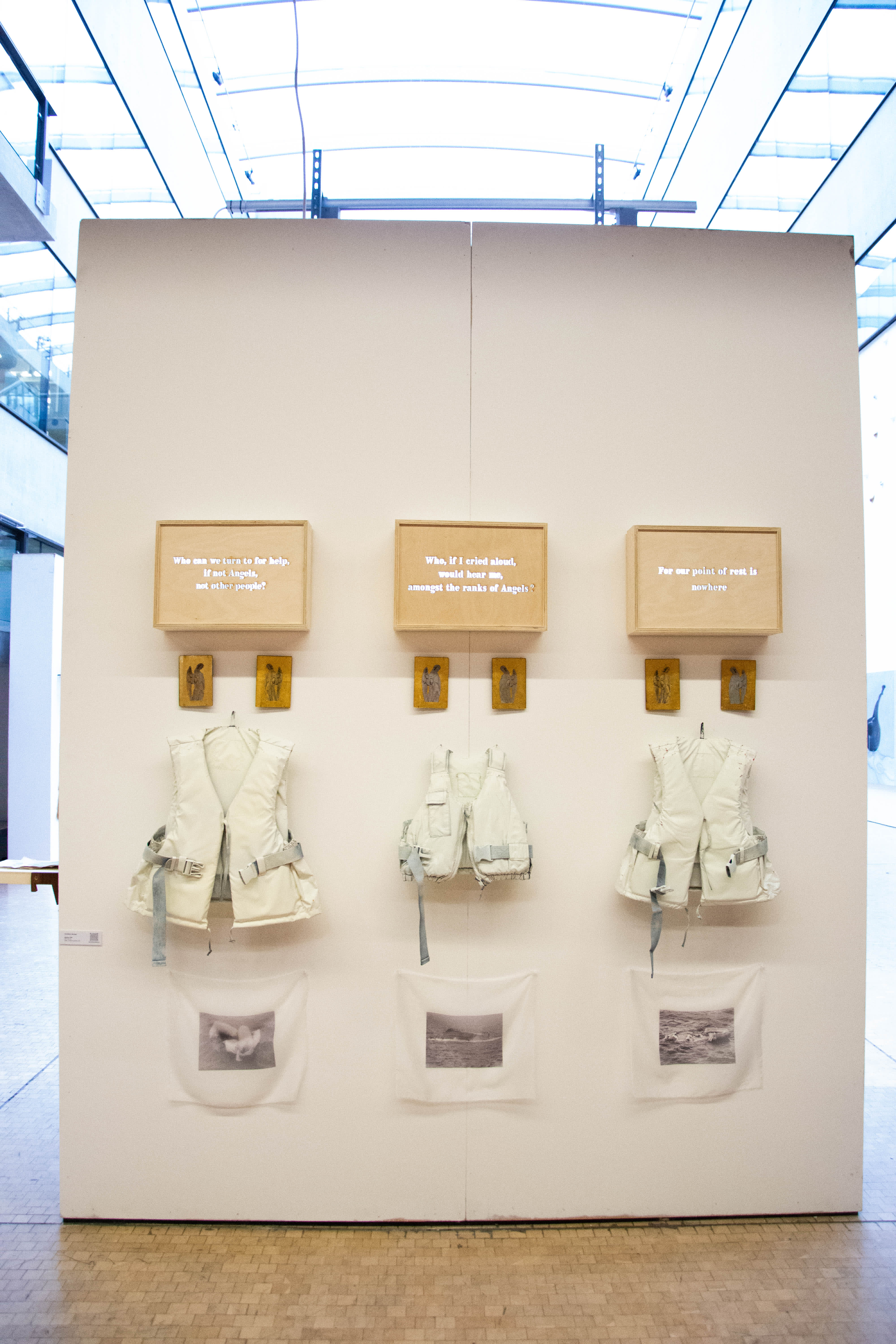
Mayday 2026 by Christine Gordon, MA Fine Art. Photo by Joy Kirigo.
Mayday 2026 by Christine Gordon, MA Fine Art
Many years ago, in a life before art school, Christine Gordon was working for shipowners in Antwerp, handling a claim relating to a ship that had deviated from its route to rescue another vessel in distress. Reflecting on the situation, an operations manager told her: “It is a duty to save life at sea.”
This moment stayed with Gordon and later informed Mayday ‘2026’, an installation inspired by a 2021 news story in which a small boat carrying migrants sank in the English Channel after repeated calls for help went unanswered. The work responds to what Gordon describes as a profound humanitarian failure, shaped by a political climate in which migrants have been dehumanised.
Explain your project and what inspired it
The work was inspired by a news story. The title of this work is ‘Mayday’. A Mayday message is sent out by ships in peril at sea. On 24 November 2021, a small inflatable dinghy carrying 33 migrants sank halfway across the English Channel. Neither the British nor the French authorities responded to the repeated, desperate calls for help from those on board. Possibly there was confusion over which nation should respond, but the result was that both did nothing. Only two survivors were found by fishing vessels, 12 hours after the first Mayday call. The youngest victim was only seven years old. It is the deadliest small boat incident on record in the English Channel.
What particularly shocked me was that two sophisticated, resourceful nations should fail so dramatically in effecting a simple rescue in calm weather. It is the product of a political climate in which migrants have been dehumanised. The report of the UK government inquiry into the incident found there was a widely held belief among HM Coastguard personnel that callers from small boats exaggerated their distress, with the risk that their appeals for help were not taken seriously. This work functions as a memorial to those who have lost their lives seeking a better life. It points to our common humanity and recognises that those undertaking such desperate journeys deserve to be treated equally and to be rescued if they get into danger.
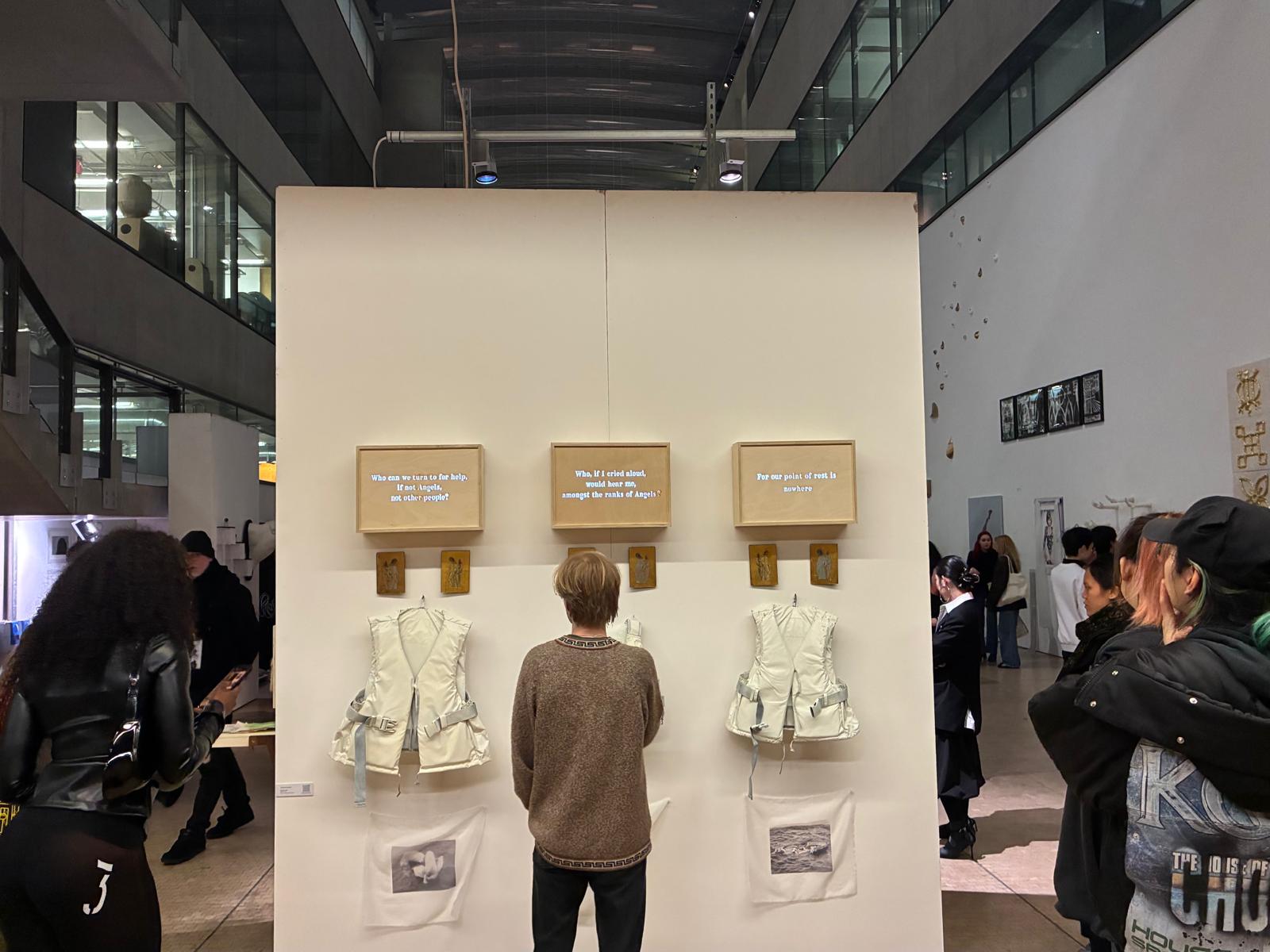
The installation consists of lightboxes with illuminated text taken from Rainer Maria Rilke’s first Duino Elegy, eloquently invoking the unanswered call for help. The lightboxes are accompanied by angel icons in gold leaf on glass, which hover over the shoulders of lifejackets painted a ghostly white. Below these, news images of the remains of shipwrecked migrant vessels have been printed on to translucent net fabric. Every draught in the gallery disturbs the fabric and is a reminder of the vulnerability of people on flimsy boats on the open sea.
What do you hope the finished work looks like?
I first had the idea to make this work four years ago. I made a large number of drawings using gold acrylic washes, black ink, charcoal and graphite, and incorporating collaged images of angels and migrant shipwrecks. However, I felt that these drawings did not adequately express the tragedy of these incidents. When I applied to do my MA, it was with the specific intention of developing an installation. I am interested in how inanimate objects, particularly those we wear or handle, have a resonance, carrying an affective power, and the project has gradually evolved into the current installation using actual lifejackets. I was able to use the college workshops to make the lightboxes. Rilke’s text was compelling and I wanted it to be illuminated.
The collaged images of angels have translated into separate gilded works on glass. These icons recall the directness of medieval faith. The gold is reminiscent of Byzantine and pre-Renaissance art, eras when religion was expected to provide secure answers to our place in the universe; religion as a salve for the existential despair generated by the unanswered call for help. The angel icons set up a tension between so-called Christian values and the political rhetoric of hostility underpinning much discussion on migration.
In view of this evolution, I feel that the installation is now near final form. The complete version has six lightboxes, each with a line from Rilke’s poem illustrating the alienation of the dispossessed and vulnerable in a climate of hostility.
I am undecided whether creating a more immersive work by adding a sound element would enhance the piece or be a distraction.
What you’re excited for in the future regarding your work (final show or after graduation)
My work is often commemorative in nature and I try to capture the essence of how something, in this case a particular event, made me feel. Here, I strove for a poetic, elegiac quality. Going forward, I would like to be able to control the lighting conditions for display of the work to maximise the atmospheric effects of light and shadow.
I think a memorial will, sadly, continue to be relevant, because the migrant crisis is ongoing and people continue to lose their lives at sea every day. So there is a future life for this piece. I am excited to find further opportunities to display this work. In view of my own previous career in shipping, it would be a neat closure to display ‘Mayday ’in a maritime museum or setting, or in a sacred space, a space for contemplation.
-
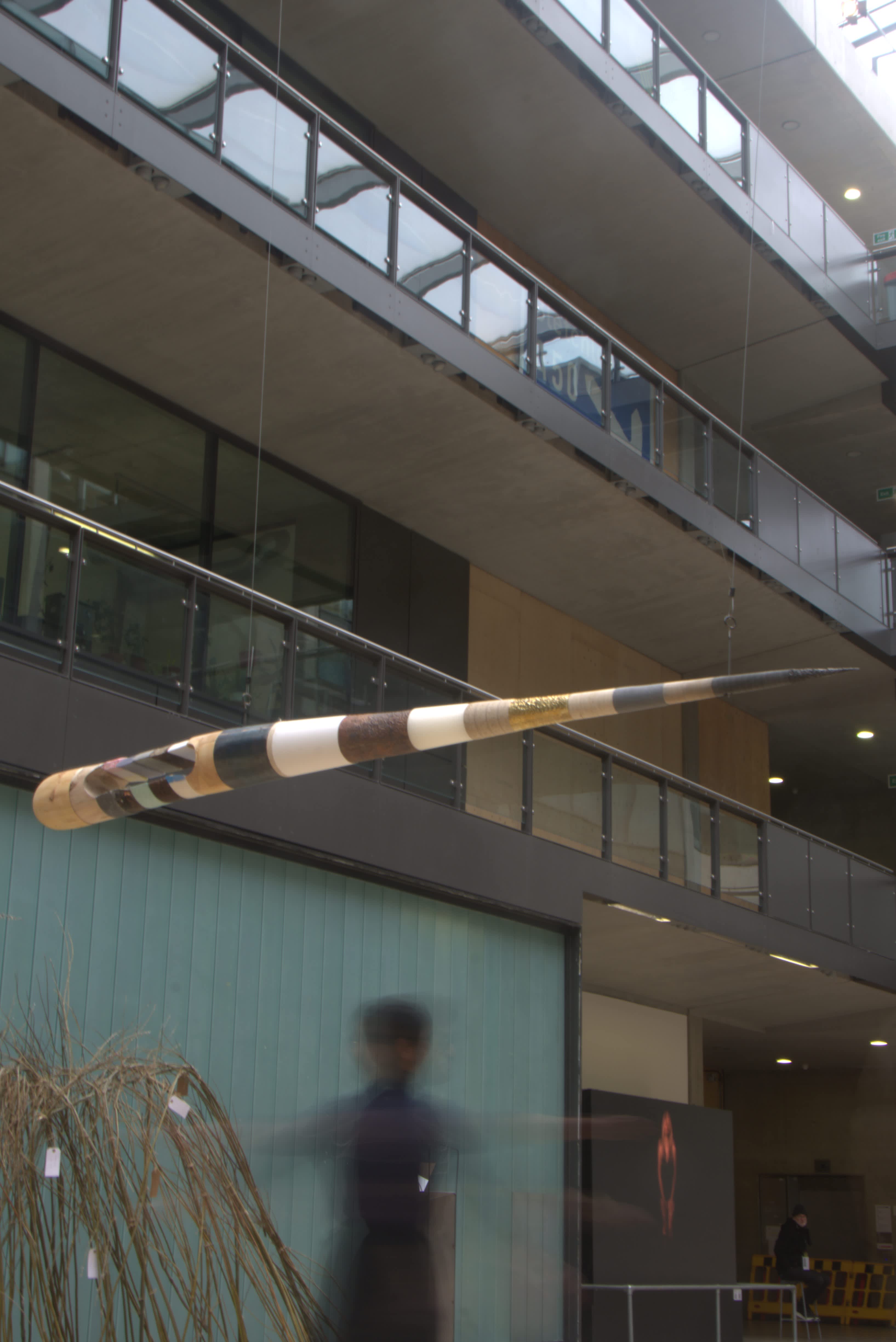
Just a Stitch by Lakshya Singla, MA Art & Science. Image courtesy of Lakshya Singla.
-
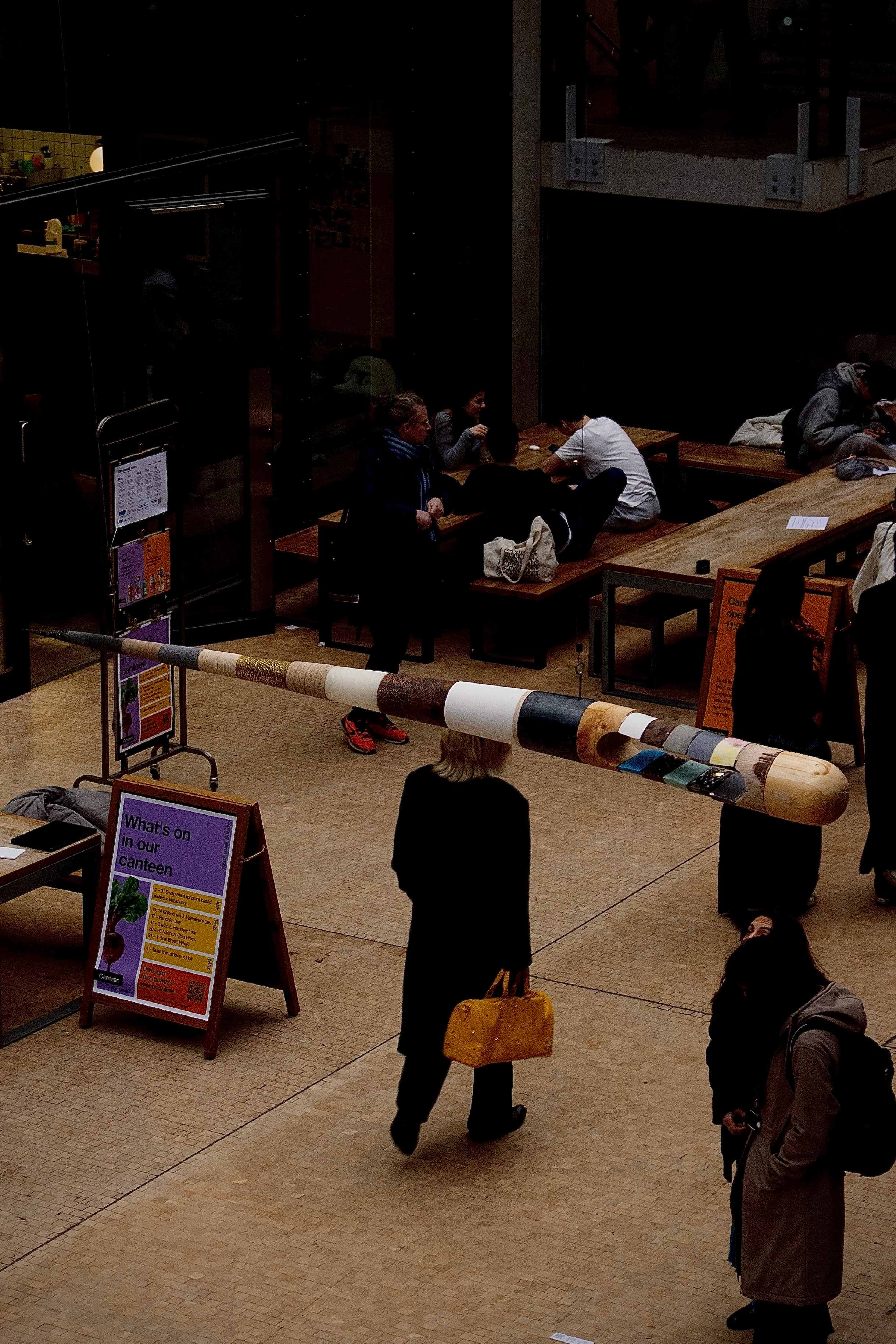
Just a Stitch by Lakshya Singla, MA Art & Science. Image courtesy of Lakshya Singla.
Just a Stitch by Lakshya Singla, MA Art & Science
Lakshya Singla’s Just a stitch begins with a simple but compelling idea: what happens when a needle — an object used to join materials — is itself constructed from multiple materials?
The result is a large-scale sculptural needle composed of 26 segments using 18 different materials, built through a combination of digital and manual processes, including welding, casting, sanding, drilling, cutting, grinding, soldering, hammering, carving and 3D printing.
Explain your project and what inspired it
The work is a large-scale needle made from multiple materials. What interested me was the idea that a needle, which is usually used to stitch different materials together, is itself being stitched together by different materials. It’s a simple shift, but it allowed me to rethink the object and its role.
This piece builds on my earlier work “Just Another Everyday Object,” where I began looking closely at familiar objects and their meanings. With this iteration, I wanted to push the scale much further and also challenge myself in terms of material exploration. The needle is made up of 26 individual segments using 18 different materials.
The process became really important — moving between digital and manual ways of making. It involved a range of techniques like welding, casting, sanding, drilling, cutting, grinding, soldering, hammering, carving, and 3D printing. The idea grew from a smaller needle I was making earlier, and I started wondering how far I could take it if I kept adding more materials and processes into one continuous form. It slowly came together piece by piece.
What do you hope the finished work / final show looks like?
Through making this work, I’ve learned a lot about how different materials interact — some sit comfortably together, while others resist or behave unpredictably. That learning is something I’d like to carry forward into refining the piece.
For the final show, I imagine the needle installed vertically, suspended from above, with the tip just slightly above the ground. I feel this orientation would give it a stronger presence and make the scale more noticeable. I’d also like to place it against a plain backdrop so that the focus remains on the materials and their textures.
At the same time, I don’t really think of the work as something that reaches a fixed “finished” state. For me, the process of making and learning from it is as important as the outcome, and that’s something I’d like to keep open-ended.
What you’re excited for in the future regarding your work?
I’m really looking forward to seeing how this work can exist in different contexts and be experienced by a wider range of people. A needle is such a familiar object, and there’s something interesting about encountering it at this scale where it becomes slightly absurd and unusable.
Seeing the diversity of work around me has also made me reflect on how objects can shift meaning depending on where they are placed. I’m interested in exploring how this piece might sit in spaces beyond traditional gallery settings, and how different audiences might interpret it in their own ways.
More broadly, I’m excited to keep experimenting with materials and processes, and to continue developing work that stays rooted in everyday objects but pushes them into unfamiliar territory.