Jennifer Jones
Profession
BA Fine Art Alum
College
Central Saint Martins
Person Type
Alumni
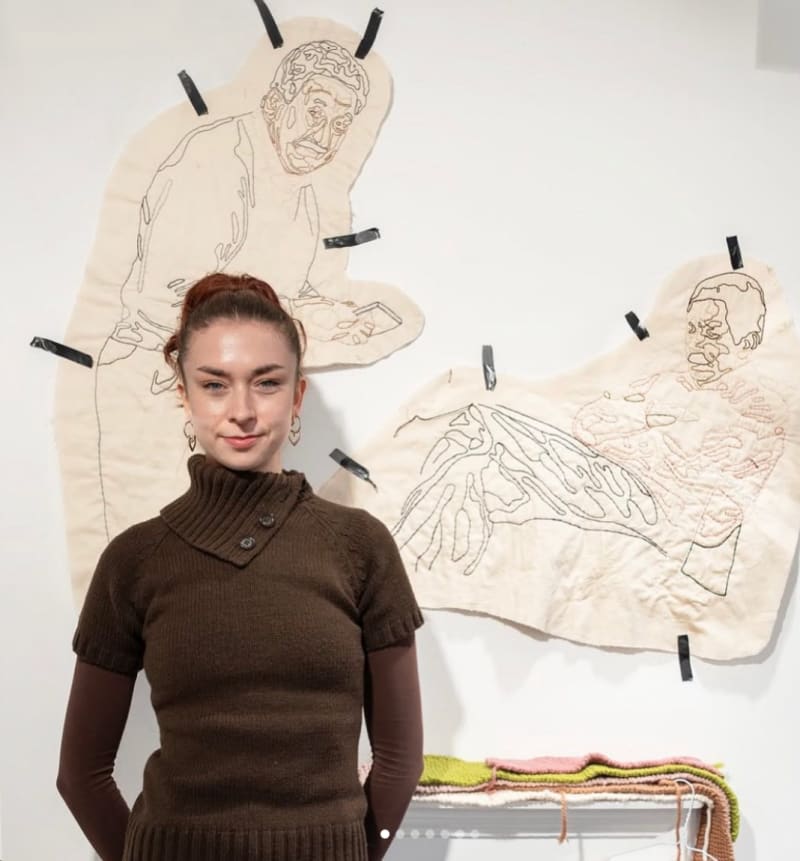
Jennifer is a textiles-based conceptual artist, making work around themes of nostalgia, family memories and the domestic. Alongside her personal practice, Jennifer founded Grafters Collective, which is a support network for artists from working-class backgrounds or who faced barriers to the art world.
Jennifer graduated from BA (Hons) Fine Art at Central Saint Martins in 2022.
Why did you choose to study BA Fine Art at Central Saint Martins (CSM)?
I’ve always loved fashion and wanted to work in that industry when I left school. For a couple of years after finishing school I worked as a freelance stylist/fashion intern, and studied Fashion Communication at Foundation level at CSM. Whilst doing this, I found that I loved researching and generating ideas for these projects, but I felt like the tight deadlines, strict briefs and commercial aspect didn’t allow me the time or space to realise my ideas to their fullest potential. It just didn’t feel like the correct outlet for my creative process. I decided to study fine art as I felt this would still allow me to work with clothing, but enable me to sit with my ideas for longer, experiment more and spend time finding my reason for making: the things I want to say and the people I want to impact. I was a bit nervous about choosing this course as, coming from a working-class background, I wasn’t aware of how an artist could make a sustainable living. I was given advice from a tutor on my Foundation course to do what was right for your practice at this time, and to figure out work and money later. It felt like a big risk at the time but something in my intuition was telling me that this was the step I needed to take next to improve my work.
What have you been working on since graduating?
I have been developing a body of work revolving around my family photo archive. For this, I take elements from different family photographs across time periods and collage them together to create invented scenarios which are simultaneously real and imagined. I then recreate them in textiles form through hand embroidery onto found furniture and clothing, or into household objects such as curtains, or into hand punched tapestries and rugs. The work is exploring impacts of trauma on memory and how we might look back on a difficult childhood, for example, with nostalgia, fragmenting and rose-tinting the past.
Creating this body of work has granted me recognition from awards and publications including Bloomberg New Contemporaries, The Ingram Prize, Vogue Italia, Show Studio, and FAD Magazine. I’ve also exhibited this work n venues including South London Gallery, The Saatchi Gallery and Camden Arts Centre. Since graduating, I’ve taken part on residencies including the Associate Studio Programme, Sarabande (the Lee Alexander McQueen) Foundation and School of Speculation. These have been incredibly valuable experiences where I’ve received studio space, a cohort of artists to work alongside and professional development.
Roughly two years after graduating, I decided to form Grafters Collective, for which I’ve gathered a group of 26 artists from working class backgrounds. We have exhibited at The Peckham Pelican and Hypha Studios and hosted various public facing workshop and group activities. Most recently, we have been carrying out a residency in the ground floor space of Acme’s new studio building in Walthamstow. I have been organising a series of crits, studio meetings, workshops and visits from industry professionals.
What was the most interesting project you worked on during your time on the course?
I found the most interesting project on the course to be working towards the degree show. It was up to us to form groups and curate our works together in the space. This was a great learning experience for me, stepping outside of my own making for the first time to consider how it might be seen by a member of the public coming to look at the show. It was also a useful challenge in collective working - balancing everyone’s wishes for how and where they wanted their work displayed and coming to compromises where every work was able to shine. There had also been a self-inflicted pressure on the degree show to be this final crescendo of the course. It was interesting to re-evaluate this and develop ways to make sure my practice can function to adhere to deadlines, whilst still allowing the creative process to happen naturally, not forcing a set outcome or becoming limited or mentally stunted by time frames or refinement.
What important piece of advice would you give to students thinking of studying this course?
To make use of the workshops! I remember when I was studying, I felt like I wasn’t entitled to use the workshop facilities because I wasn’t confident in how to, but I realise now that that’s why they’re there, for students to learn! I regret not feeling entitled enough to take up space there, use the resources and ask the technicians questions. Although I think it’s important to not become too reliant on making in ways in which you won’t be able to continue after graduating, I do think that whilst you’re on the course, it’s so valuable to be able to learn and experiment with processes available in the workshops.
What was the highlight of your Central Saint Martins experience?
The highlight of my Central Saint Martins experience was having the luxury of time to think, sit with ideas, experiment and make lots of work - good and bad with no pressure. Perhaps this is not a specific highlight, but the consistent time in the studio and library is what I look back on fondly. I will be forever grateful for the three years of studying where I was afforded the time to develop and experiment with my practice.
What is the most important thing you learnt on the course?
Not to sound pretentious, but I think the most important thing I learnt on the course was to think critically. Art school didn’t necessarily teach me skills like painting, drawing or sculpting, you are left to develop those yourself, instead, it taught me how to question ideas, the steps to take to develop an idea into something tangible, how to read artwork and decipher meaning from it. It also taught me to be confident in my own opinions, to voice and argue them critically and how to listen and learn from alternative perspectives.
Check out Jennifer’s website
Follow Jennifer on Instagram
Follow Grafters Collective on Instagram