
Earlier this term, Central Saint Martins welcomed visitors to its Postgraduate Work in Progress Show - a chance to see what happens before the final polish.
Across 6 MA courses, students shared work that feels urgent, experimental and deeply personal; from AI-driven domestic objects and wearable devices that let you feel a waterfall’s turbulence, to a living lamp powered by bioluminescent algae. Together, the show offered an honest glimpse into the messy, ambitious and exciting stage where thinking is still unfolding and futures are still being shaped.
We caught up with 3 of the students who presented work at the show to hear more about the ideas behind their projects, the challenges they’ve faced along the way, and how they hope the work will evolve ahead of the final degree exhibition.
-

Tony Qinan Chen (he/him) MA Design for Industry 5.0, Central Saint Martins, UAL Project: TSUKUMO (Work in Progress) Instagram: @qinanchen_tony
-

Tony Qinan Chen (he/him) MA Design for Industry 5.0, Central Saint Martins, UAL Project: TSUKUMO (Work in Progress) Instagram: @qinanchen_tony
TSUKUMO by Tony Qinan Chen, MA Design for Industry 5.0
TSUKUMO is an attachable module that reintroduces meaningful friction. It doesn’t have a fixed setting; instead, it spends its first few days observing its environment - tracking daily usage patterns and human behaviours to cultivate a bespoke temperament.
In his own words, Tony Qinan Chen, MA Design for Industry 5.0 student, explains how he hacked that “contract” asking, what if we replace a century of spiritual cultivation with an attachable patch that simulates a soul using machine learning and computer vision?
Explain your project and what inspired it
This project was inspired by tsukumogami - Japanese folklore in which everyday tools gradually acquire a spirit over time. Depending on where it’s attached, it adopts different roles: a fussy laundry critic (an angry, vibrating gaze at scattered clothes), or a strict guardian of the fridge. By retrofitting appliances to role-play these customised agencies, it interrupts autopilot and forces us to be present again.
How has the course challenged your way of thinking and making?
Before this course, my US undergraduate studies rooted me deeply in traditional, utility-driven problem-solving. The MA Design for Industry 5.0 didn’t abandon this foundation; it elevated it—towards systemic design and broader commercial strategies.
Mentally, it taught me to use critical thinking as a research tool: looking beyond efficiency to question the emotional impact of hyper-automation. Practically, the cross-disciplinary environment challenged me to apply my technical skills differently. I now build provocative, functional prototypes not as art pieces, but to validate complex, human-centric proposals.What do you hope the finished work looks like?
For the final show, TSUKUMO evolves into a coherent set of spirited home attachments - a suite of working “organs” including an eye, an ear, a mouth, and a kinetic limb - that clip onto everyday appliances and develop personality through a few days of cohabitation.
Like tsukumogami, each unit “soaks up” the owner’s traces; rhythms, habits, small routines, and gradually forms a personalised way of looking back, talking back, and occasionally refusing the easy option. Staged in a lived-in domestic set, the work foregrounds relationship over convenience: objects that grow a soul by living with you.
What you’re excited for in the future regarding your work (final show or after graduation)
What excites me next is testing the core proposition behind TSUKUMO: when embodied AI appears to develop a “soul,” is it a soul - or a mirror?
During and after the final show, I’ll run longer cohabitation trials and make personality-formation visible through subtle behavioural shifts and the traces they leave behind. I hope visitors encounter the objects mid-growth and help locate where “aliveness” begins: in the code, in the home, or in the relationship itself.
-

Work by Javier Durango
-

Work by Javier Durango
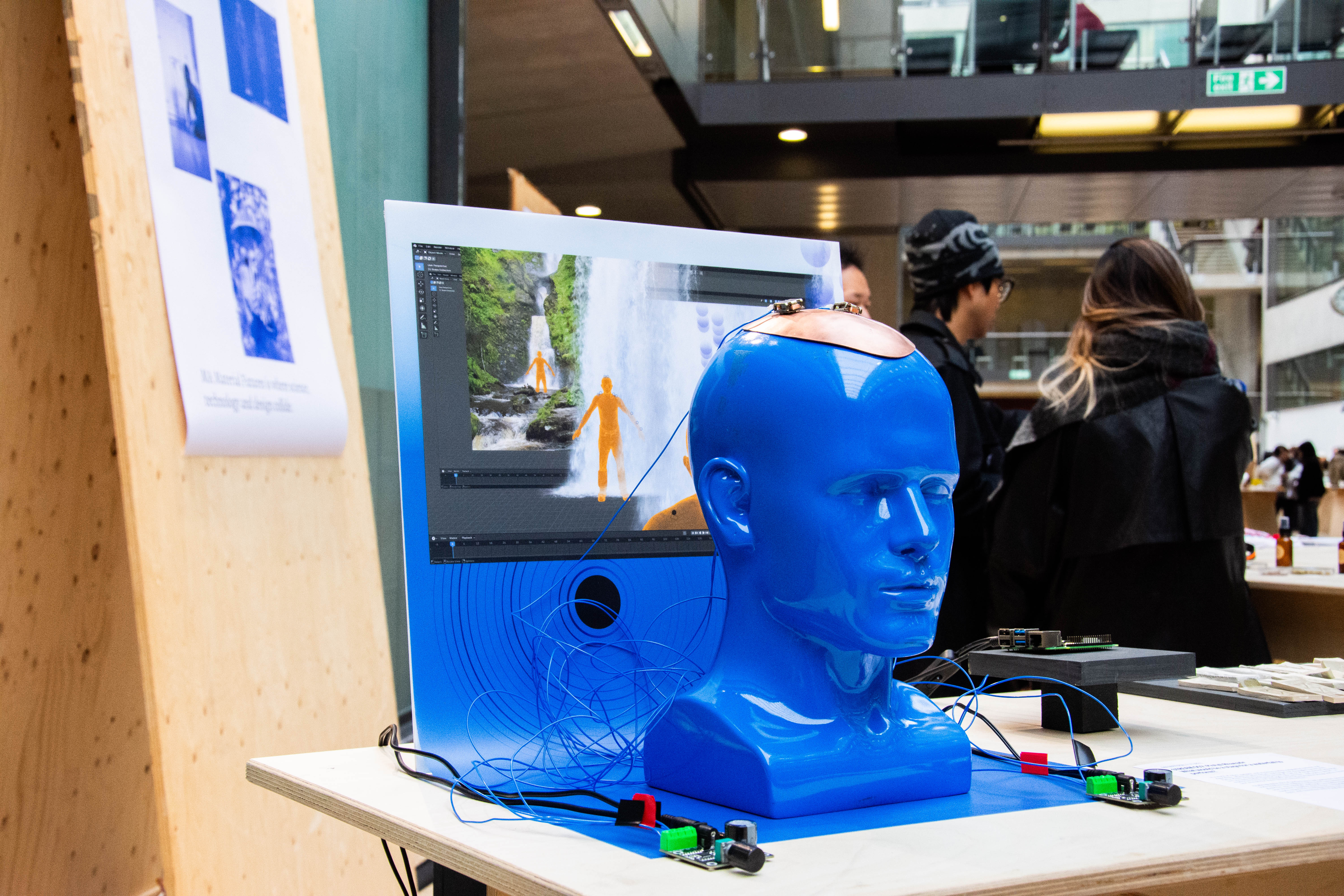
STREAM 002: Pistyll Rhaeadr by Javier Durango, MA Material Futures
STREAM 002: Pistyll Rhaeadr is part of an evolving body of work by Javier Durango that asks a deceptively simple question: how might we feel a river again? As the second prototype in his STREAM series, the project explores how technology might move beyond screens and spectacle to become a mediator of sensory reconnection - translating the turbulence and aeration of a Welsh waterfall into vibration patterns felt directly on the body.
In his own words, the MA Material Futures student describes drawing on ancestral knowledge from the Muysca community in Colombia and working across sound, physical computing and craft, Durango imagines a speculative future where wearable systems allow us to listen to - and physically inhabit - the living dynamics of water.
In your own words, describe your project?
STREAM 002: Pistyll Rhaeadr is the second prototype in an ongoing series of experimental devices that attempt to stream the stream of a body of water. The STREAM series explores how we might restore an affective bond with rivers, waterfalls,and lakes through new technological avenues. Specifically, technologies that, rather than alienating us from reality, catalyse a deeper connection to nature by expanding how we sense, inhabit, and relate to it.
Historically, many rivers have been canalised, polluted, redirected, or dried in response to political and economic visions of modernity, treating water as a resource without territory, as infrastructure rather than as a living system embedded in land, memory, and community.
In contrast, the Muysca community, an Andean Indigenous community in Colombia, have cultivated over generations a sacred and affective relationship with specific bodies of water within their territories. The STREAM series proposes that it is neither a return to the past nor a fetishisation of Indigenous cosmologies. Instead, it imagines a speculative future in which technology becomes a mediator for sensory reconnection, a tool through which we relearn how to coexist with land and water.
The project proposes new sensory portals through which our bodies can relearn how to experience water, territory, and land, opening conversations about modernity, water governance, coexistence, and the kinds of futures we wish to inhabit.
What challenges have you faced on the journey to creating your work?
Being physically far from Colombia has been complex. The communication with my Muysca friends, and the waterfalls, rivers, and páramos I grew up connected to, landscapes filled with personal and collective memory, are not here. Working in the UK has meant building new relationships with different territories and water bodies, which has become a beautiful and humbling process of relearning how to listen.
Technically, this project has pushed me beyond my usual practice. I do not come from a background in sound engineering or physical computing but thanks to the MA Material Futures tutors and the incredibly skilled technicians, the process has flowed with generosity and support.
It has been a process of building what I call “ceremonial technology”: devices that are technical yet intimate, structured yet sensorial. Balancing poetry and scientific clarity has been one of the central challenges, ensuring the work remains emotionally powerful while staying materially honest and precise.
The work you’re exhibiting is a work in progress, what do you hope the finished work looks like?
At the moment, STREAM 002 is still in a prototyping phase. I want to continue refining the wearable system, exploring placement on the body, vibration textures, and how turbulence and aeration can be more precisely translated into embodied sensation. Once the wearable language is more resolved, I imagine the project evolving into a collective experience.
My vision is to guide small groups through a ceremonial-tech session: listening to a specific body of water through STREAM 001 and feeling its internal dynamics through STREAM 002. A shared sensory exercise, somewhere between deep listening, somatic awareness, and improvisation, to contemplate and celebrate a particular river or waterfall.
Ultimately, I imagine the STREAM series becoming a growing sensory archive of different territories, allowing us to compare and analyse their songs and, perhaps, their messages. STREAM 003: Amazon, STREAM 004: Ganges, STREAM 005: Nile. Each stream would become not only a new sensorial transmission, but a relational encounter, a way of holding memory, land, and coexistence within the body.
-

Jiawei Chu, MA Bio Design, IG: @SLEEPYDAISY330
-

Jiawei Chu, MA Bio Design, IG: @SLEEPYDAISY330
Living Light by Jiawei Chu, MA Biodesign
What if the light in your home wasn’t simply switched on, but cared for? Jiawei Chu’s project reimagines domestic lighting as a living system, integrating bioluminescent algae into an interactive lamp designed to support mental wellbeing. Rather than producing a fixed, mechanical glow, the lamp responds to gentle movement, activating a soft natural luminescence that encourages calm, slows the body, and invites moments of quiet reflection.
In her own words, Jiawei Chu, MA Bio Design student describes the work as an attempt to build a “symbiotic relationship within the home.” She proposes a family-oriented system in which care, maintenance, and shared responsibility become part of everyday ritual - reframing bio design not as distant or laboratory-bound, but as poetic, intimate, and deeply human.
In your own words, describe your project?
This project aims to support mental wellbeing while encouraging people to rethink their relationship with nature. By combining product design with bio design, I integrate bioluminescent algae into an interactive lighting system. In this system, light is not fixed or mechanical, but a living and constantly changing presence. A gentle physical movement can activate the glow, creating a calming experience that helps reduce stress and bring moments of quiet into everyday life. I hope to invite living organisms into our daily environments and build a new form of symbiotic relationship within the home.
Designed as a family product series, it includes simple children’s toy containers that can hold a portion of the algae during routine maintenance. I hope this system establishes a two-way relationship: people can appreciate the beauty of the algae, but they must also take responsibility for its survival. By caring for the organism together, families can develop environmental awareness, a sense of responsibility, and a deeper respect for living systems.
This project brings together product design and bio design through a living therapeutic lamp, rethinking the relationship between humans and nature. My final design is a lamp containing living algae, integrating both visual and auditory elements to explore how biological systems can support mental wellbeing. It is not just an object, but a small living system.
This natural glow is very different from artificial lighting. It is soft, subtle, and calming — helping users relax, reduce stress, and transition into sleep in a gradual and organic way. Through this design, I want to express a simple idea: humans and living organisms can support one another. We provide light, water, and care. The algae offer beauty, calmness, and emotional comfort.
What was your inspiration for this project?
My inspiration originally came from the bioluminescent algae itself. Through conversations and interviews, I found that many people were genuinely fascinated by this organism and felt a strong sense of curiosity and affection toward it. During my research and cultivation process, I also discovered that it is relatively easy to maintain and harmless to humans. This led me to a simple question: why not design a product that allows people to cultivate it at home?
From that point, I began developing the project. The prototype has gone through many iterations, both technically and structurally. In its final stage, the mechanical inspiration for the structure was influenced by automata, incorporating movement and physical interaction to create a more engaging and responsive experience.
Does your course work motivate the work you’re creating?
Yes, I am really enjoying my course so far. The structure of the programme has helped me build a strong foundation in the early stages, and through different collaborative projects, we have been able to deepen our understanding of both biology and design principles. My tutors and the researchers in the laboratory have provided a great deal of professional guidance, and they have always been incredibly patient and supportive. I still believe that bio design is a forward-looking field with unlimited potential, which is exactly why I chose this course in the first place.
What unexpected thing did you learn during the process of creating your project?
One of the most surprising things I learned during this project is how strongly people respond emotionally to living organisms, even something as small as bioluminescent algae. I expected curiosity, but I did not expect such affection and excitement. Many people immediately described it as “magical” or “so beautiful,” which made me realize that emotional connection can be a powerful entry point for bio design. Technically, this project pushed me beyond my comfort zone. I experimented with flame-worked glass for the first time, and I also began researching and redesigning more complex mechanical and kinetic structures to create responsive physical movement within the lamp.
With the understanding that what you’re showing now is a work in progress, what do you hope the finished work looks like?
The project is intended to grow into a series rather than remain a single object, designed for both adults and children. Through interaction with living materials, families can better understand what it means to coexist with biological systems. By observing growth cycles, maintaining habitats, and engaging with the light they produce, users build a more intimate and responsible relationship with nature.
As a next step, I will continue developing and refining the mechanical and kinetic structure of the lamp. I want to further research how physical movement can activate the algae in a gentle and reliable way, while ensuring the mechanism is durable, safe, and suitable for long-term domestic use. At the same time, I will begin to consider the overall aesthetic language of the product, including its form, proportions, and material choices. Selecting appropriate materials will be important—not only for structural stability, but also to express warmth, care, and transparency toward the living organism inside.
Alongside these design refinements, I will continue cultivating and studying the algae. Ongoing experiments will help me better understand their growth patterns, maintenance needs, and long-term behavior, ensuring that the final design remains biologically responsible and sustainable. At the same time, I will continue to conduct interviews and questionnaires to obtain more feedback and data and improve research on human mental health.