Postgraduate

MA Innovation Management

Three textured panels in brown and blue
Molly Hiebert
College
Central Saint Martins
Start date
September 2026
Course length
Two years (60 weeks)
Extended full-time

MA Innovation Management will help you develop the creative strategies you need to drive innovation and transformative change in an uncertain world.

Course summary

Apply now to start in September 2026

Applications are open for this course. Apply by 18 March for equal consideration.

Led with a strong sense of vision, MA Innovation Management at Central Saint Martins combines theory and practice, mixing creative projects and fieldwork opportunities with lectures and rigorous writing assignments. It offers a collaborative learning community in which students from a wide range of fields – including design, business, science, policy, digital entrepreneurship and art ­– continuously challenge each other to transcend their limits. This course is part of the Creative Enterprise programme.

Why choose this course at Central Saint Martins

  • Envisioning alternative futures: Develop critical and creative strategies to drive innovation and transformation in an uncertain world. Harness imagination, care, and empathy to build more equitable, sustainable, and regenerative futures.
  • Innovation in practice: Identify unseen patterns and opportunities to foster innovation- from radical and disruptive changes to iterative improvements- across global companies, social enterprises, and start-ups. Client projects have included collaborations with Adidas, Chanel 4, Tate Enterprise, London Transport Museum, Demos Helsinki among others.
  • Career strategy: With a focus on employability, entrepreneurship, and social impact, the course MA Innovation Management will support you in shaping your career across disciplines such as design, strategic foresight, management consulting, social innovation, regenerative practice, health innovation, and fashion. Our graduates have gone on to work at leading organisations including IDEO, IBM, Arup, Tate Enterprise, Cartier, Chanel, Digital Catapult, and the United Nations, and in roles such as innovation consultants, service designers, foresight strategists, and creative entrepreneurs.
  • Interdisciplinary practices: Work with diverse teams on real-world projects, developing as an adaptive practitioner who navigates creative frictions, systems thinking, and business strategies at the intersection of multiple disciplines.
  • Academic and critical rigour: Gain in-depth knowledge of theoretical, philosophical, socio-cultural, business, research and technological contexts that shape the roles and mindsets of innovation managers.

Open days

Upcoming open days for this course will take place on the following dates:

Recordings

Watch a recording of the recent MA Innovation Management open day.

Have a question?

Email Mo-Ling Chui, Course Leader

Scholarships, bursaries and awards

All postgraduate funding options for Central Saint Martins.

Course overview

On MA Innovation Management (MAIM) you will learn how to develop the creative competencies and strategies to drive innovation and change in and across your chosen fields. Located within Central Saint Martins, University of the Arts London, the course positions critical creative practice in innovation management with this intersection of practice offering an alternative to conventional business school innovation and management courses. We attract applicants with a strong desire to pursue original ideas, initiatives, alternative futures and innovative careers.   

Designed to meet the increasing industry demand for innovation managers who can prioritise regenerative (sustainable) outcomes and societal thriving over narrower interests and preoccupations with economic value or technology, this course explores innovation management as a dynamic process that unfolds over time through continued creative interactions and collective experimentation, requiring imagination, care and empathy as much as analysis, strategy and formal frameworks. You will learn key skills in project management, digital innovation, creative and critical thinking, innovation research, collaboration and teamwork, that will enable you to succeed in your chosen innovation related future role. 

Compared to mainstream approaches to Innovation Management as a field of study and professional practice, this course addresses a wider range of concerns relating to society, culture, ecology, technology, business and creativity. You will learn how to generate creative strategies for change, with the aim of bringing to life (or creating the foundations for) products, services, systems, organisations, cultures and societies that are inclusive and regenerative. You will explore how innovation and technology can be leveraged to transform organisations into agents of social transformation and how to work critically and dynamically across multiple disciplines, organisational types that considers human and nonhuman (technological and biological) intelligences and impacts. 

MA Innovation Management prepares students to thrive at the intersection of business and creativity, theory and practice, analysis and imagination, and to leverage their skills and leadership to drive social value as well as positive organisational and societal change. Our alumni are equipped to be highly adaptable in the job market.  Their post study employment, business and enterprise work spans a spectrum of roles in the innovation field from strategists to creative design and marketing. 

MA Innovation Management is situated within the S-School, Creative Enterprise Programme at CSM. All courses within Creative Enterprise identify common ground in addressing how art and design, culture, business and diverse industries are mediated. This sits at the heart of CSM, closely connected to makers, product, architectural, fashion designers and more. Our postgraduate courses explore how we manage, communicate, collaborate, and facilitate relationships within this interdisciplinary community. This puts us in special position as opposed to perhaps other humanities based, business-based or arts management-based institutions. We find common ground for creative strategies through the spectrum of culture, art and design, enterprise, technologies, social purpose and change. 

Contact us

Register your interest to receive information and updates about studying at UAL.

Contact us to make an enquiry.

Course units

This course is designed to develop your skills and ability to lead and co-ordinate creativity and innovation through both theoretical and practical learning. As an MA Innovation Management student, you will learn how to envision desirable alternative futures and foster creative mindsets (for individuals and within teams) to build agility and resilience in the face of uncertainty. You will learn to work independently and collaboratively, developing your ability to lead diverse teams and to thrive through collective engagement, harnessing empathy, criticality and creative friction to generate and deliver sustainable innovation practices and solutions.  

The course begins by introducing the contrasting theories, discourses and practices which inform and influence innovation management, challenging you to engage critically and creatively with these bodies of knowledge. As you progress through the course you will engage in a collaborative project with your peers at Central Saint Martins, where you will explore multi and trans-disciplinary co-operation, undertake a live client-led brief with an external partner, and explore how to situate your practice through either a placement or field study in professional environments. The course culminates in a final project that brings together your research and insights to apply and articulate your innovation management proposal, disseminating your work through a range of formats including an extended journal article and collaborative cohort-wide externally-facing events.  

On this course you will encounter a range of academic disciplines, approaches and frameworks, including organisational science, sociology, anthropology, philosophy, regenerative design, service design and design strategies – to help deepen and broaden your inquiry and ability to foster and lead innovation in complex organisations and contexts.  

Unit 1: Exploring Innovation (40 credits)       

Unit 1 equips you with the foundational knowledge and skills to approach and navigate complex briefs. The unit begins with a rapid, critical review of contrasting views on innovation, innovation management, design and design thinking, drawing upon academia and practice, challenging you to engage with conventional and more challenging perspectives including foresight and speculative futures. The experiential part of the unit is a service innovation project, that develops your critical understanding of service design thinking and innovation process and methods, applying collaborative approaches to problem-framing and solving. 

Unit 2: The Collaborative Unit (20 credits)    

This Unit provides an opportunity to collaborate with students from other postgraduate courses across CSM to work on a challenge-based project. The unit requires you to engage with how your specialist knowledges and skillsets can be applied in support of a specific societal or environmental challenge as part of an interdisciplinary collaborative team, harnessing creative thinking, critical judgement and creative output. It is an opportunity to be fully situated within the art college environment, both digital and physical, and to work alongside students from creative arts and design courses in imagining and implementing innovative responses to an assigned challenge. Key insights include interdisciplinary communication and collaboration, ethical practice, and feedback.  

Unit 3: Imagining Futures and Situating Innovation (60 Credits)    

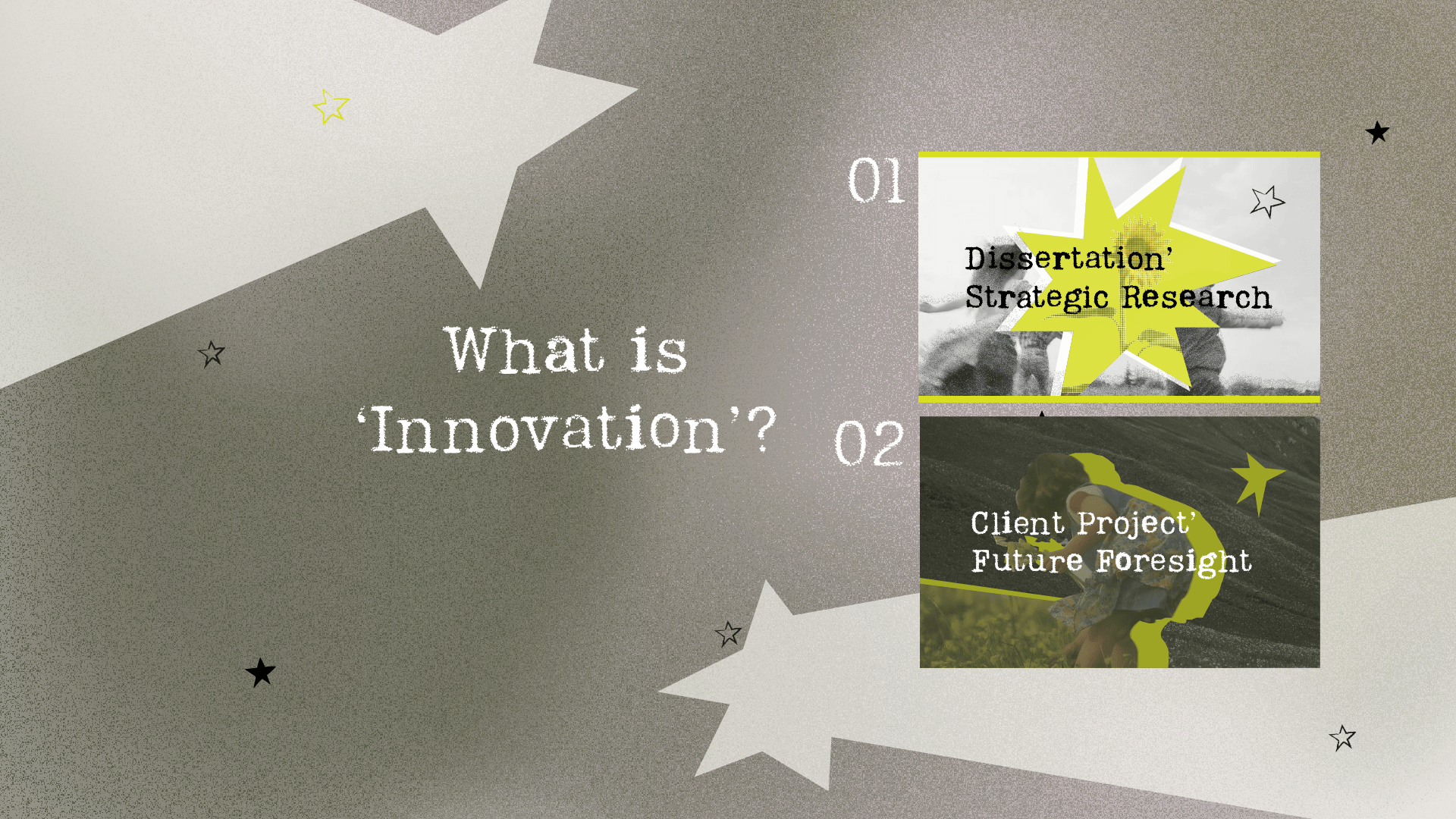
Unit 3 offers you the opportunity to respond to a live client-facing brief and it supports you to determine your personal direction for the next stages of the course. You will be required to work in groups to discover, articulate and showcase promising novel (business and impact) opportunities and solutions that have the potential to advance desirable future visions, co-imagined with industry clients. This unit involves practical and professional workshops including project management, facilitation, pitching and ethics. It also includes preparation for your placement or field study later in the unit, including applying for a placement, writing a research question, ethnographic methods, and qualitative and quantitative research methods.  You will be asked choose between fieldwork supervised internally at CSM or securing a work based placement through which to explore innovation situated in a professional organisation. You will have the opportunity to develop your individual interests and concerns as an innovation professional.  Teaching includes basic ethnographic and other research skills that you will need to grasp before carrying out your research activities. It challenges you to identify a core theoretical and practical concern that can be subsequently researched in a real-world context, through placement or field study, to deepen your learning and insight, and lays the groundwork for your dissertation.  

Unit 4: Applying and Articulating Innovation (60 credits)     

The course culminates with the application and articulation of innovation, based on your synthesis of learning from earlier units. This takes forms including an academic dissertation and a public-facing journal article. You will also work with your cohort to organise, manage and deliver an outward facing series of end-of-course events, designed to engage diverse audiences. These may combine contributions produced by individuals and small teams with collectively organised symposia, festivals or conferences (that bring together professionals and other attendees from the extended MA Innovation Management community and beyond), alongside digital media outputs for identified and international audiences.   

All course units integrate personal and professional development, enabling students to explore the professional world and manage them career development. Students are offered opportunities to engage with industry professionals at different points along their journey, to support their professional development and emerging creative or entrepreneurial projects.  

Important note concerning academic progression through your course: If you are required to retake a unit you will need to cease further study on the course until you have passed the unit concerned. Once you have successfully passed this unit, you will be able to proceed onto the next unit. Retaking a unit might require you to take time out of study, which could affect other things such as student loans or the visa status for international students.  

CSM Academic Support is delivered by a team of academics and practitioners working alongside your course to help you progress and achieve your maximum potential as a student. Academic Support can help you to develop your skills in different areas, including critical thinking, research and writing, time management, presentations and working independently and collaboratively. These may be offered as part of your timetabled classes or as bookable tutorials and workshops. 

Mode of study  

MA Innovation Management is offered in extended full-time mode which runs for 60 weeks over two academic years. You will be expected to commit 30 hours per week to study, which includes teaching time and independent study.    

The course has been designed in this way to enable you to pursue studies, while also undertaking part-time employment, internships or care responsibilities.   

Credit and award requirements   

The course is credit-rated at 180 credits.   

On successfully completing the course, you will gain a Master of Arts (MA degree).   

Under the Framework for Higher Education Qualifications, an MA is Level 7. All units must be passed in order to achieve the MA but the classification of the award is derived from the mark for the final unit only.   

If you are unable to continue on the course, a Postgraduate Certificate (PG Cert) will normally be offered following the successful completion of 60 credits, or a Postgraduate Diploma (PG Dip) following the successful completion of 120 credits.   

Learning and teaching methods

The learning and teaching methods devised for this course include: 

  • Briefing and feedback sessions 
  • Collaborative project work 
  • Independent writing and related feedback 
  • Peer discussions 
  • Lectures, seminars and workshops 
  • Group activities 
  • Group and individual tutorials and supervision 
  • Individual situated learning in the field (work placements or field surveys) 
  • Industry and alumni mentor sessions 
  • Independent study 
  • Peer-group reviews and self-reflection 

Assessment methods

  • Individual, group and collective assessments
  • Individual presentations
  • Individual essays and case studies
  • Individual journal articles
  • Group project presentations
  • Collective event creation and delivery

Collaborative projects and opportunities

UAL Showcase

Explore work by our recent students on UAL Showcase

  • Innovating for Feeling
    Innovating for Feeling, Molly Hiebert, 2025 MA Innovation Management, Central Saint Martins, UAL
  • Spatial Innovation Lab
    Spatial Innovation Lab, Eitan Senerman, 2022 MA Innovation Management, Central Saint Martins, UAL
  • Colourful posters stuck on a wall
    Emergence 2025 Showcase exhibition. Poster wall of Provocations based on MA Innovation Management 2025 postgraduate student Research Questions (RQs). This demonstrates the cohort’s rich diversity of interests, issues and research directions.
  • People looking at a wall covered in alphabetised coloured sheets
    The Index of Innovation participatory wall. A collective Glossary of Innovation created by MAIM 2025 students, synthesising terms and ideas from design-led innovation management. The wall encouraged viewers to interact and respond to prompts linked to the featured concepts and terms.
  • Coloured paper hanging on a wall
    Showcase audience feedback was then integrated into the Index of Innovation, now featured at the end of the Æffect 2025 Journal of Innovation Management publication. This is available both as an online PDF and in printed magazine format.
  • People interacting with one another at an exhibition
    The MAIM 2025 Showcase unfolded across three interconnected zones of the Platform Bar, highlighting student research, provocations, and industry conversations. Featuring work from the 2025 grad class, the exhibition brought together design, culture, strategy, business, and systems thinking. The space was especially vibrant on Opening Night
  • Publications titled Æffect laid out on two tables
    Æffect 2025 continues the publication’s exploration of innovation as both affect and effect that transforms and becomes. The Showcase theme this year, Emergence, frames innovation as a growing, interconnected process rather than a single breakthrough. Students developed four pathways: Art and Culture, Design and Business, Earth Systems, and Emerging Technology.
  • Three people wearing headphones
    The MAIM 2025 Media Series features interviews on Innovation-in-practice and Emergence with MAIM students and industry experts and across interdisciplinary fields. During the showcase, visitors could watch the interviews, listen through silent-disco headphones, or relax to a bespoke ambient soundtrack woven with student conversations.

Publications

Staff

Fees and funding

Home fee

£8,305 per year

This fee is correct for 2026/27 entry and is subject to change for 2027/28 entry.

Tuition fees may increase in future years for new and continuing students on courses lasting more than one year. For this course, you can pay tuition fees in instalments.

Home fees are currently charged to UK nationals and UK residents who meet the rules. However, the rules are complex. Find out more about our tuition fees and determining your fee status.

International fee

£22,175 per year

This fee is correct for 2026/27 entry and is subject to change for 2027/28 entry.

Tuition fees may increase in future years for new and continuing students on courses lasting more than one year. For this course, you can pay tuition fees in instalments.

Students from countries outside of the UK will generally be charged international fees. The rules are complex so read more about tuition fees and determining your fee status.

Additional costs

You may need to cover additional costs which are not included in your tuition fees, such as materials and equipment specific to your course. For a list of general digital equipment you may need (and how you can borrow equipment), visit our Study costs page.

Accommodation

Find out about accommodation options and how much they will cost, and other living expenses you'll need to consider.

Scholarships, bursaries and awards

If you’ve completed a qualifying course at UAL, you may be eligible for a tuition fee discount on this course. Find out more about our Progression discount.

You can also find out more about the Postgraduate Masters Loan (Home students only) and scholarships for Home and International students. Discover more about student funding.

If you’re based in the UK and plan to visit UAL for an Open Event, check if you’re eligible for our UAL Travel Bursary. This covers the costs of mainland train or airline travel to visit UAL.

How to pay

Find out how you can pay your tuition fees.

Scholarship search

Entry requirements

The standard entry requirements for this course are as follows:

  • An honours degree at upper second-class (2:1) or above in a relevant field: business studies; management; social sciences; humanities; physical sciences; marketing; arts and design
  • Or an equivalent EU/international qualification

And normally at least one year of relevant professional experience.

AP(E)L – Accreditation of Prior (Experiential) Learning

Exceptionally applicants who do not meet these course entry requirements may still be considered. The course team will consider each application that demonstrates additional strengths and alternative evidence. This might, for example, be demonstrated by:

  • Related academic or work experience
  • The quality of the personal statement
  • A strong academic or other professional reference

Or a combination of these factors.

Each application will be considered on its own merit but we cannot guarantee an offer in each case.

English language requirements

IELTS level 7.0 or above, with at least 6.0 in reading, writing, listening and speaking (please check our main English language requirements webpage).

Selection criteria

We select applicants according to potential and current ability in the following areas:

  • Skills and knowledge in your own discipline and preferably some examples of post college work in your particular field
  • Evidence of interest and understanding of innovation and its management
  • Work demonstrating engagement with innovation and its management
  • A reflective and critical approach
  • Evidence and experience of teamwork
  • Evidence and experience of research and analysis
  • Self-motivation, ambition and a commitment to the course.

What we are looking for

We actively seek open-minded graduates from diverse academic and industry backgrounds who want to innovate, ideally with relevant work experience from business, marketing, engineering, sciences, social sciences, humanities, arts and design. A key characteristic of our candidates is the desire to extend their subject-specialisms by colliding with, negotiating between, and connecting with people, concepts, discourses and practices that are outside their normal activities, and who are keen to locate the creative outputs of these engagements in the area of innovation management.

Information for disabled applicants

UAL is committed to achieving inclusion and equality for disabled students. This includes students who have:

     
  • Dyslexia or another Specific Learning Difference
  • A sensory impairment
  • A physical impairment
  • A long-term health or mental health condition
  • Autism
  • Another long-term condition which has an impact on your day-to-day life

Our Disability Service arranges adjustments and support for disabled applicants and students.

Read our Disability and dyslexia: applying for a course and joining UAL information.

Apply now

Application deadline

Deadline

Round 1:

2 December 2025 at 1pm (UK time)

Round 2:

18 March 2026 at 1pm (UK time)

Video task deadline

Round 1:

16 December 2025 at 1pm (UK time)

Round 2:

31 March 2026 at 1pm (UK time)

Decision outcome

Round 1:

20 March 2026

Round 2:

19 June 2026

Round 1
Round 2
Deadline
2 December 2025 at 1pm (UK time)
18 March 2026 at 1pm (UK time)
Video task deadline
16 December 2025 at 1pm (UK time)
31 March 2026 at 1pm (UK time)
Decision outcome
20 March 2026
19 June 2026

We have 2 rounds of deadlines for postgraduate courses: one in December and one in March. If there are still places available after 18 March, this course will remain open to applications until all places have been filled.

Read more about deadlines

Apply now

Application deadline

Deadline

Round 1:

2 December 2025 at 1pm (UK time)

Round 2:

18 March 2026 at 1pm (UK time)

Video task deadline

Round 1:

16 December 2025 at 1pm (UK time)

Round 2:

31 March 2026 at 1pm (UK time)

Decision outcome

Round 1:

20 March 2026

Round 2:

19 June 2026

Round 1
Round 2
Deadline
2 December 2025 at 1pm (UK time)
18 March 2026 at 1pm (UK time)
Video task deadline
16 December 2025 at 1pm (UK time)
31 March 2026 at 1pm (UK time)
Decision outcome
20 March 2026
19 June 2026

We have 2 rounds of deadlines for postgraduate courses: one in December and one in March. If there are still places available after 18 March, this course will remain open to applications until all places have been filled.

Read more about deadlines

Apply to UAL

Start your application
or

Apply with a UAL Representative

Based across the world, our local UAL representatives can support you with your application from your home country. Check to see if there is a representative available in your country currently.

Find your representative

How to apply

Follow this step-by-step guide to apply for this course

Step 1: Initial application

You will need to submit an initial application including your personal statement, CV and written task.

Personal statement advice

Your personal statement should be maximum 500 words and include:

  • your reasons for choosing the course
  • your current creative practice and how this course will help you achieve your future plans
  • any relevant education and experience, especially if you do not have any formal academic qualifications.

CV advice

Please provide a CV detailing your education, qualifications and any relevant work or voluntary experience. If you have any web projects or other media that you would like to share, please include links in your CV. If English is not your first language, please also include your most recent English language test score.

Read our advice on preparing the tasks and documents for your initial application.

Written task advice

Please submit a written task alongside your initial application (2500 – 5000 words).

It should:

  • be an academic essay or a piece of creative writing. This could either be a submitted piece of work or something completely new
  • demonstrate your academic and creative skills
  • include images or illustrations where relevant
  • include references and bibliography if relevant.

Step 2: Video task

We will review your initial application. If you have met the standard entry requirements, we will ask you to submit a video task.

You’ll need to submit this via PebblePad, our online portfolio tool.

Video task advice

We’d like you to submit a 2-3 minute video to help us learn more about you. When recording your task, please face the camera and speak in English.

What to include in your video task:

  • Please discuss an important learning experience that involved generating new solutions through the application of 2 or more fields, disciplines or different perspectives.
  • what did you find challenging and what did you learn from the process?
  • please discuss a particular idea, project, vision, dream or career strategy that you would like to develop during your time at Central Saint Martins?

Find advice on how to plan and film your video task. Then read our guidance on how to submit your video task, including the file types we accept.

Step 3: Interview

You may be invited to an interview following our review of your application. All interviews are held online and last 15 to 20 minutes.

For top tips, see our Interview advice.

You also need to know

Communicating with you

Once you have submitted your initial application, we will email you with your login details for our Applicant portal.

Requests for supplementary documents like qualifications and English language tests will be made through the applicant portal. You can also use it to ask questions regarding your application. Visit our After you apply page for more information.

Applying to more than 1 course

You can apply for more than 1 postgraduate course at UAL but we recommend that you apply for a maximum of 3 courses.

As every course has its own entry and assessment requirements, we recommend tailoring each application to showcase how your experience, skills and interests match that course. Applying for many different courses may make it more difficult for you to show that you are suitable for each course in a competitive admissions process.

Only apply to the course(s) you are most interested in – applying for too wide a range of different courses may reduce your ability to clearly demonstrate your suitability for each. It’s better to make fewer bespoke applications than many generic ones. This will help you to stand out where we have high demand for places.

If you receive offers for multiple courses, you'll only be able to accept 1 offer. UAL doesn't accept repeat applications to the same course in the same academic year.

Visas and immigration history check

All non-UK nationals must complete an immigration history check. Your application may be considered by our course teams before this check takes place. If your course requires a portfolio and/or video task, we may request these before we identify any issues arising from your immigration history check. Sometimes your history may mean that we are not able to continue considering your application. Visit our Immigration and visas advice page for more information.

External student transfer policy

UAL accepts transfers from other institutions on a case-by-case basis. Read our Student transfer policy for more information.

Alternative offers

If we are unable to consider you for the course you have applied to but your application is really strong, we may make you an alternative offer on a different course or at a different UAL College. This happens when our admissions tutors have found another course that they believe would be a strong match for your skills and interests.

Deferring your place

We do not accept any deferral requests for our postgraduate courses. This means that you must apply in the year that you plan to start your course and you will not be able to defer your place to start at a later date.

Application deadlines

Most of our postgraduate courses have 2 rounds of deadlines: one in December and one in March.

As long as you apply ahead of each deadline we will consider your application alongside all the other applications in that round. We always make sure to hold enough places back for round 2 to make sure we can consider your application fairly, no matter which round you apply in.

If there are still places available after the second deadline, the course will remain open to applications until all places have been filled.

For our MBA courses, there is only 1 deadline. This is 31 July for international applicants and 31 August for UK applicants. This is to make sure you have enough time to apply for your visa if you are an international student.

For our January-start courses, the deadline is in October. If there are still places available after this deadline, the course will remain open to applications until all places have been filled.

Careers

Innovation has been identified as crucial to business success, Cox Report. MA Innovation Management will generate career opportunities within:

Creative industries

  • Innovation research
  • Strategy development
  • Business development
  • Brand management

Public sector

  • Innovation research
  • Policy and strategy development

Corporate sector

  • Innovation research
  • Strategy development
  • Business development
  • Brand management

Staff

Our staff members have active and ongoing links with a wide range of institutions, organisations and companies including The Built Environment Trust, The Design Council, EDF, the Royal Society of Arts, Studio INTO and Transport for London.

Student jobs and careers

Find out how careers and employability helps our students and graduates start their careers.