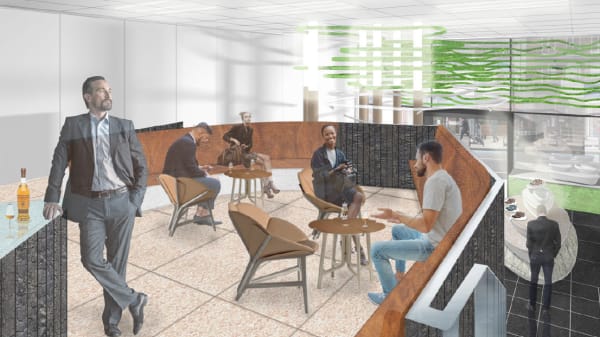
The Maison/0 Schools Challenge Fund develops creative collaborations with LVMH through student and graduate-led engagement.
Designed around a specific brief set by LVMH, project activity is based around workshops, hackathons or longer-term projects.
Working with our students brings fresh creative outlook to LVMH, while working on Challenge Fund projects introduce our students to the inner workings of a luxury group.
The Challenge Fund explores key strategic pillars for LVMH as part of their LIFE 360 environment strategy. The project supports collaborations with creative practitioners to foster new relationships between nature restoration and creative endeavours. The strategy has 4 pillars - creative circularity, biodiversity, climate and transparency - and a target of 'zero virgin fossil-based plastic in packaging by 2026'.
Latest projects
Plastic Extinction
What cultural, material and social changes could emerge if virgin petroleum-based plastic was no longer available? Earthsuits: Plastic Extinction brought students, researchers, industry partners and practitioners together to explore this defining material question of our time.
Earthsuits research and development investigates wearables as a planetary technology: how garments, gear and interfaces mediate between the human body and its surrounding conditions. Earthsuits: Plastic Extinction was produced in collaboration with over 80 CSM MA Narrative Environments and MA Industrial Design students, supported by the Maison/0 Challenge Fund.
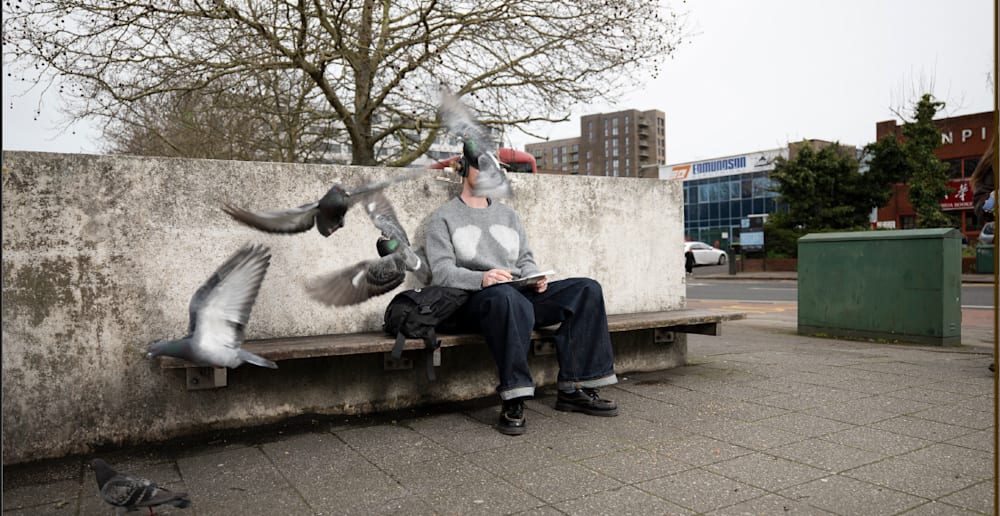
Student and industry collaboration
Students worked together across mixed disciplines, combining observation, worldbuilding, prototyping and film to explore how everyday life might adapt to changing material conditions. The resulting artefacts – 18 wearables and 18 films – are not endpoints but expressions of a shared creative process.
Extending beyond the design studio, a series of lectures, workshops and public events brought the conversation around materials, technology and speculative practice into broader focus for CSM Digital Innovation Season 2026. The ideas explored by students were enriched, challenged and expanded upon by researchers, designers, artists and industry practitioners.
Outcomes
The project has generated 4 key outputs:
- 18 speculative wearable artefacts: Physical garments, gear, and interfaces, including bio-based protective wear, analogue recording devices, haptic tide-trackers, and micro-algae sound shelters, that mediate between the human body and post-plastic environments.
- 3 site-specific field investigations: In-depth social and material research mapping post-plastic adaptations across Hackney Wick, Thames Barrier Park and Park Royal.
- Public talks and workshop programme: CSM Digital Innovation Season keynotes and workshops on worldbuilding, 3D digital twins, virtual fashion and cognitive archaeology.
- Project publication and film series: Documenting the creative methodologies, theoretical frameworks, process critiques and speculative narratives produced during the 7-week initiative.
Acknowledgements
- Bethany Shepherd, Course Leader, MA Narrative Environments
- Sitraka Rakotoniaina, Collaborative Unit Project Direction
- Jesús Felipe Querol, Course Leader, MA Industrial Design
- Digital Innovation Season 2026 project team
Mentors, guides and critics
- Thomas Thwaites (speculative design and research)
- Elsée Ekambi Eyoum (LVMH)
- Maria McLintock (architecture curation, writing)
- Sven Mündner (place strategy and cultural innovation)
- Philip Maughan (writing, research)
- Namrata Krishna (place strategy, and narrative)
- Akvilė Terminaitė (research-led experience design)
- Eleanor Armstrong (social science of outer space)
- Carole Collet (LVMH Maison/0)
- Alexandre Capelli (LVMH)
Where Land and Water Meet
What can biodiversity do for designers and what can designers do for biodiversity?
An MA Regenerative Design project in partnership with Kilchoan Melfort Trust, and knowledge partners from Scottish Association for Marine Science and Seawilding in Scotland, United Kingdom. Supported by the LVMH Maison/0 Challenge Fund 2025 it brought together ecologists and designers to activate place-based biodiversity restoration, research and collaboration.
The project generated 4 key outputs:
- Expedition in Scotland.
- A series of short films.
- An online symposium.
- A Lexicon.

Expedition and field research
A research group expedition by MA Regenerative Design graduates and students took place in Argyll and Bute, Scotland, in September 2025. The group represents diverse ecosystem knowledge from around the world.
Working with the Kilchoan Melfort Trust and the Scottish Association for Marine Science (SAMS), we explored and developed new approaches to practicing biodiversity restoration. Not only a scientific challenge, it has social, cultural, ecological and material aspects that require creative approaches, community action and long-term collaboration.
The research was structured around hands-on fieldwork, developing individual research and understanding the role of design in supporting local biodiversity restoration, through case studies and meetings with local experts:
- Dr Alasdair O’Dell from the Scottish Association for Marine Science: to learn about blue carbon research
- Dr Alex Thompson at the boathouse at Loch Craignish: leading local seagrass restoration through community-based research and engagement.
Land restoration
The aim of the field research was to develop new empirical biodiversity methods to enable collaboration between ecologists, designers and local communities.
Designing for biodiversity restoration is not just a puzzle to be solved but a quest for restoring new relational capacities in understanding how we are collectively dependent on the diversity of life.
Working with biodiversity requires new modes of interdisciplinary collaboration to understand ecosystem interactions, relations and impact. Hands-on fieldwork involved removed gorse to revive meadows and collecting plastic tree guards across the hills. These small but significant interventions in the dynamics of landscape help us pause projecting and designing and instead start from learning and understanding the dynamics of place, time and species.
These embodied practices help us shift our understanding of regenerative design. Away from the studio and into the field, we learn to listen to place, to species and to the histories embedded in land use. In order to think about the future, we need to learn from how we are situated. Restoration work requires attention to ecological context, local and the cultural relationships communities in the landscapes. The manual labour becomes a form of inquiry, it is body intensive, slow, relational, and deeply instructive.
By working with land, we understand that biodiversity restoration is not a technical fix but a long term, collaborative process that teaches about scale, time and where we enter and contribute in the process of restoration.
Outcomes
We explored how collaborative approaches can unlock the potential of biodiversity restoration, demonstrating that this challenge requires new methodologies and an evolution in design practice rather than a single solution.
The week laid the foundation for future collaborations and insights. The work was presented in a public biodiversity symposium, where we shared our findings, reflections and next steps in building effective biodiversity alliances.
The research group proposed work ranging from:
- frameworks for designers and ecologists to work together using ecological data, inspired by Life Cycle Assessment (LCA) processes
- reframing data-collection and design interventions
- rethinking citizen-science initiatives and local geographical understanding and assessments
- rethinking how regenerative design practices can operate as part of ecosystem and support new functions and ways of seeing the world.
Acknowledgments
Project led by: Dr Barbara Smith, Lecturer in Ecology, MA Regenerative Design and Judith van den Boom, Course Leader MA Regenerative Design.
MA Regenerative Design research group participants: Quoi Alexander (JP), Inés Quiñones Fábregas (ESP), James Harlow (UK), Sami Kimberley (UK), Charline Lalanne (FR), Tom Longmate (NOR), Lucy Mitchell (UK), Gabriella Rhodes (UK), Lesley Roberts (US)
With thanks to
- Alexandre Capelli, Deputy Head Environment, LVMH.
- Laura Dawson, Louisa Habermann, and Marnik van Cauter, Kilchoan Melfort Trust.
- Dr. Alasdair O’Dell, Scottish Association for Marine Science.
- Dr Alex Thompson, Seawilding.
Future Harvest: Designing Rainwater for Regenerative Urban Food Systems
What can rainwater harvesting and living microalgae systems teach us about the future of food resilience in our cities?
An MA Biodesign project, supported by the 2024 Challenge Fund, brought together scientists, designers and local communities to reimagine urban agriculture and climate adaptation in London.
The project generated 3 key outputs:
- A rooftop biological system and harvesting prototype: Designed for the Central Saint Martins terrace to monitor rainwater quality, sample atmospheric micro-organisms, and cultivate local microalgae strains.
- An immersive food event: A curated culinary experience exploring future scenarios of hyper-local nutrition, regenerative soil creation, and climate resilience.
- A speculative futures video and technical report: Documenting lab protocols, ecological monitoring data, and systemic design frameworks.
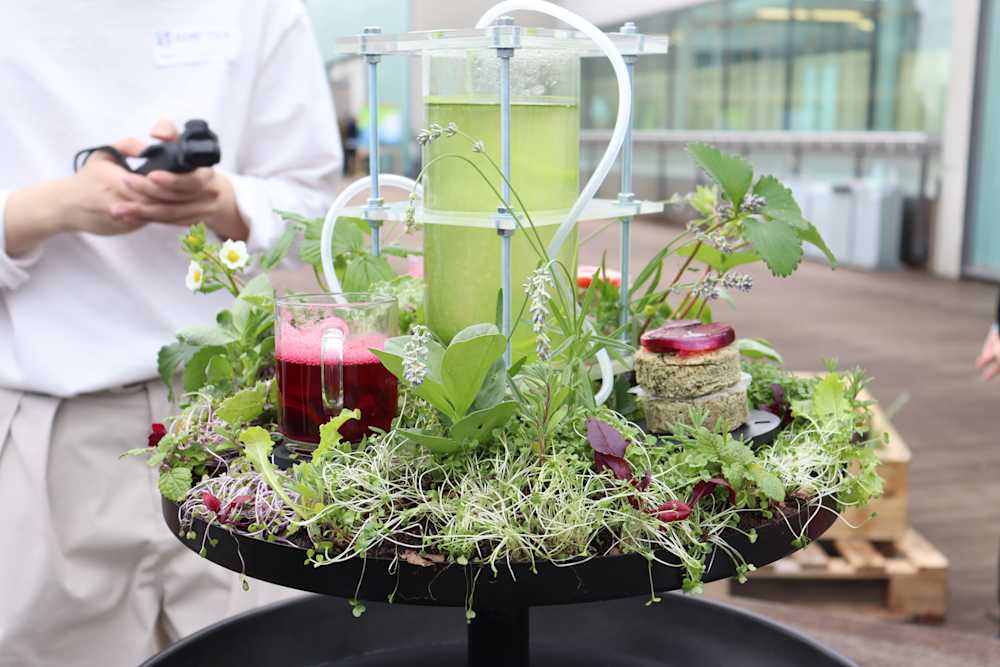
Field research and bio-lab experimentation
Rainwater is far more than simple H₂O; it carries a complex atmospheric microbiome including airborne algae, bacteria, and wild fungal spores that nourish soil ecosystems. Climate change is shifting rainfall patterns across the globe, creating intense flooding and prolonged drought.
Students and researchers from MA Biodesign explored how urban communities can adapt to these challenges in an intensive 20-week research period combined field harvesting, laboratory analysis and systemic design.
Through laboratory work in the Grow Lab and rooftop sample collection at Central Saint Martins, the group mapped local cloud-atmosphere microbial communities.
Using collected rainwater, we cultivated indigenous microalgae species to nourish urban soils, promote plant health and create nutrient-dense food systems without relying on energy-intensive external resources. Harvesting rain and tracing the flow of water as it nourishes plants and different strains of algae, the project speculated on scenarios to manage food production in the face of extreme weather.
Speculative food proposals
Future Harvest took place on the Central Saint Martins Roof Terrace, presenting 4 culinary experiments ranging from mobile mushrooms to algal teas, cryo-therapuetic sorbets and microbial mists:
- Aqualibrium: Inspired by biological water-collection strategies (such as spider webs and leaf geometries), this system purifies collected rainwater to grow nutrient-rich native plants like nettles and dandelions, serving them as cryo-therapeutic sorbets paired with hydrogel algae cooling patches.
- Low Tea: A reimagining of the traditional British afternoon tea that reduces water consumption to zero through hyper-local rainwater harvesting, microalgae bioreactors, and native herb permaculture, served alongside edible tabletops.
- NOU: Exploring the intersection of nutrition and beauty, NOU utilizes pink-hued microalgae cultivated in rainwater to create eco-luxury ingestible spray boosters and skin-microbiome mists.
- Terragelli: Situated in a resource-depleted 2050 scenario, this nomadic trade system utilises rainwater-grown oyster mushrooms to break down microplastic pollutants while creating Tetris-shaped nutritional confections infused with local British aromatics.
Acknowledgements
- Course Leader MA Biodesign: Nancy Diniz
- Grow Lab Technical Support: Dr Shem Johnson, Dr Barbara Paes
- Teaching and Research Team: Dr Alice Taylor, Dr Lorraine Archer, Dr Alejandro Luna, Jon Flint, Lucrezia Alessandroni, Mia Luong
Projects archive
-
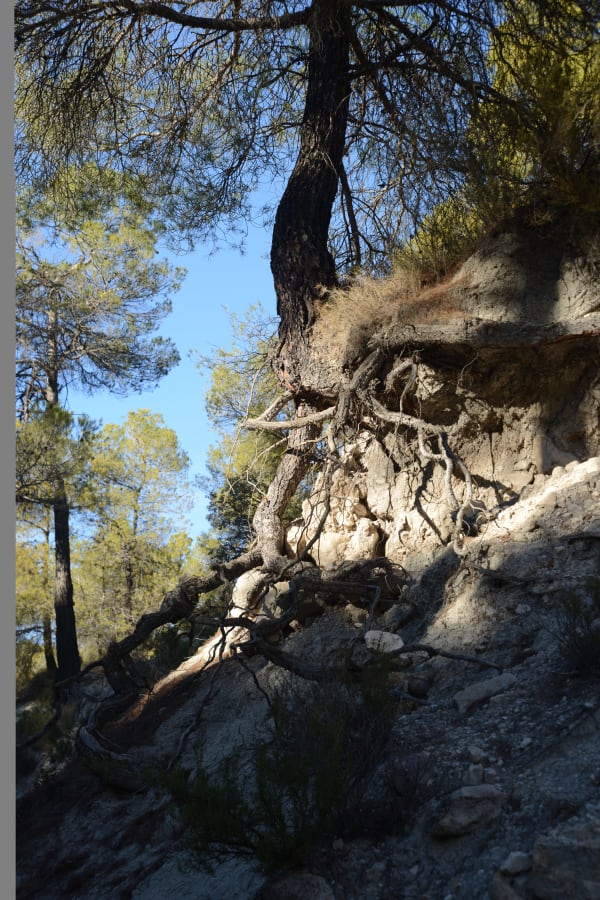
Juliet Williams, 2024 MA Art & Science, Central Saint Martins, UAL
-
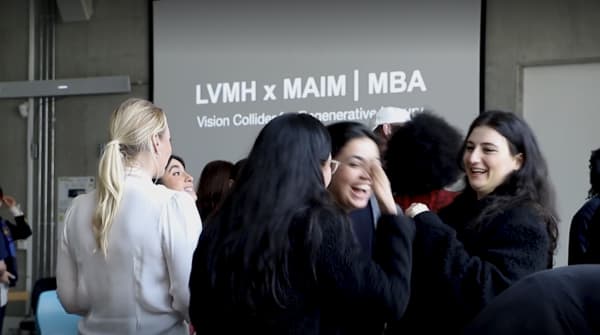
Image credit: Culture and Enterprise programme
-
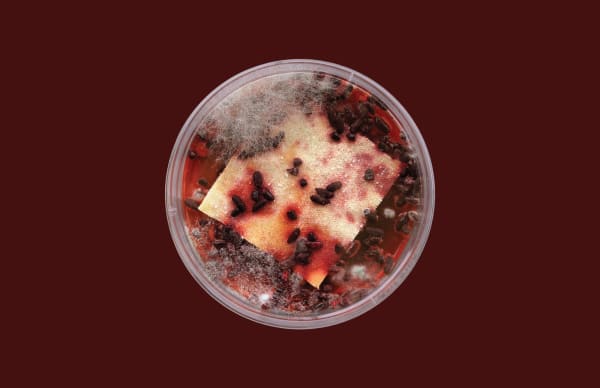
Julia Jueckstock, Hyphae Hues, MA Biodesign

-
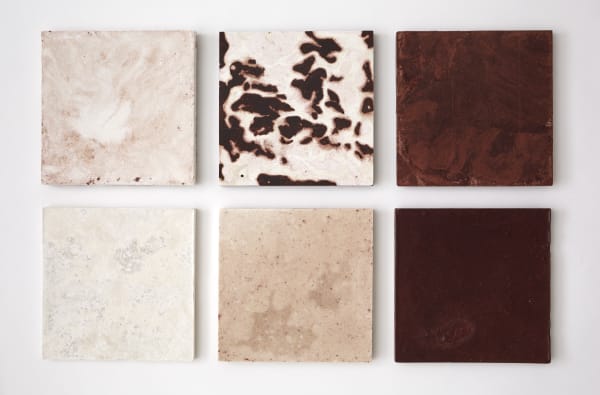
Collection En Route - Materials by Brigitte Kock and Irene Roca Moracia
-

Image courtesy of UAL,