MA Visual Effects student explores emerging technologies, experimentation, and new ways of seeing
- Written byLondon College of Communication
- Published date 29 April 2026
Tell us about yourself
My name is Shannon (Qianwen), and I am currently studying MA Visual Effects at London College of Communication (LCC), part of the University of the Arts London. I am particularly interested in how emerging technologies are shaping new ways of seeing and constructing visual experiences.
What did you do before joining London College of Communication (LCC), and why did you choose this course?
Before studying MA Visual Effects at LCC, my background was in motion design, user experience, and user interface. I used to focus on clarity, structure, and user experience, but became increasingly interested in how experiences could be shaped beyond the screen, and how emerging technologies are reshaping creative practice. The course became a way to step into that uncertainty and explore innovative approaches.
What has your experience on the course been like so far?
What stands out most is how the course gradually shifts the way you think. Learning tools such as Unreal Engine and Nuke is an important part of the experience, but the more lasting change comes from understanding how technical decisions shape outcomes.
Lighting, timing, and composition begin to work together to guide how a moment is experienced. Visual effects start to feel less like a purely technical field and more like a way of constructing a journey.
How do you approach learning and experimentation on the course?
Much of the learning happens through experimentation. Working with real-time rendering, testing unfamiliar workflows, and developing projects without clear answers often means stepping outside what feels comfortable.
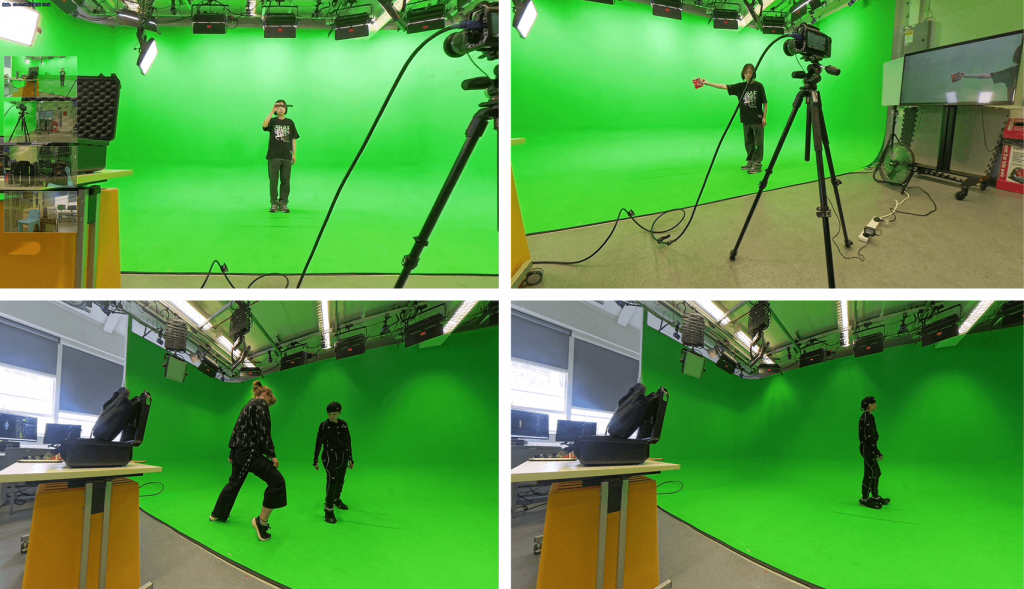
Access to facilities such as green screen and motion capture opens new ways of working, allowing ideas to be explored in both physical and digital contexts. Applying these techniques within projects makes the process more tangible and reveals how various parts of a pipeline connect.
Over time, testing, failing, and refining becomes just as valuable as the outcome, building confidence, resilience, and a willingness to explore the unexpected.
Experimentation is often collaborative, as shown at our Graduate Showcase, where we worked across different projects and disciplines.

How has the course helped you engage with emerging technologies?
Technology is always present within this journey. Digital tools, and increasingly AI, are integral to how work is created, but also something to reflect on.
They can accelerate iteration and open new possibilities but still rely on human intention. The course creates space to explore that balance through practice and ongoing discussions with tutors and peers.
Opportunities to speak with industry professionals through LOOP, the Screen School industry conference, have also shaped my understanding of emerging pipelines and future practice, highlighting how quickly workflows are evolving and the importance of adaptability.
How have you experienced the wider LCC community?
Outside the course, the community at LCC has been equally important to me. There are students from diverse backgrounds, skillsets, and creative interests, which has influences how we learn from each other.
Through collaboration and informal exchange, new perspectives often emerge. Being part of the UAL network has connected me with students across film, music, fine art, and other disciplines, opening broader possibilities for collaboration.

What advice would you give to future students?
Looking back at the course, it has been a journey of learning not only new tools, but a new way of seeing and working. The biggest piece of advice I would like to share to future students, is that it is not necessary to have everything defined from the beginning.
What matters more is exploring and discovering your own creative direction over time.
Related links
- Discover MA Visual Effects
- Explore more from our Screen School
- Follow Shannon Tang (Qianwen Tang)