In conversation with Genaro Rivas: A designer’s journey through death, gold and memory
- Written byC. Miller
- Published date 09 October 2025
Share story
Sustainability, circularity, and empowerment - these are the mantras that have guided MA Fashion Entrepreneurship and Innovation graduate Genaro Rivas throughout his design process since his time at London College of Fashion (LCF) UAL. Following on from achievements such as pioneering Peru and Latin America’s first 3D printed dress, capturing the grand prize at this year’s Visa x Vogue Business Young Creators: Recycle the Runway Awards and recently debuting his new collection at his 5th appearance at Fashion Week, it’s fair to say this philosophical approach to fashion is certainly working for Genaro in his mission to give the industry a deeper purpose. Ultimately, his commitment to consistently challenge himself and his innovative approach to making fashion more sustainable continue to set him apart as a trailblazer in circular fashion emerging from the UK.
We sat down with Genaro to discuss his philosophy on fashion, the inspiration behind his latest collection ‘A Golden Shroud’ and what it takes to continue to create and innovate when building your own brand.
How did your time at LCF influence you and shape your understanding of fashion?
Thank you so much. Honestly, I don’t feel I’ve “achieved a lot” yet just because I'm still looking for stockists and things like that for my brand. But it certainly strengthened my vision and gave me the guts to keep following my passion and to continue to give fashion a purpose, which is the main thing. I simply feel lucky to have had the opportunity to open my brand and start building something of my own. My time at LCF was transformative. I’ll never forget when my course leader told me to enjoy the moment because time flies, and it truly did. Studying at one of the world’s leading fashion schools not only gave me the knowledge and network I needed but also strengthened my vision of fashion with purpose. It gave me the right tools at the right time, and the connections across the entirety of UAL’s network and other colleges were equally inspiring. I’m very proud to be part of the LCF legacy; it’s something I carry with me in every collection.
Could you please explain your fashion philosophy?
My philosophy is simple: to give fashion a purpose. Since my very first show in Lima, where the collection raised funds for a children’s hospital, I’ve believed that fashion should be more than clothing. It should be a platform. For me, that means collaborating with communities, independent makers, and students, creating not only garments but also opportunities. My vision of fashion with purpose is about using design to open doors, to generate fair work, and to bring meaning into an industry that often forgets its social power.
Genaro’s goal of fostering a collaborative environment with the aim of aiding neglected communities is something he feels extremely passionate about integrating within his work. Whilst discussing his Fashion Philosophy, he recounted a story that shaped his motivation behind this particular element of his vision.
During the COVID-19 pandemic, I had to shut down part of my practice. At the time, restrictions in Peru were very strict, and I remember seeing a news report about a group of women living on the outskirts of Lima. They relied on informal jobs — recycling, house cleaning, day work — and with everything on pause, they were asking for food donations. I was really moved by their situation, so I contacted the reporter, got in touch with the women, and asked if they had any sewing or knitting experience. Some of them did, so I asked if they could train the others. I started sending them materials and designs, and we began creating collections together during lockdown. That experience changed my understanding of fashion — from that point onwards, it became a tool for social impact.
Through that work, I connected with more groups of women and even began collaborations with companies like Coca-Cola, Bioderma, and LG Electronics. When I joined LCF, everything started to make sense — I was finally able to give language and structure to what I had been doing, and it was during this time that I got really deep into my concepts about sustainable fashion and circularity. A short course on sustainable fashion introduced me to the concept of circularity, and my MA helped me deepen that knowledge. With support from my tutors, I shifted my final project from a traditional collection to developing a methodology for fair wage estimation between artisans and designers.
My fashion philosophy was always rooted in purpose and collaboration — but my time at LCF helped me define and refine it.
As a Peruvian, how does it feel to be the first person to make a 3D printed dress in Peru and Latin America, and what do your other projects mean to you?
It was both challenging and deeply rewarding. I started with a simple premise: to design a piece using only 3D-printed technology, without glue or threads. This, because to break the rules, first you need to know them. Another project I’m proud of is an alpaca jacket that could charge a mobile phone battery, which combined tradition with innovation. But perhaps most meaningful was a collection I developed with a retailer in Lima, where I insisted on sustainable materials and fair-paid jobs for women and small businesses. Mariza and her team of knitters not only worked on that collection, but were later hired by the retailer for other projects. That, for me, is what fashion with purpose truly means: creating lasting opportunities and breaking glass ceilings.
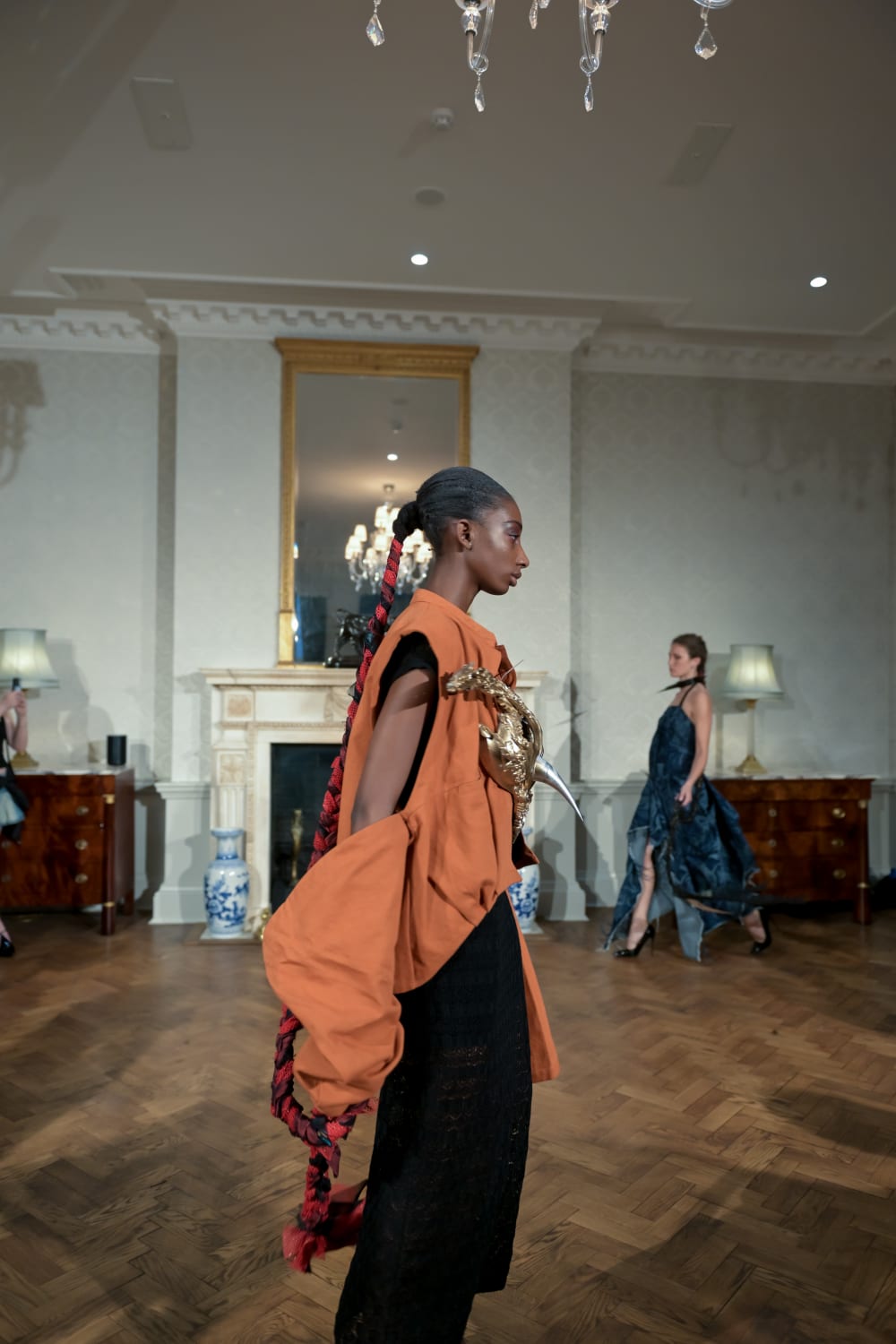
Creating the first 3D-printed dress in Peru and Latin America was definitely about pushing myself outside my comfort zone. If I was going to use technology, I wanted it to be meaningful — not just for aesthetics or as a gimmick. I wanted it to be functional and accessible. I used one of the most basic 3D printers — a MakerBot Replicator 3 — and developed a modular structure that could be assembled like a puzzle, forming a kind of flexible, wearable fabric. One of the biggest challenges was incorporating tailoring techniques, like darts, into the design without thread, glue or traditional materials.
That experience opened up a new world of possibilities. In A Feast for Crows, my latest collection, we’ve continued using 3D printing — this time to create sculptural accessories like an oversized crow skull. I’ve always had a thing for skulls, but this collection goes deeper. It’s inspired by murals I saw in churches in Cusco — especially The Fiction of Hell and The Triumph of the Dead. The whole collection is about death, rebirth, and transformation.
We’re incorporating those themes through accessories, symbols, and techniques like 3D printing — and I’m really excited to see how it all comes together.
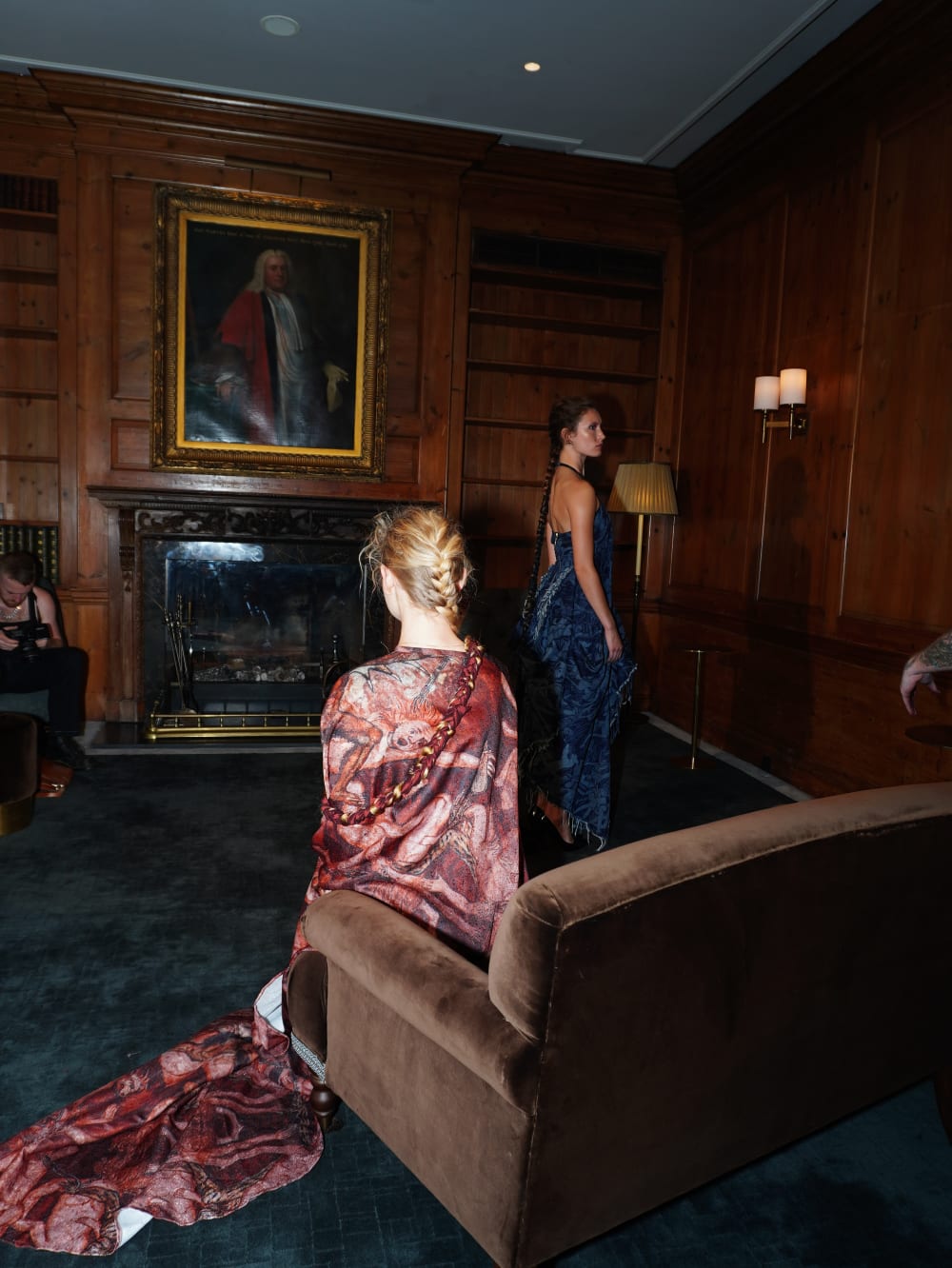
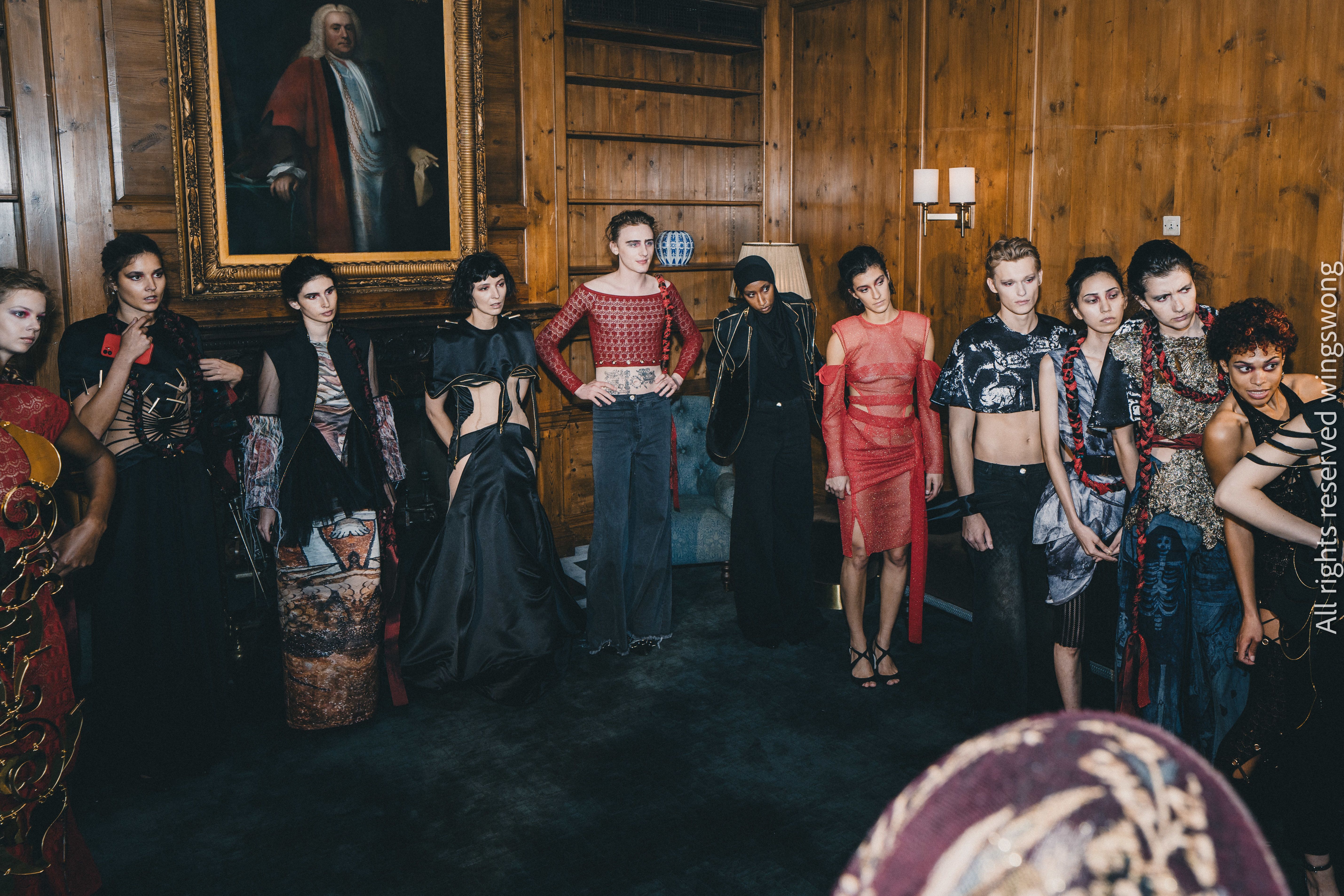
When asked what Genaro had next in the pipeline, at the time of writing, Genaro was on the cusp of debuting his latest collection, ‘ A Golden Shroud,’ at the September 2025 edition of London Fashion Week. 'A Golden Shroud’ is a deeply personal collection due to its ties to his home country of Peru, drawing inspiration from Baroque churches that he discovered on a trip to the Peruvian Andes.
This September’s edition of London Fashion Week, I’ll present my fifth on-schedule London Fashion Week show, A Golden Shroud. The inspiration comes from the Andean Baroque churches I discovered on a research trip to Cuzco and Huaro in the Peruvian highlands. Surrounded by this incredible art, I felt a dialogue between the sacred and the earthly, between gold, shadow, silence and hell.
One mural that was a large source of inspiration in particular — The Triumph of Death — shows that death comes for everyone, regardless of status or power. That idea became central to the collection’s concept: transformation through darkness.
Rather than traditional florals or seasonal motifs, I focused on pain, rebirth, and beauty found in unexpected places — incorporating gold not just as a colour, but as a symbol of resilience. Soft silhouettes are contrasted with prints of torture devices from the murals, creating a clash between delicacy and intensity.
This collection will bring together many of the ideas I’ve been exploring over the past year with my last two collections. Looking ahead, my dream is to reach retail and, eventually, be part of a major fashion conglomerate. But for now, my focus is on making sure my work finds the right homes and people who resonate with it.’
Do you have any advice for students looking to build their own brand as a Creative Director?
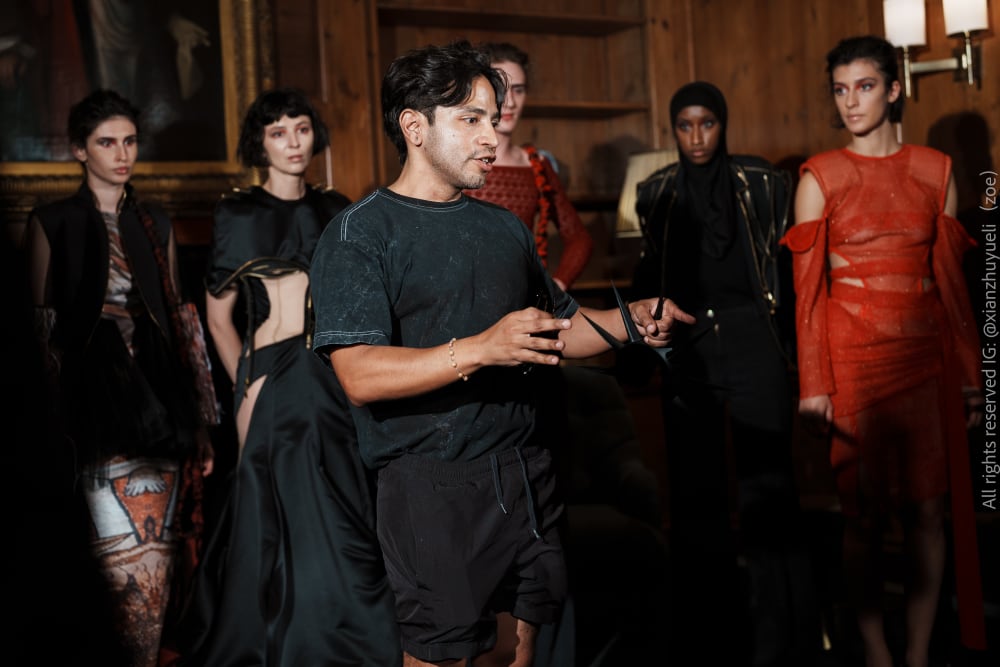
Trust your vision. Trust your instincts. And be ready to work. Really work. Fashion is not only sketching in a studio; it’s also getting your hands dirty, learning every step, and giving back. Create opportunities for others, be resilient, and don’t be afraid to dream big. Building a brand is not easy, but if you put your purpose at the centre, everything else will follow.
- Find out more about MA Fashion Entrepreneurship and Innovation
- Connect with Graduate Futures
- What’s on at LCF: open days and events
- More LCF Stories