
Oh Boy! Boy’s Dress 1760-1930
- Written byCentre for Fashion Curation, Amy de la Haye
- Published date 09 October 2023
Share story
I met artist and private collector Alasdair Peebles in 2017. I was interviewing the specialist fashion auctioneer Kerry Taylor for a text I was writing on the specificities of collecting fashion (as distinct from other media) for a special issue of Fashion Theory (2018) I was guest editing. She identified the two distinct markets for buying fashion at auction: buy-to-wear and buy-to-collect. With reference to the latter, she stressed that I must meet with Alasdair Peebles a private collector of historical boy’s dress. Ten minutes later Alasdair walked in.
We got talking and I invited him to bring in examples from his collection and teach on the MA Fashion Curation and Cultural Programming course at LCF. His sessions, which included an erudite reflection of his obsession with collecting, immediately became a student favourite. Over the years we talked about exhibiting the collection and now, this is about to become a reality. In 2022 I asked Alasdair about his ideal venue; he immediately said the small downstairs gallery at London’s Fashion Textile Museum (FTM). We approached Curator Dennis Nothdruft who immediately agreed to our proposal to stage two consecutive themed exhibitions. Below is the, standard 150-word, text panel that introduces our project.
'Oh Boy!' at the Fashion and Textile Museum, London is the first exhibition devoted to historical boy’s dress. This area of fashion history and collecting has generally been overlooked and under-valued. Fortunately, over the last 30 years, artist and private collector Alasdair Peebles has formed an exceptional and outstanding collection.
'Oh Boy!' comprises two small shows. Act 1: 'Breeched: no more dresses' (29 September – 16 December 2023) explores the sartorial transition in a young boy’s life from the feminine domestic sphere into the masculine world. Act 2: "Ship Shape" (21 December – 3 March 2024) examines the enduring vogue for sailor suits and nautical styles. These clothes were worn by boys from financially privileged, mostly white-skinned, families.
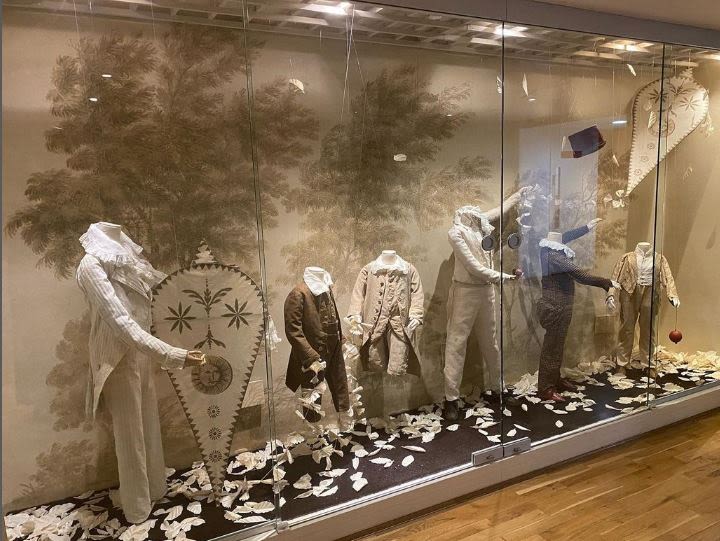
'Oh Boy!' is a collaboration between Alasdair Peebles and dress curator and writer Amy de la Haye. Together they explore these themes and the longer-term biography of the garments as collected objects. The installation aesthetic is decidedly romantic. The painted backdrop, kite props and suspended mannequins - painted and made by Alasdair - seek to create drama and suggest movement.

At the time of writing, Alasdair is working with a French tailor on buttons and button holes and has booked a studio to paint in the grisaille (a decorative scheme executed in a neutral colour) of wind-blown trees in sepia hues. "Oh Boy! " has a theatrical feel, hence our usage of the terms ‘Act 1’ and ‘Act 2’. With our emphasis upon object-led narratives and use of contemporaneous terminology (I feel very strongly that we must also collect and preserve the words that describe historical garments), it is in many respects, an unashamedly ‘traditional’ and/or ‘connoisseur’ exhibition.
The exhibited garments survive as they were little worn (by boy’s who had many clothes) or comprise unsold shop stock. Many of the captions feature Alasdair’s ‘voice’, commenting on how he acquired various items and highlighting aspects that particularly appeal to him. Below are some examples of objects and labels from Act 1: 'Breeched: No more dresses':
Formal dress suit (coat and breeches only), patterned silk, 1760s, French
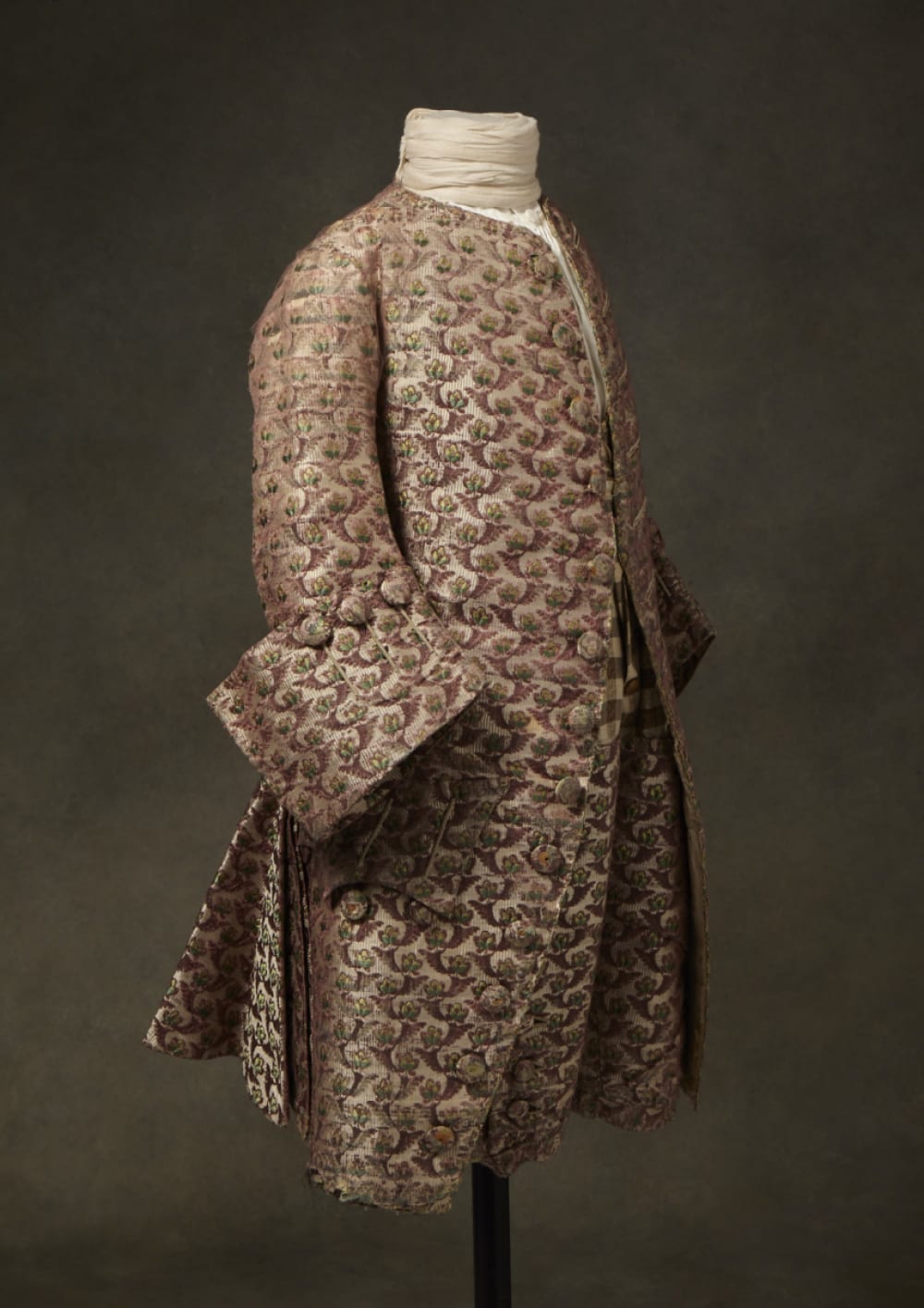
This fine suit would have been worn for special occasions, perhaps at Court, accessorized with a black fur-felt cocked hat (tricorn), white silk stockings and buckled shoes. It is a perfect replica of a man’s fashionable suit of the period, with sword slits in the coat skirts. The luxurious patterned silk was woven in France. The coat is interlined with horsehair to create stiffness, making it a heavy and constricting garment for a young child. At some point the original waistcoat became separated. It now forms part of the collection of the Rijksmuseum, Amsterdam.
Boy’s dress (robe and gown), dimity (corded lightweight cotton), 1770-1790, British
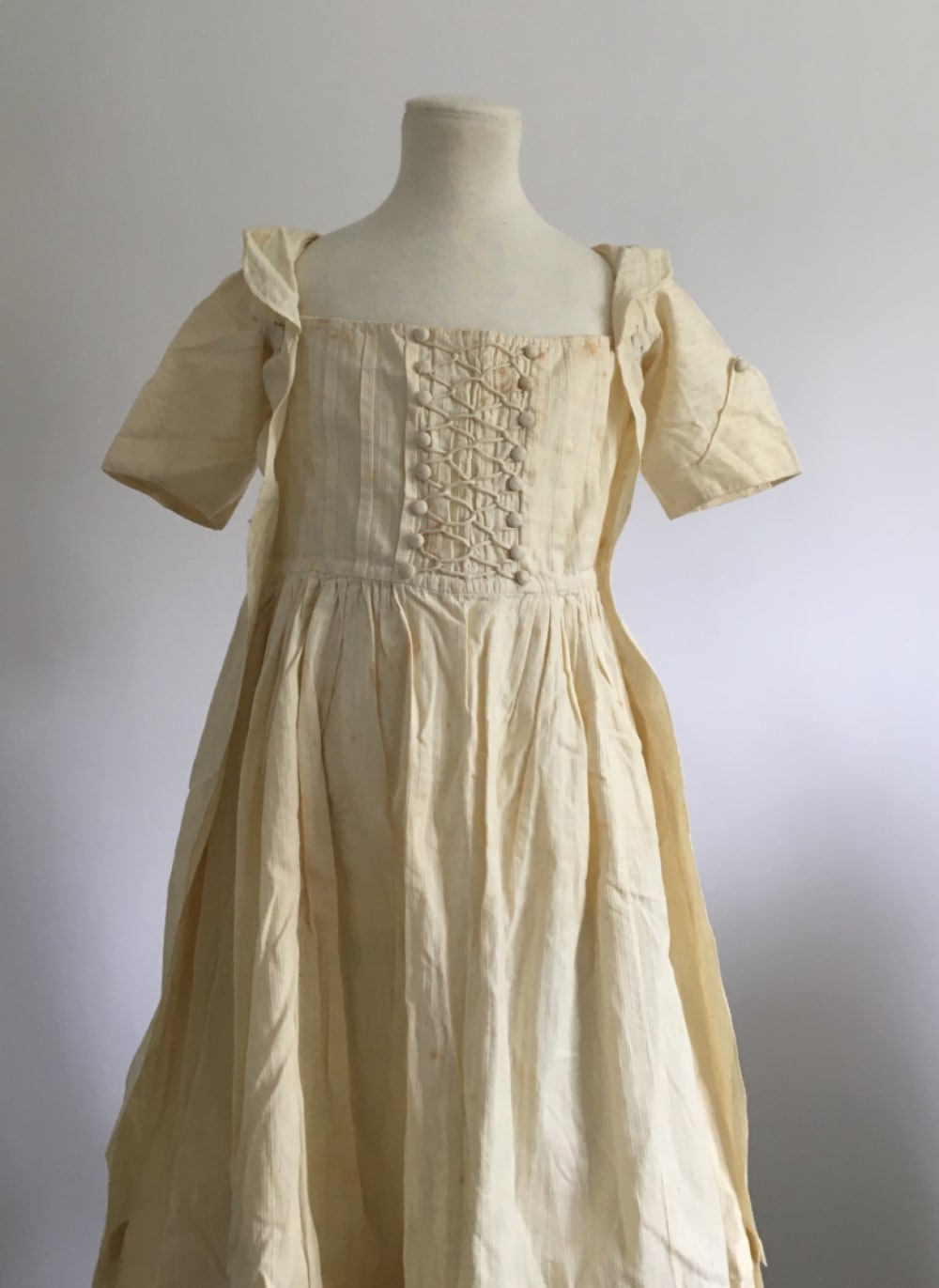
This was made for a boy aged about five years. Alasdair bought it at auction in 2020.
"I knew the decorative buttons and cross-lacing on the bodice signified that it was certainly worn by a boy. And, as such, the dress contributed to a story about breeching."
Skeleton suit, trousers and jacket (with separate long sleeves), facecloth with soutache (flat metal braid) and metal buttons, c1810, French; reproduction cambric (fine, dense cotton) shirt

From tiny acorns mighty oak trees grow. Embroidered in the hussar (light cavalry regiments known for their elegant uniforms) style, this skeleton suit is unusually decorative. The oversize acorn design is highly symbolic. Within print media and social satire, male anatomy, sexuality and physiology were often likened to vegetables and seeds. The acorn is associated with fertility, growth, good fortune and health. The oak tree (quercus) is venerated for embodying wisdom, strength, beauty and power. Alasdair bought it an auction where its rarity and significance as boys wear was overlooked. Small garments like this are highly desirable to teddy bear collectors.
Alasdair stores his collection to museum standards. On occasion he styles portraits of boys wearing items from the collection (which is the prerogative of the private collector). These will be shown in the exhibitions, alongside historical imagery.
Boy dressed in French Revolutionary era suit flying a kite. Photographic portrait, digital print, styled by Alasdair Peebles. Photography by Nic Shonfeld, 2013

"This image was inspired by the many 18th century portraits of boys flying kites. I wanted the clothes to become simply an everyday outfit worn by an active boy engaged in play. I made the paper kite using 18th century examples as a model. The short red wool jacket is in the Carmagnol style, worn by the Sans Culottes during the French Revolution (1789)."
It is rare and a great privilege to enjoy the curatorial freedom we have been granted for 'Oh Boy!' And, it has been a joy to work with Dennis Nothdruft and his team of consummate professionals at FTM. If the project takes on new iterations we will focus on very rare examples of workwear drawn from Alasdair’s superlative collection.
An article about 'Oh Boy!' by Amy de la Haye appears in October Selvedge Magazine
'Oh Boy!' Act 1: 'Breeched: no more dresses' is at the Fashion and Textile Museum, London (29 September – 16 December 2023)
Act 2: "Ship Shape" (21 December – 3 March 2024)