
LCF MA26 | MA Pattern and Garment Technology

- Written byS Williams
- Published date 20 February 2026
Share story
Where form, fit, and thinking begin
The MA Pattern and Garment Technology course invites visitors to take a closer look at the graduate work presented in the LCF MA26 | School of Design and Technology Exhibition. Here, fashion is not introduced through surface or silhouette alone, but through the structures that sit closest to the body: pattern, cut, construction, and the decisions embedded within them.
Across the space, garments unfold as evidence of thinking. Patterns are tested, folded, manipulated, and reassembled. Both digital design software and hand-drafted forms coexist; heritage techniques, such as traditional sewing methods, interact with algorithmic processes that inform design and production. This work positions pattern cutting and garment technology as critical tools for questioning how fashion is designed, produced, worn, and valued.
“MA Pattern and Garment Technology positions pattern cutting and garment technology as critical tools for questioning, reshaping, and advancing contemporary fashion practice. The 2024/25 cohort demonstrates this through projects that operate across digital and physical making, engaging with fit, inclusivity, sustainability, and adaptability. Through rigorous research, experimentation, and collaboration, students use pattern cutting and garment technology to interrogate established systems of sizing, production and use.” — Lex Cawley, Course Leader, MA Pattern and Garment Technology
Rewriting the rules of fit
Fit, a prominent theme, appears as a system-level problem, not just a styling challenge. Several projects examine how bodies are measured, categorised, and standardised, and what is lost in that process.
Astha Gupta’s ‘Algorithmic Pattern Manipulation’ research proposes an alternative to proportional sizing by treating the body as a three-dimensional structure. Using 3D scanning, individual asymmetries and volumes are translated into bespoke pattern blocks, which are algorithmically manipulated for production-ready patterns. Instead of bodies adapting to garments, fit is built around the individual, pointing toward future models of mass customisation based on pattern intelligence rather than size charts.
Elsewhere in the exhibition, fit is negotiated through movement and adaptability. Projects exploring professional and everyday clothing rethink how garments support bodies that shift between environments, postures, and roles throughout the day. Soft tailoring (flexible garment construction), ergonomic design (for comfort and efficiency), and unisex approaches challenge the rigidity of conventional workwear, proposing clothing that balances authority with comfort and professionalism with mobility.
“Drawing on ergonomic design principles, soft tailoring, and sportswear-informed construction, the project investigates how unisex professional garments can balance refined aesthetics with everyday functionality.” — Qianran (Sophia) Xu, MA Pattern and Garmnet Technology graduate
Geometry, simplicity, and restraint
The exhibition shows a commitment to doing more with less. Many projects use simple geometry to generate versatility, comfort, and clarity, avoiding complex forms or excessive components.
Garments developed through square and rectangular cutting systems show how geometry can reduce material waste while supporting movement and wearability. These approaches draw from traditional cutting logics, or established ways of laying out fabric, but are reinterpreted through contemporary materials and contexts. The result is clothing shaped as much by motion as by measurement.
In other work displayed, minimal pattern cutting becomes a platform for transformation. Familiar details such as buttons and buttonholes are repurposed as tools for change, allowing wearers to alter silhouette and function without specialised knowledge. These garments invite interaction, encouraging a more active relationship between wearer and clothing – one that values flexibility over fixed form.
Structure as expression
Construction techniques are treated as expressive tools, not hidden necessities. Gathering, wrapping, modularity, and reconstruction are explored to shape garments responding to material behaviour and movement.
Experiments examine how gathering techniques generate volume and shifting silhouettes as the body moves. Transformable garments inspired by nomadic clothing systems test how wrapping and reconfiguration can support multiple modes of wear, extending garment lifespan while resisting single-purpose design.
Upcycling projects extend this logic, working directly with irregular, post-consumer materials. Deconstructing and reconstructing discarded denim makes pattern cutting a negotiation, adapting to what exists rather than imposing a predetermined outcome. These garments retain traces of previous wear, framing reuse not as a compromise, but as a design and ethical stance.
“The course encourages technical rigour alongside speculative thinking, enabling work that ranges from algorithmic and AI-led approaches to mass customisation, to reinterpretations of traditional and archival garments, and the development of transformable and modular clothing systems.” — Lex Cawley
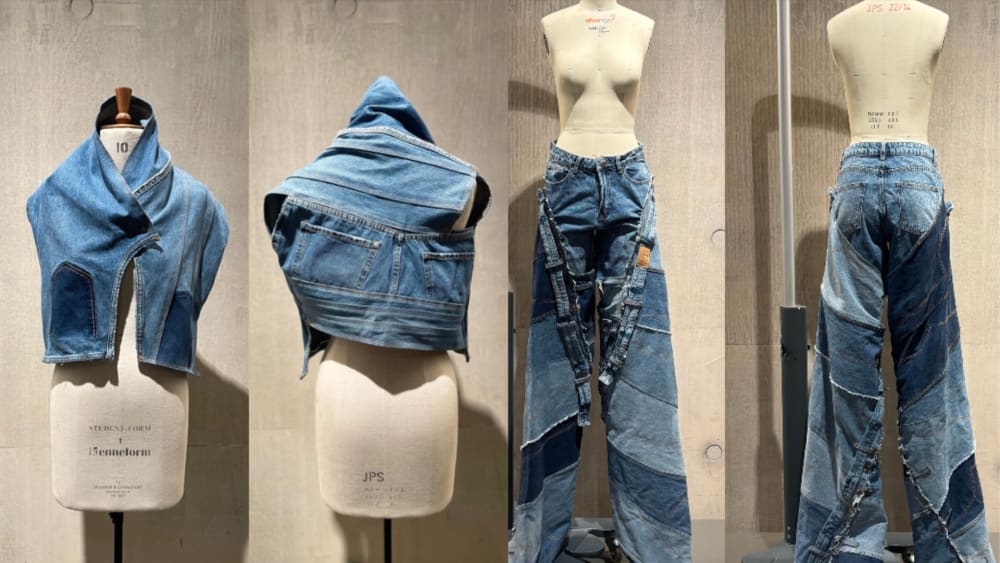
“Creative Cut and Upcycle investigates how geometric cutting techniques can transform discarded denim into reproducible, scalable garments. Addressing fashion’s environmental impact is crucial, as denim production requires up to 10,000 litres of water per pair of jeans. This project reframes post-consumer waste as a design opportunity rather than a limitation." — Deepakshi Panda, MA Pattern and Garment Technology graduate
Learning from the past, without freezing it
Historical garments also play a vital role in the exhibition, not as distant references but as active sources of technical knowledge. Projects centred on archival reproduction demonstrate how pattern reconstruction, finishing techniques, and grading can unlock new ways of engaging with fashion heritage.
By producing both digital and physical replicas of historical garments, students explore how accuracy, durability, and contemporary sizing can coexist. These works propose reproduction as an educational and public-facing tool, one that allows garments to be handled, worn, and understood through making, rather than preserved solely behind glass.
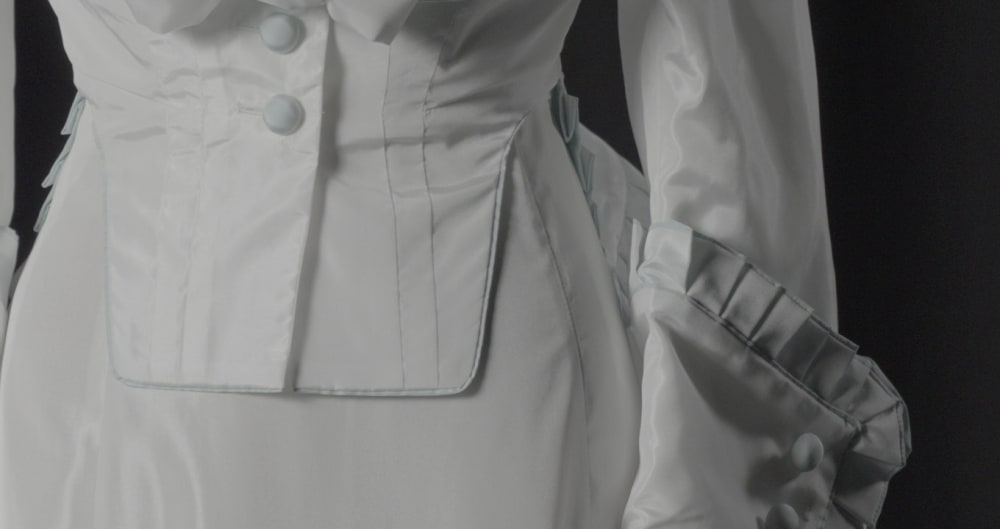
“Rather than treating museum garments solely as untouchable artefacts, the project investigates how replicas can support learning through handling, wear, and close observation. Digital pattern reconstruction, finishing experiments, grading development, and physical replica making are used to test how historical accuracy can be balanced with durability and contemporary sizing. " — Tongyue (Jose) Sheng, MA Pattern and Garment Technology graduate
Pattern as a way of thinking
What unites the MA Pattern and Garment Technology exhibition is a shared belief that pattern is not just a means to an end, but a way of thinking. Whether working with algorithms or archival seams, digital simulations or hand-sampled toiles, students treat pattern cutting as a site where social, cultural, technological, and ethical questions take shape.
“Collectively, these projects reflect the course’s ambition to shape responsible, forward-thinking practitioners equipped to challenge how fashion is made and experienced.” — Lex Cawley
Ultimately, the works in the exhibition invite us to reconsider what we value in clothing – not just its outward appearance, but the ingenuity, care, and intention embedded in every layer. Here, fashion’s most profound stories are found in the details, waiting to be discovered by those who look beneath the surface. Join us at the LCF MA26 | School of Design and Technology Postgraduate Exhibition to discover more.
The LCF MA26 | School of Design and Technology Postgraduate Exhibition is open from 17–24 February 2026. Monday–Saturday, 10am–5pm at London College of Fashion, UAL, East Bank campus.
- Read more LCF Stories.
- Explore more MA Pattern and Garment Technology graduate work on UAL Showcase