Kingly Street studios open new doors for LCF’s emerging tailors

- Written byLondon College of Fashion
- Published date 17 February 2026
Share story
For the past 8 years London College of Fashion (LCF), UAL, Soho and Carnaby Street have collaborated to champion emerging talent through real‑world opportunities. As part of the ongoing partnership, graduates are awarded dedicated studio space in Soho, connecting them directly with a working fashion district and strengthening the relationship between education and industry. The initiative, sponsored by Shaftesbury Capital, long term stewards of Carnaby Street, supports designers at a pivotal stage in their development, offering access to workspace in one of London’s most established creative neighbourhoods.
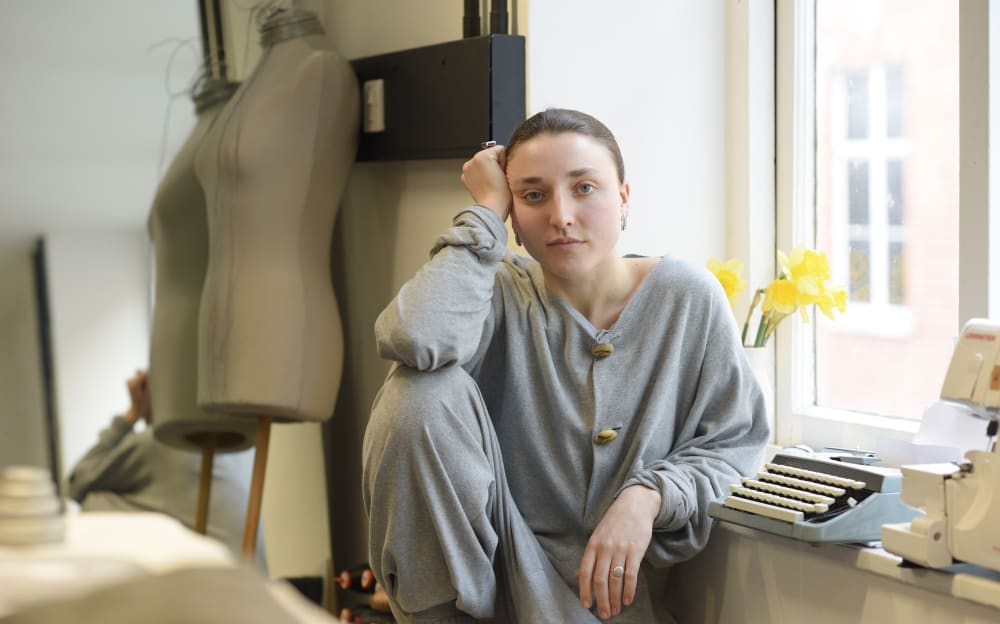
This year’s recipients are Tilda Jonathan and Johanna Boone, who have each been given studio spaces on Kingly Street.
From education to enterprise
The studio award supports emerging talent at a key transition point between education and professional practice. Through access to space, mentorship and industry insight, the partnership helps bridge the gap between graduation and establishing a fashion practice.
For Johanna and Tilda, this opportunity represents the next stage in their LCF Enterprise Journey. Their pathway began through curriculum‑embedded learning on BA (Hons) Bespoke Tailoring and participation in extra‑curricular Enterprise activity. Teaching on the course introduces students to professional practice, enterprise awareness and real‑world contexts alongside technical and creative development.
Building on this foundation, both students have now moved into the ‘Start‑up’ stage of the Journey, engaging with the LCF Founders offer. This includes access to tailored support such as mentoring, coaching and workspace opportunities, designed to help students transition from learning to early‑stage independent practice. The award of studio space marks a significant moment, providing time, autonomy and facilities to test ideas, refine approaches and build confidence.
Meet the students
Johanna Boone
Can you tell us a bit about your journey into fashion and tailoring, and who or what influences your work the most?
My journey into fashion and tailoring started when I was a little girl. For as long as I can remember, I’ve had a profound interest in fashion and clothing. I always really loved working with my hands and the physicality of making things. Because I had the luck of going to a Steiner School, I learned an array of different arts and crafts, yet always felt most drawn to knitting and sewing little things by hand. As I got older, I started seeing the connection between fashion, clothing and my love for making things, the possibility of having them work together.
When I was about 10 years old, we went to visit a traditional bespoke tailor in my hometown - I was entranced. This is what I wanted to do. The grandiose of the suits represented everything I wanted to be, and as he said, he didn’t make for women, the only option was to learn myself.
However, my dream shifted in various ways throughout my teenage years, dabbling in the various realms of fashion. When I came to do my undergraduate degree, I decided to do ‘Bespoke Tailoring’, not knowing very well what exactly this entailed, except the description ‘learn to make garments that fit the body’. This is what I wanted, this is what I had always wanted, yet it was only when I started doing my degree that I realised I was actually doing the degree of the tailor in my hometown whom I had so admired.
"What influences my work the most are the arbitrary details in my daily life.” – Johanna Boone
How has your design process developed through your course and enterprise journey?
The most important thing I learned within my graduate collection was the process I used to develop the designs, reasoning and way of working, it has been an instrumental part in understanding and figuring out a way in which I design and create, still now. It starts with the person, it always does, especially for the bespoke commissions, the research is solely based on the person in question, and I try to get to grips with them as an individual in this world. Yet throughout the development of the collection or the piece, I come across various things which I am inspired by, those will be interwoven with everything I had already gathered, imagined.
What are you hoping to explore or experiment with during your time in the studio, and what kind of tailoring practice do you hope to build?
I’d like to explore making clothing and garments in the broadest sense - meaning, I’d like to employ all different techniques I come across and am inspired by. I’d like to explore various techniques of tailoring, but also outside of tailoring, I’d like to work more with leather, knitting, crocheting, and so on, using these techniques to further explore my own designs and create my own visual language. To really work on creating and realising my own designs.
Regarding tailoring, I’d love to become better at cutting and actually working with the body. This is where the studio becomes an invaluable asset, as it allows me to invite clients into the space and really work on a more professional client/tailor relationship.
“It is not about me as the designer; it is about what you as a person feel as a response to the work I make.” – Johanna Boone
Follow Johanna's journey on Instagram @Johannaboone and @johannamarceladriana.

Tilda Jonathan
Can you tell us a bit about your journey into fashion and tailoring, and what first inspired your interest in tailoring and garment construction?
At school, I did my A-levels with a view to study Medicine or Psychology at University but during lockdown, I had a change of heart and decided to take a year to do an Art Foundation Diploma instead. I loved the freedom and expressive outlet of my Art Foundation, and I specialised in Fashion, which led me to apply for the BA(Hons) Bespoke Tailoring degree at LCF. I was delighted to be accepted onto the course, and the prospect of moving to London to further push my creativity was very exciting to me.
Growing up, I was always very picky with clothes, and I could never find exactly what I was looking for. I started sewing my own clothes while I was at school and this changed my perspective on construction and fit. This made me eager to gain technical expertise so I could achieve the perfect finish on my garments.
What was the inspiration behind your graduate collection, and what tailoring techniques or processes were most important to it?
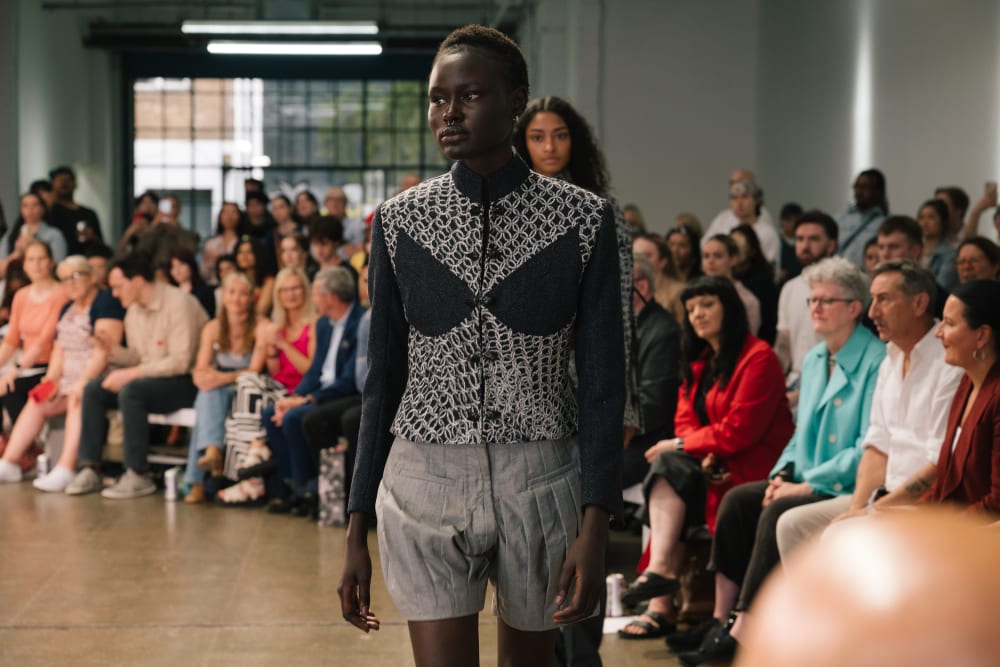
My graduate collection celebrated the power of women in craft through cherishing traditional bespoke making. The aesthetics of traditional medieval armour heavily inspired the silhouettes of the pieces, playing with the visual juxtaposition of sturdy chainmail woven in 100% wool.
The curation of craft techniques was central to my collection. I collaborated with a ceramic artist who created bespoke buttons and buckles for the garments, and I hand-dyed all my garment linings with foraged plants. As part of a competition, I lino-printed chainmail motifs that were digitised and woven in jacquard by AW Hainsworth, who sponsored the fabric for my collection. All these processes were thoughtfully undertaken.
What does access to the Kingly Street studio mean to you at this stage of your career, and are there specific skills or areas of tailoring you're aiming to refine over the year?
Winning the competition with Shaftesbury Capital has helped to elevate my practice immensely. Having a dedicated workspace in the heart of Soho is really exciting, and it enables me to push myself and my craft to the next level. The physical proximity of the Kingly Street studio to Savile Row is just amazing and something I could never have achieved this early in my career without the competition.
Over this year, I really want to refine my skills in cutting and develop a ‘house style’. As a tailor who is new to the industry, I feel it is really important to establish my fundamentals in style and design. I hope to learn from the rich culture of bespoke tailoring that I am surrounded by in Soho and Mayfair.
“Keep your eyes peeled for a project I’ve been working on with a fashion brand based in Paris later on in the year! Until then, I’ll be developing my practice and building my skills as a cutter/maker, so there will be some exciting bespoke projects on the way.”– Tilda Jonathan
Follow Tilda’s journey on Instagram @tildajonathanbespoke.
Supporting students through the enterprise journey
Access to studio space plays a critical role in tailoring education, allowing students to translate technical skill and creative thinking into professional practice. Initiatives like this demonstrate how Enterprise support can be embedded across the student lifecycle, connecting curriculum, extracurricular activity and the Founders provision.
The impact of this support is already evident through previous recipients. Reflecting on his experience, former studio award winner Khalil Khaliqiar describes how the initiative helped him take important early steps in his career:
“The Shaftesbury x LCF initiative is extremely helpful for individuals looking to get started in their careers. Its excellent location serves as a springboard for establishing yourself in the industry. The support provided by LCF’s Graduate Futures Enterprise Team has been invaluable. They offer constant assistance for all inquiries. Additionally, the networking events are fantastic for building contacts and receiving advice from industry professionals.” — Khalil Khaliqiar
Together, these experiences demonstrate how this partnership between LCF, Soho and Carnaby Street not only provides space but creates the conditions for meaningful professional growth. The continued success of the studio award and the trajectories of graduates like Khalil reflect the strength of this ecosystem of support. It's a perspective shared by academic leaders championing the future of bespoke craft and enterprise at LCF.
“The BA (Hons) Bespoke Tailoring course is proud to build on the success of its partnership with Shaftesbury Capital, creating a powerful platform where craft excellence meets entrepreneurial ambition. It enables our talented alumni to launch and scale their own brands within a dynamic commercial landscape. Helping them to establish sustainable businesses, innovating within traditional craft practices, by gaining invaluable visibility among clients, collaborators and a vibrant community of creatives and industry leaders." — Daniel Poulson, Course Leader: BA (Hons) Bespoke Tailoring
“Shaftesbury's generous support since 2019 has completed the missing link in the support ecosystem offered to our aspiring designers at LCF. Founders need our expert enterprise education, mentorship and networking opportunities but most of all they need space to turn their creative innovation into commercial reality.” — Liz Gee, Dean of Fashion Business School
Looking ahead
Johanna and Tilda’s progression through the LCF Enterprise Journey highlights the value of a joined‑up approach to enterprise support – one that connects education, extra‑curricular opportunity and industry partnership. As LCF continues to develop pathways for students, collaborations such as this create scope for future opportunities, including the potential to explore wider initiatives that support emerging talent at different stages of their development.
Congratulations to Johanna and Tilda on securing this great opportunity.
- Read more LCF Stories
- Check out BA (Hons) Bespoke Tailoring graduate work on UAL Showcase