Centre For Sustainable Fashion wins Green Gown Award for exploring cultural sustainability
- Written byUna Andzane
- Published date 02 December 2024
Share story
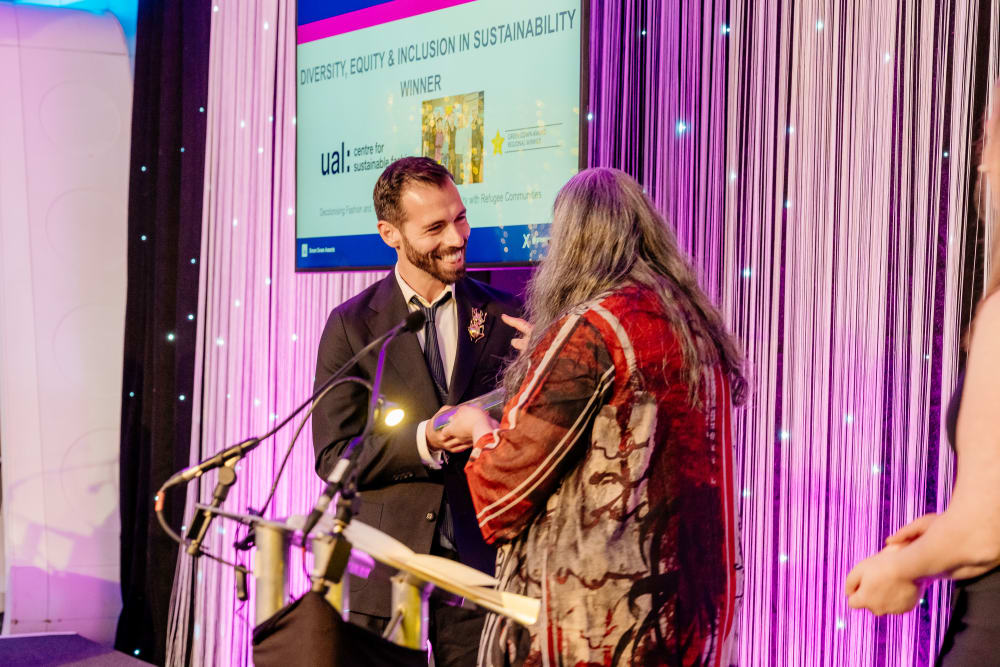
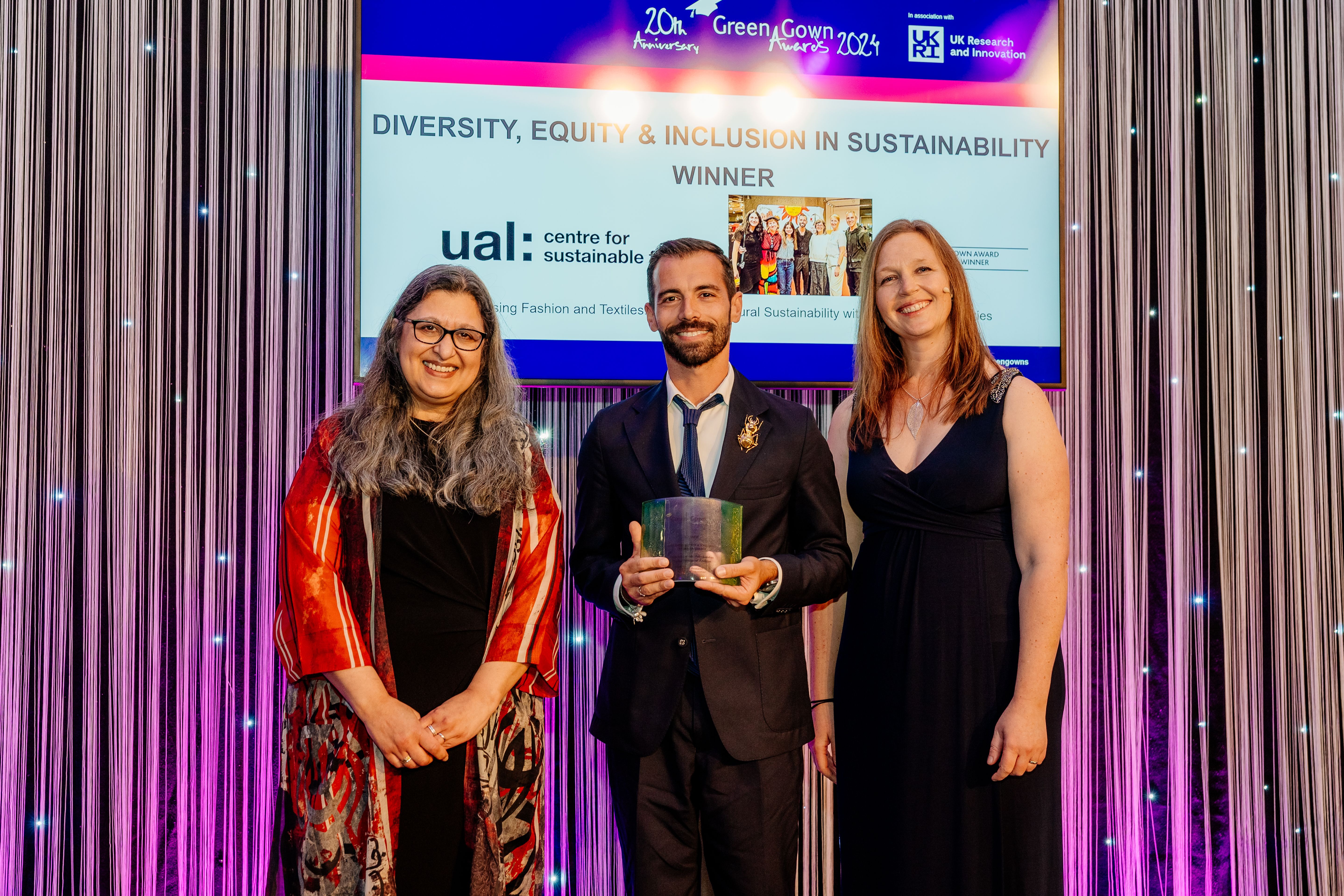
Centre For Sustainable Fashion won the Green Gown Award for exploring cultural sustainability last month. This award joins the long list of accolades that the Centre has received since its establishment in 2008.
‘Decolonising Fashion and Textiles’ is a participatory action-research project that explores cultural sustainability and community resilience through the lived experiences of refugees and asylum seekers in London.
The project, led by Principal Investigator Dr. Francesco Mazzarella, Co-Investigator Professor Lucy Orta, Post-Doctoral Research Fellow Dr. Seher Mirza, and Project Administrator Nicole Zisman, recently won the Green Gown Award for Diversity, Equity, and Inclusion in Sustainability at the UK and Ireland Green Gown Awards, in association with UK Research and Innovation (UKRI).
Established in 2004, these prestigious awards recognise exceptional sustainability initiatives undertaken by universities and colleges across the UK and Ireland.
Spanning categories such as sustainability reporting, impactful research, individual actions, and whole-organisation approaches, the awards shortlisted 133 projects from 83 institutions, culminating in 22 winners and 23 highly commended recognitions.
For Dr. Francesco Mazzarella, winning the award was empowering. “It made me feel fulfilled that all the efforts that went into the project were recognised and valued by such an important national award,” he comments.
"It makes me even more driven and passionate to continue to do this work and use fashion as a vehicle for social change," Dr. Mazzarella says, explaining why it was important for him to give voice and visibility to marginalised communities that are often not given space in these kinds of competitions.
He hopes that the award will attract more funding and support from the university for future projects, but most importantly, Dr. Mazzarella wishes it will inspire other designers, researchers, educators, and activists to start similar initiatives within their local communities.
The judges found this cultural sustainability initiative truly inspiring, praising the project for its powerful demonstration of genuine collaboration with local communities and marginalised groups. They also appreciated the innovative, engaging, and fun elements of the project, highlighting it as an excellent example of using creativity to foster engagement.
The participatory action-research project included ethnographic research, photovoice workshops, storytelling sessions, autobiographical textile crafting, a mapping workshop, participation in Refugee Week 2024, the creation of textile banners for a public action, and the organisation of roundtable discussions to recommend policy changes.
The creative outcomes of the project included 42 textile photo series, three fashion performances presented at the Victoria and Albert Museum, a collection of 21 artefacts co-created with participating refugees, and much more.
Two symposiums were also held at London College of Fashion and the Barbican Centre, along with publishing a policy paper outlining recommendations for addressing the barriers faced by UK-based refugees.
The Centre was also shortlisted as a finalist in the Next Generation Learning and Skills category for its education and knowledge exchange work in the Fashion Values Online Courses: Nature, Economy, Society, Cultures.
Both of the shortlisted projects are part of the Centre for Sustainable Fashion’s long-standing research, knowledge exchange, and educational work, aligned with the centre’s aim to build a transformed fashion system towards ecological, cultural, economic, and social sustainability.
When talking about hope for a sustainable future, Dr. Mazzarella instantly turns to the project participants. “I have witnessed lots of trauma and fear, but what has stayed with me the most is the lesson of community resilience and cultural sustainability,” he remembers. It was incredible to see the ways in which they had held onto their culture and values beyond material possessions.
The road ahead is wide and long, but Dr. Mazzarella remains hopeful for a better future. “Often the discourse of the climate emergency can be quite overwhelming and make people feel paralysed, but culture is a much more positive entry point,” he says.
Soon, Dr. Mazzarella will be launching a new elective unit for all MA courses focused on embracing fashion practices for social change. “I have good hopes for what I'm doing next, and I am very excited to work with more students and community members to together contribute to a more sustainable, compassionate, and equitable future,” he concludes.
- Learn more about Centre for Sustainable Fashion
- What’s on at LCF: Open days and events
- More LCF Stories