Postgraduate

MA Performance: Theatre Making

Start date:
September 2026
Application deadline:
Applications closed for 2026/27 entry
College:
Wimbledon College of Arts
Fees:
£14,420 (Home) £30,890 (International) Fee details
Course length:
12 months (full time)

MA Performance: Theatre Making at Wimbledon College of Arts invites you to re-imagine the possibilities of theatre and performance and expand the horizons of your practice.

Course summary

Applications closed 2026/2027

Applications are now closed for 2026/27 entry. Applications for 2027/28 entry will open in autumn 2026.

Course length change

This course is undergoing a process to make changes to the course structure and content. As part of these changes, the length of this course is changing from 15 months to 12 months for 2026/27 onwards. Please contact us if you have any questions about the course.

Course overview

MA Performance: Theatre Making will enable you to develop your creative and critical practice. It will encourage you to become a confident and articulate theatre maker and researcher.

Performance at Wimbledon is approached through questions of politics, ethics, aesthetics, and practice. The course asks you to examine them through practical investigation and experimentation in a studio context.

You will think critically about your theatre making, situating it in the context of contemporary performance and visual culture.

The course focuses on:

  • Theatre-making as an integrated, multi-disciplinary practice. Combining, for example, writing, design, scenography, performing and dramaturgy.
  • Developing innovative compositional strategies for performance-making as a studio-based, embodied, and material practice.
  • The creation of post-dramatic and politically engaged performance.

What to expect

  • Investigation: Explore the opportunities and challenges posed by the development of new theatre and performance practices, technologies, histories and critical and decolonial perspectives.
  • Learn new skills: Become familiar with theatrical and compositional practices and improve your performer skills. Ensemble theatre: You will develop skills in forming, supporting and sustaining ensemble practice.
  • Collaboration: Enhance your understanding of the collaborative nature of performance. This will enable you to build ideas, proposals, and events.
  • Research: You’ll produce a dissertation, as well as learn about creative research methods through practical workshops, lectures and seminars.
  • Project frameworks: You’ll be introduced to project conceptualisation, design and development.
  • Wider contexts: You’ll look at interdisciplinary practices. 
  • Audience relationships: You’ll consider engagement and interaction with individuals, communities and the public.
  • Potential opportunities: You’ll research the partnerships and collaborations needed to create effective interventions.
  • Final major project: You’ll develop a final project based on an area of personal research that will be presented as a performance or similar output.
  • Access to Wimbledon's shared workshops: View the Wimbledon facilities.

Industry experience and opportunities

There may also be opportunities to take part in international exchanges, including festivals, biennales and other MA exchanges. Your course leader can also offer advice on how to find internships and network with performance companies and other relevant partners.

Mode of study

MA Performance: Theatre Making is offered in full-time mode and runs for 45 weeks over 12 months. You will be expected to commit an average of 40 hours per week to your course, including teaching hours and independent study.

Contact us

Register your interest to receive information and updates about studying at UAL.

Register your interest

Contact us to make an enquiry.

Postgraduate advice sessions

Discuss your application, portfolio and course options.

Book a session

College Tours

Come and see our facilities and workshops.

Book a tour

Course units

Unit 1: Introduction to Performance: Theatre Making

This unit will introduce you to the critical and creative practices of performance research and theatre making. You'll look at interdisciplinary methods of artistic and political enquiry. This will help you gain a deeper understanding of contemporary theatre and performance as an expanded field of cultural and political practice.

Unit 2 - Developing practice

The unit will enhance the development of your creative research and compositional methods in collaborative performance-making.

Unit 3 - Research through practice

In this unit, you will develop your practice through a collaborative research project with other Wimbledon MA performance-based courses. Focusing on a specific area of interest, you will undertake a collaborative creative research project which could serve as a foundation for your practical and/or written work in Unit 4.

Unit 4: Performance Research

In the final unit, you’ll complete a collaborative, collective, or self-directed project drawing on the knowledge and skills developed throughout the course. You’ll examine a specific idea or theme through a critical lens, considering how climate, racial, and social justice issues may shape your personal performance practice.

Note: 120 Credits must be passed before the final unit is undertaken.

Learning and teaching methods

  • Ensemble projects and collaborative work with peers
  • Group and individual tutorials
  • Independent practice and self-directed learning
  • Introductions and inductions to university, college and course resources
  • Staff and student led seminars
  • Lectures and visiting speaker talks
  • Performance skills training
  • Performance studio practice
  • Practical performance projects and workshops
  • Performance analysis of live theatre and digital screenings
  • Studio, external venue and other visits
  • Supervised rehearsals

Assessment methods

  • Critical framework reviews 
  • Contextual ethics reviews 
  • Ensemble contribution and reflective analysis 
  • Essays 
  • Live presentations – performances, pitches, proposals
  • Project proposals, plans and reports 
  • Written and performed dissertations.

MA Performance: Theatre Making | Course Introduction

Student work

  • A woman giving a performance about being a waitress emerged from under a table with a knife
    Victoria Mazeris, 2023 MA Performance: Theatre Making, Wimbledon College of Arts, UAL | Photograph: Kristina Sarkisyan
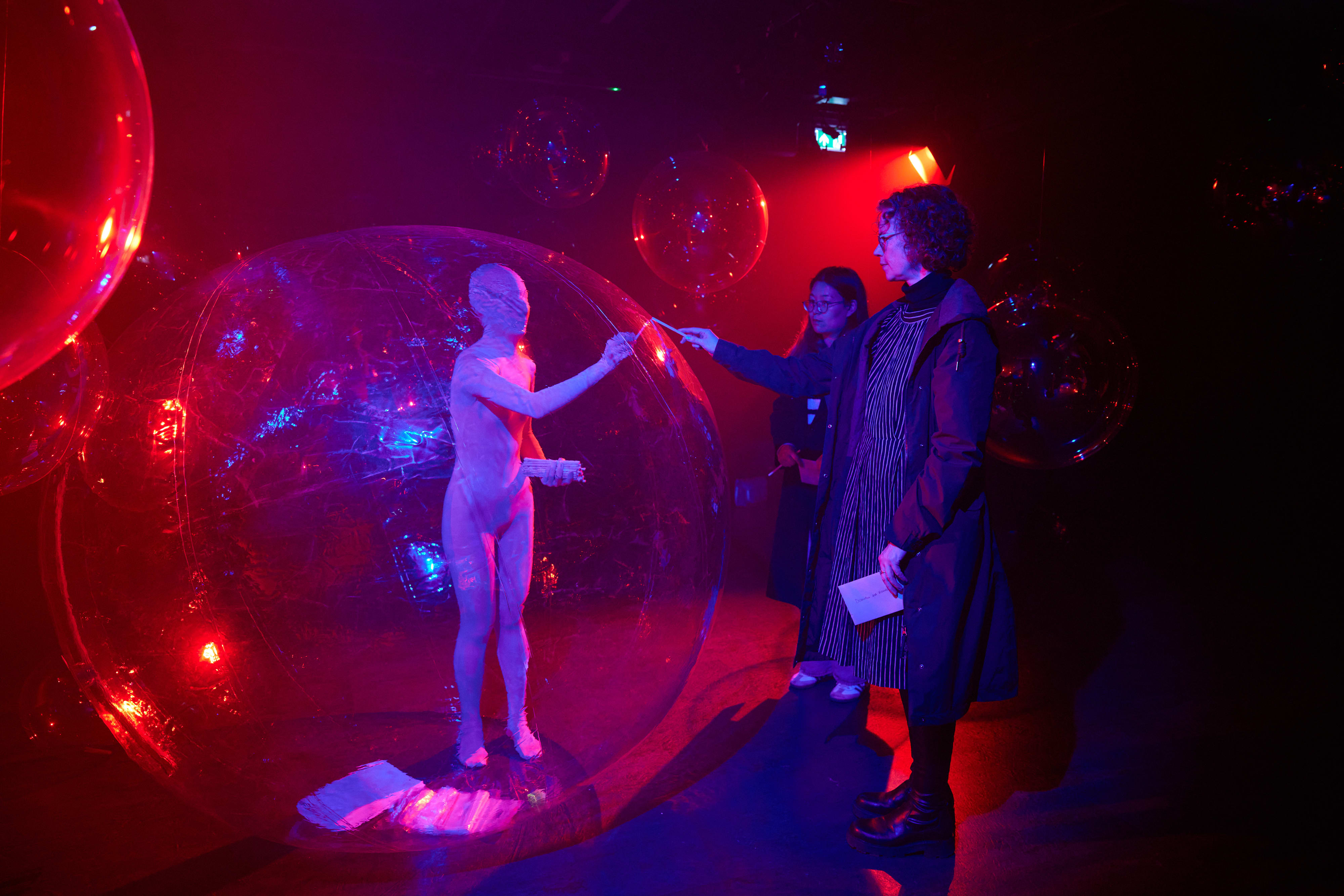
  • Colourful large bubbles with neon lighting. There is a person in a full body suit in side one of the bubbles interacting with people outside
    Xinran Meng, 2023 MA Performance: Theatre Making, Wimbledon College of Arts, UAL | Photograph: Kristina Sarkisyan
  • A girl looks shocked as she holds two styrofoam cups to her chest, she is performing ona set with orange and blue lighting
    'You're Away with the Fairies' by Holly O'Connor, 2024 MA Performance: Theatre Making, Wimbledon College of Arts, UAL | Photograph: Andrea Capello
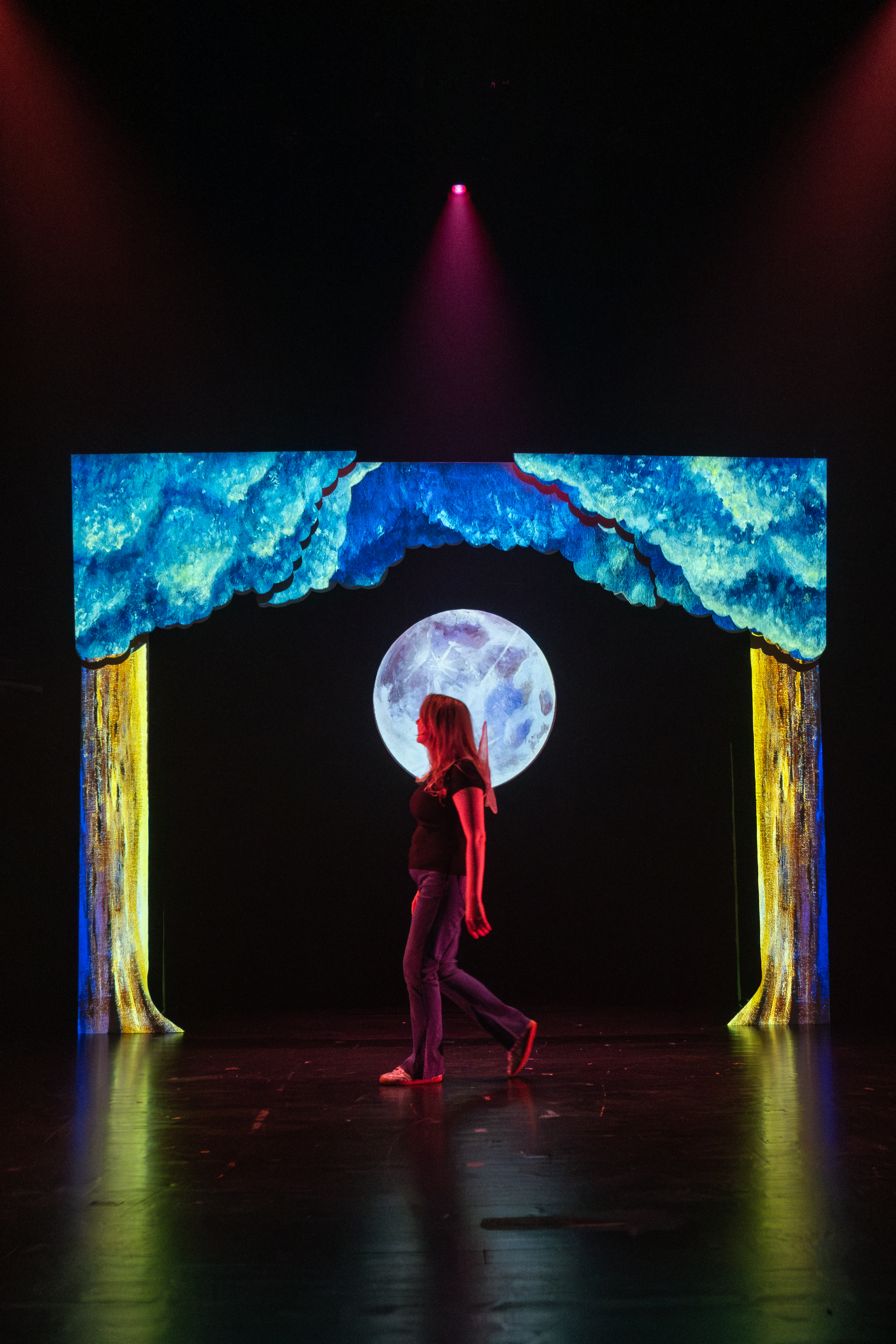
  • A girl walks in front of a set wearing wings, the set has a large moon and blue trees
    'Hope Away from Home' by Kai Zhao, 2024 MA Performance: Theatre Making, Wimbledon College of Arts, UAL | Photograph: Orlando Myxx

Staff

Fees and funding

Home fee

£14,420

This fee is correct for 2026/27 entry and is subject to change for 2027/28 entry.

Tuition fees may increase in future years for new and continuing students on courses lasting more than one year. For this course, you can pay tuition fees in instalments.

Students from countries outside of the UK will generally be charged international fees. The rules are complex so read more about tuition fees and determining your fee status.

International fee

£30,890

This fee is correct for 2026/27 entry and is subject to change for 2027/28 entry.

Tuition fees may increase in future years for new and continuing students on courses lasting more than one year. For this course, you can pay tuition fees in instalments.

Students from countries outside of the UK will generally be charged international fees. The rules are complex so read more about tuition fees and determining your fee status.

Additional costs

You may need to cover additional costs which are not included in your tuition fees, such as materials and equipment specific to your course. For a list of general digital equipment you may need (and how you can borrow equipment), visit our Study costs page.

Accommodation

Find out about accommodation options and how much they will cost, and other living expenses you’ll need to consider.

Scholarships, bursaries and awards

If you’ve completed a qualifying course at UAL, you may be eligible for a tuition fee discount on this course. Find out more about our Progression discount.

You can also find out more about the Postgraduate Masters Loan (Home students only) and scholarships for Home and International students. Discover more about student funding.

If you’re based in the UK and plan to visit UAL for an Open Event, check if you’re eligible for our UAL Travel Bursary. This covers the costs of mainland train or airline travel to visit UAL.

How to pay

Find out how you can pay your tuition fees.

Scholarship search

Entry requirements

The standard minimum entry requirements for this course are:

  • BA (Hons) degree in either theatre and performance or art and design - related disciplines, including social and other sciences or engineering
  • Alternative qualifications and experience will also be taken into consideration
  • Personal statement
  • Portfolio of work

Entry to this course will also be determined by the quality of your application, looking primarily at your portfolio of work and personal statement.

APEL - Accreditation of Prior (Experiential) Learning

Applicants who do not meet these course entry requirements may still be considered in exceptional cases. The course team will consider each application that demonstrates additional strengths and alternative evidence. This might, for example, be demonstrated by:

  • Related academic or work experience
  • The quality of the personal statement
  • A strong academic or other professional reference
  • A combination of these factors

Each application will be considered on its own merit but we cannot guarantee an offer in each case.

English language requirements

All classes are taught in English. If English isn't your first language you must provide evidence at enrolment of the following:

IELTS level 6.5 or above, with at least 5.5 in reading, writing, listening and speaking (please check our English language requirements)

Selection criteria

We look for:

  • Evidence of a clear commitment to approaching theatre-making as a mode of critical investigation and creative experiment, demonstrating the ability to communicate ideas in performance forms and in writing
  • Evidence of an ability to work in an ensemble and to develop collaborative practices, demonstrating respect for other people’s ideas, personhood and cultural identity
  • Evidence of creative problem solving and sustained critical thinking, and willingness to explore new performance forms and innovative theatre practices
  • Evidence of an ability to conduct performance research through critical and creative practice

Information for disabled applicants

UAL is committed to achieving inclusion and equality for disabled students. This includes students who have:

     
  • Dyslexia or another Specific Learning Difference
  • A sensory impairment
  • A physical impairment
  • A long-term health or mental health condition
  • Autism
  • Another long-term condition which has an impact on your day-to-day life

Our Disability Service arranges adjustments and support for disabled applicants and students.

Read our Disability and dyslexia: applying for a course and joining UAL information.

How to apply

Follow this step-by-step guide to apply for this course

Step 1: Initial application

For a general guide to applying to our courses, read our postgraduate application advice.

You will need to submit an initial application including your personal statement and CV.

Personal statement advice

Your personal statement should be maximum 500 words and include:

  • your reasons for choosing the course
  • your current creative practice and how this course will help you achieve your future plans
  • any relevant education and experience, especially if you do not have any formal academic qualifications.

CV advice

Please provide a CV detailing your education, qualifications and any relevant work or voluntary experience. If you have any web projects or other media that you would like to share, please include links in your CV. If English is not your first language, please also include your most recent English language test score.

Step 2: Video task and digital portfolio

We will review your initial application. If you have met the standard entry requirements, we will ask you to submit a video task and digital portfolio.

You’ll need to submit these via PebblePad, our online portfolio tool. Please submit your video task on the first page followed by your portfolio.

Video task advice

We’d like you to submit a 2-3 minute video to help us learn more about you. When recording your task, please face the camera and speak in English.

What to include in your video task
  • Talk about a performance you have been involved in making, indicating the role, title of the work and the context it was shown in.

Find advice on how to plan and film your video task. Then read our guidance on how to submit your video task, including the file types we accept.

Digital portfolio advice

Your portfolio should consist of recent work that reflects your creative strengths.

It should:

  • A maximum of 30 pages, including your video task
  • include written reflections and images indicating your role and crediting the work, include titles and context of where it was shown
  • include critical review(s) of performances that you have found instructive, insightful and illuminating. Explain how they helped you improve your practice
  • include pages and images from performance-making journals, sketchbooks and notebooks
  • demonstrate your ability to work collaboratively.

For more support, see our Portfolio advice and PebblePad advice.

Step 3: Interview

You may be invited to an interview following our review of your application. All interviews are held online and last 15 to 20 minutes.

For top tips, see our Interview advice.

Final step: After you apply

Find out how we'll communicate with you and see what happens after you apply.

Apply now

Application deadline

Applications are now closed for 2026/27 entry. Applications for 2027/28 entry will open in autumn 2026.

Read more about deadlines

Apply now

Application deadline

Applications are now closed for 2026/27 entry. Applications for 2027/28 entry will open in autumn 2026.

Read more about deadlines

Careers