Postgraduate

MA Fashion Storytelling: Fashion Cultures and Histories

Model in colourful pink Asian dress at sunset.
Katharine Nixon | London College of Fashion | UAL
College
London College of Fashion
Start date
September 2027
Course length
12 months

Take an interdisciplinary approach to the analysis of fashion as a key marker of social and cultural change, and a means of understanding the relationship between individuals and communities.

Course summary

Applications closed 2026/2027

Applications are now closed for 2026/27 entry. Applications for 2027/28 entry will open in autumn 2026.

How your information will be used

By submitting an application, you consent to your personal details and application materials being shared with the Victoria and Albert Museum (V&A) for the purposes of application review, selection, and related administrative processes.

Why choose this course at London College of Fashion

  • Theoretical analysis: Build your writing, research and analytical skills as you develop an understanding of the relationship between individuals and communities, creating compelling narratives about fashion for a range of audiences.
  • Focus on research: Develop a suite of specialised skills, competencies and knowledge to generate independent and original research across academic and industry contexts.
  • Social transformation: Equip yourself with the knowledge and skills to become a socially connected, ethical, and globally oriented fashion citizen who can activate change in creative and critical ways.
  • Collaborative learning: Work with your peers and external partners in order to respond to live briefs and critical debates, developing your teamwork skills.
  • Enquiry based: Ask questions and investigate your individual areas of interest, care, concern and passion, allowing you to shape the focus of your learning.

MA Fashion Storytelling

MA Fashion Storytelling is an exciting collaboration between London College of Fashion and the V&A. It offers 2 pathways: Fashion Curation and Fashion Cultures and Histories.

Open Days

To visit us in person, book a Campus Tour.

Scholarships, bursaries and awards

Use our scholarship search to discover if you are eligible for any scholarships, bursaries or awards.

Course overview

MA Fashion Storytelling, a new collaboration between London College of Fashion and the V&A, brings together two world-leading institutions for the research, study and curation of fashion. 

Through specialist teaching and sustained access to the V&A’s collections, this course will provide an intellectual framework to consider the active role played by museum professionals, researchers and audiences in the shaping of fashion narratives, and the centrality of storytelling to cultures of fashion and dress. 

The course has two pathways: Fashion Cultures and Histories will equip you with high-level theoretical analysis and research skills for a diverse range of professional and academic contexts. Fashion Curation will provide you with the practical skills and knowledge to thrive as a curator and cultural producer within the museum, cultural and commercial sectors. 

Fashion Cultures and Histories Pathway

MA Fashion Storytelling: Fashion Cultures and Histories takes an interdisciplinary approach to the theoretical analysis of fashion as a key marker of social and cultural change, and a means of understanding the relationship between individuals and communities. On this course, you will develop high level writing, research and analytical skills, preparing you to become an informed storyteller, critic and communicator, generating new knowledge about fashion in its multiple contexts and shaping the ways it is understood. 

A unique Master’s degree situated in a dedicated London fashion college, provides you with grounding in relevant, innovative and critical fashion histories and theories. The course is committed to embedding UAL’s Principles for Climate, Social and Racial Justice. Taught principally by London College of Fashion’s Cultural and Historical Studies Department alongside curators and researchers from the V&A, you will join a unique community of researchers at the forefront of fashion studies, using your knowledge to enact meaningful and transformative change.

This course responds to shifting dynamics within the fashion industry, and the increasing need for storytellers, critical thinkers and cultural leaders, who can activate fashion knowledge within the workplace. Through this course, you will learn vital leadership and research skills that will enable you to reflect and articulate fashion knowledge across cultural difference, within professional and academic contexts. You will actively generate new thinking about fashion and help to shape the ways in which it is understood, presented and evaluated. 

In providing the tools for constructing compelling narratives about fashion for specialist and general audiences, the course prepares you for future-facing careers in research, publishing, education, museums, think tanks, institutes, within the fashion and culture industries, or to undertake further study in a fashion-related subject. 

What to expect

  • Theoretical analysis: Build your writing, research and analytical skills as you develop an understanding of the relationship between individuals and communities, creating compelling stories and narratives about fashion for a range of audiences.
  • Focus on research: Develop a suite of specialised skills, competencies and knowledge to generate independent and original research across academic and industry contexts.
  • Social transformation: Equip yourself with the knowledge and skills to become a socially connected, ethical, and globally oriented fashion citizen who can activate change in creative and critical ways.
  • Collaborative learning: Work with your peers and external partners in order to respond to live briefs and critical debates, developing your teamwork skills.
  • Enquiry based: Ask questions and investigate your individual areas of interest, care, concern and passion, allowing you to shape the focus of your learning.

Industry experience and opportunities

MA Fashion Storytelling: Fashion Cultures and Histories is embedded within the research culture of the LCF Cultural and Historical Studies Department. On this course, you will become part of an international network of emerging and established fashion researchers, and you will engage in unique collaborations and joint symposia.

Mode of study

MA Fashion Storytelling is offered in full-time mode and runs for 45 weeks over 12 months. You will be expected to commit an average of 40 hours per week to your course, including teaching hours and independent study. 

Course units

Stage 1

Theoretical Approaches (20 Credits)

This unit explores theories and concepts vital to the study of fashion. Drawing from the fields of cultural studies, sociology, gender studies, philosophy, anthropology, economics, politics and art history, it will set out key theorisations of fashion, assembling a clear engagement with contemporary research. Through group discussion, you will place theory in tension with practice, in order to locate concepts within a critical context and evaluate their usefulness for various approaches to researching fashion. This unit will support you in developing your own analysis of fashion and dress cultures.  

Research in Practice (20 Credits)

This unit focuses on the responsible and ethical implications of carrying out fashion research, engaging with individuals and communities. It provides you with an opportunity to work collaboratively with your peers alongside, industry and cultural partners to generate research for professional contexts in fashion. You will employ a range of research methods to develop an original response to a project brief. Addressing contemporary debates and concerns within the field of fashion you will put research in practice and in action.

Fashion Narratives: Histories (20 Credits)

This unit provides you with an in-depth exploration of contemporary and historical fashion cultures, examining how they inform and shape each other. Delivered by experts from LCF and the V&A, this unit offers a rigorous grounding in global histories of fashion, attending to diverse cultural narratives and addressing issues of Western dominance. You will develop a critical historiography to evaluate key disciplinary themes that typify the evolving relationship between fashion, dress and history. This unit runs across both the Fashion Curation and Fashion Cultures and Histories pathways, cultivating a shared research culture across the course. 

Stage 2

Fashion Narratives: Dialogues (20 Credits)

Building on your exploration of fashion histories, this unit engages with emerging and established scholarship from a range of disciplines to explore storytelling in fashion in its multiple iterations. You will consider the centrality of stories to cultures of fashion and dress, and you will evaluate how cultural narratives shape our understanding of individual and collective identities. This unit will help you develop a sound understanding of how the narratives we tell shape human society and culture, both forming and informing our understanding of historical knowledge. This unit runs across both the Fashion Curation and Fashion Cultures and Histories pathways, cultivating a shared research culture across the course.

PG Elective Units (20 Credits)

(see Elective Units Handbook)

Research Proposal (20 Credits)

In preparation for your final Masters Project this unit provides an introduction to, and an overview of, different qualitative research methods appropriate to Fashion Histories, Cultures and Fashion Studies. In development of your own Research Proposal, you will consider primary and secondary sources, ways of developing and originating research, and formulation of research questions, and identification of appropriate methods for your project. In review of existing research and literature you will begin to produce a body of work and study that will contribute to your final Masters Project.

Masters Project (60 Credits)

The Masters Project is the final stage of your Masters course. It is the culmination of your studies and provides you with a space to synthesise all of the knowledge and skills you have gained on the course so far. Your project will be self-directed and you will negotiate the shape and direction of your project at the outset with your supervisor. This important final phase of your studies is where you will effectively communicate your work along with your ability to critically interrogate your practice with robust approaches to research and theoretical analysis. Upon completion of your project, you will have generated a high-level Masters quality piece of work that will showcase your practice, academic literacy and the professional standards that will act as a platform for your future career and professional development.

Learning and teaching methods

Alongside more traditional methods, such as lectures, seminars, workshops, field trips, and group and individual tutorials, the course cultivates the following set of teaching and learning strategies. 

  • Enquiry-based learning: You will be supported to develop your own critical enquiry through provocations, methodologies and collaborations with external sites for research.  
  • Collaboration: You will work collaboratively with each other, and with external cultural and academic partners, producing research projects and participating in research seminars and symposia. 
  • Knowledge Exchange: A central component to this course is its participation in urgent debates and discussions that frame and inform both the fashion industry and the field of fashion studies. You will learn how to frame and communicate research for academic and professional contexts. 
  • Peer-to-Peer Learning and Feedback: You will develop the skills of offering collegial and constructive criticism of each other’s ideas.  
  • Expert Talks: V&A curators and researchers, and leading scholars from across UAL and other Universities, are regularly invited to share their expertise with you in an array of forms, including guest lectures, panels and workshops. 

Assessment methods

Students on this course will produce: 

  • Written, researched essays.
  • Written reviews.
  • Group presentations and collaborative projects. 
  • Critical, researched outcomes.
  • Written, researched dissertation.

Facilities at LCF

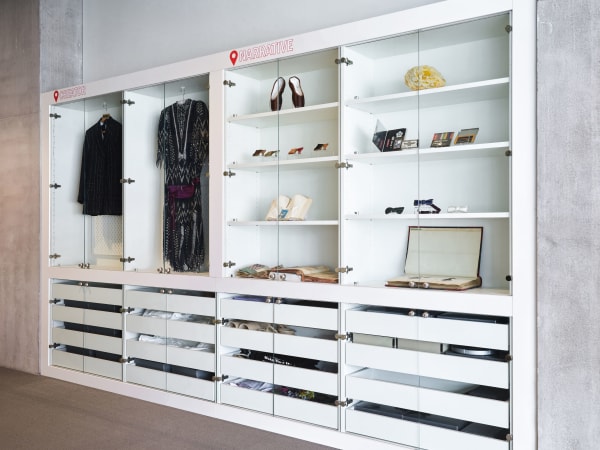
  • White shelves with various objects on, such as a dress, shoes, books and other garments.
    LCF Archives at East Bank. Photography by Nian Xu.

    General facilities

    At LCF's East Bank campus, students have access to facilities including the library, Materials Collection and Archives.

Staff

Fees and funding

Home fee

£14,420

This fee is correct for 2026/27 entry and is subject to change for 2027/28 entry.

Tuition fees may increase in future years for new and continuing students on courses lasting more than one year. For this course, you can pay tuition fees in instalments.

Students from countries outside of the UK will generally be charged international fees. The rules are complex so read more about tuition fees and determining your fee status.

International fee

£30,890

This fee is correct for 2026/27 entry and is subject to change for 2027/28 entry.

Tuition fees may increase in future years for new and continuing students on courses lasting more than one year. For this course, you can pay tuition fees in instalments.

Students from countries outside of the UK will generally be charged international fees. The rules are complex so read more about tuition fees and determining your fee status.

Additional costs

You may need to cover additional costs which are not included in your tuition fees, such as materials and equipment specific to your course. For a list of general digital equipment you may need (and how you can borrow equipment), visit our Study costs page.

Accommodation

Find out about accommodation options and how much they will cost, and other living expenses you’ll need to consider.

Scholarships, bursaries and awards

If you’ve completed a qualifying course at UAL, you may be eligible for a tuition fee discount on this course. Find out more about our Progression discount.

You can also find out more about the Postgraduate Masters Loan (Home students only) and scholarships for Home and International students. Discover more about student funding.

If you’re based in the UK and plan to visit UAL for an Open Event, check if you’re eligible for our UAL Travel Bursary. This covers the costs of mainland train or airline travel to visit UAL.

How to pay

Find out how you can pay your tuition fees.

Scholarship search

Entry requirements

The standard entry requirements for this course are as follows: 

  • An Honours degree at 2.1 or above in a related discipline. Applicants with a degree in another subject may be considered, depending on the strength of the application 
  • OR Equivalent qualifications 

1. APEL (Accreditation of Prior (Experiential) Learning) 

Applicants who do not meet these course entry requirements may still be considered in exceptional cases. The course team will consider each application that demonstrates additional strengths and alternative evidence. This might, for example, be demonstrated by: 

  • Related academic or work experience (minimum of three years) 
  • The quality of the personal statement 
  • A strong academic or other professional reference 
  • OR a combination of these factors 

Each application will be considered on its own merit but we cannot guarantee an offer in each case. 

2. English Language Requirements 

IELTS level 7.0 with a minimum of 6.0 in reading, writing, listening and speaking. Please check our main English Language Requirements.

Selection criteria

The course seeks to recruit students from diverse socio-economic and cultural backgrounds, and welcomes applications from mature students. The procedures fully comply with the Equal opportunities Policy of UAL and all interviewers have undertaken Fairness in Selection training.

The course seeks to recruit students who demonstrate some of the following:

  • a clear academic interest in the study and/or curation of fashion through a multidisciplinary approach
  • evidence of cultural awareness and engagement with social and historical debate
  • relevant experience working in the fashion (or related) industries
  • a capacity for intellectual enquiry and reflective thought
  • a developed and mature attitude to independent study and intellectual growth

Information for disabled applicants

UAL is committed to achieving inclusion and equality for disabled students. This includes students who have:

     
  • Dyslexia or another Specific Learning Difference
  • A sensory impairment
  • A physical impairment
  • A long-term health or mental health condition
  • Autism
  • Another long-term condition which has an impact on your day-to-day life

Our Disability Service arranges adjustments and support for disabled applicants and students.

Read our Disability and dyslexia: applying for a course and joining UAL information.

Apply now

Application deadline

Applications are now closed for 2026/27 entry. Applications for 2027/28 entry will open in autumn 2026.

Read more about deadlines

Apply now

Application deadline

Applications are now closed for 2026/27 entry. Applications for 2027/28 entry will open in autumn 2026.

Read more about deadlines

How to apply

Follow this step-by-step guide to apply for this course

Step 1: Initial application

You will need to submit an initial application including your personal statement, CV and written task.

Personal statement advice

Your personal statement should be maximum 500 words and include:

  • your reasons for choosing the course
  • your current creative practice and how this course will help you achieve your future plans
  • any relevant education and experience, especially if you do not have any formal academic qualifications.

Visit our personal statement page for more advice.

CV advice

Please provide a CV detailing your education, qualifications and any relevant work or voluntary experience. If you have any web projects or other media that you would like to share, please include links in your CV. If English is not your first language, please also include your most recent English language test score.

Written task advice

‘Choose one key area of interest within the field of fashion culture and history and explain why you think it is important and interesting.

For example, you may want to talk about a particular garment or a style of dress, or a specific time and place applicable to global fashion histories. Or perhaps you might want to focus on a theme such as the relationship between clothes and memory, or the influence of digital culture on fashion media.’

Your written task must take the form of a 1,500–2,500 word essay. It must include a bibliography and equivalent standard academic referencing system. It can also include an appendix if necessary. The bibliography and appendices will not be included in the word count.

Step 2: Video task

We will review your initial application. If you have met the standard entry requirements, we will ask you to submit a video task.

You’ll need to submit this via PebblePad, our online portfolio tool.

Video task advice

We’d like you to submit a 2-3 minute video to help us learn more about you. When recording your task, please face the camera and speak in English.

What to include in your video task

  • Tell us why you have applied to study MA Fashion Cultures and Histories.
  • Explain what you hope to study on the course and how this will help you achieve your future career ambitions.

Read our guidance for how to submit your video task and which file types we accept.

Step 3: Interview

You may be invited to an interview following our review of your application. All interviews are held online and last 15 to 20 minutes.

For top tips, see our Interview advice.

You also need to know

Communicating with you

Once you have submitted your initial application, we will email you with your login details for our applicant portal.

Requests for supplementary documents like qualifications and English language tests will be made through the applicant portal. You can also use it to ask questions regarding your application. Visit our After you apply page for more information.

Applying to more than 1 course

You can apply for more than 1 postgraduate course at UAL but we recommend that you apply for a maximum of 3 courses.

As every course has its own entry and assessment requirements, we recommend tailoring each application to showcase how your experience, skills and interests match that course. Applying for many different courses may make it more difficult for you to show that you are suitable for each course in a competitive admissions process.

Only apply to the course(s) you are most interested in – applying for too wide a range of different courses may reduce your ability to clearly demonstrate your suitability for each. It’s better to make fewer bespoke applications than many generic ones. This will help you to stand out where we have high demand for places.

If you receive offers for multiple courses, you'll only be able to accept 1 offer. UAL doesn't accept repeat applications to the same course in the same academic year.

Visas and immigration history check

All non-UK nationals must complete an immigration history check. Your application may be considered by our course teams before this check takes place. If your course requires a portfolio and/or video task, we may request these before we identify any issues arising from your immigration history check. Sometimes your history may mean that we are not able to continue considering your application. Visit our Immigration and visas advice page for more information.

External student transfer policy

UAL accepts transfers from other institutions on a case-by-case basis. Read our Student transfer policy for more information.

Alternative offers

If we are unable to consider you for the course you have applied to but your application is really strong, we may make you an alternative offer on a different course or at a different UAL College. This happens when our admissions tutors have found another course that they believe would be a strong match for your skills and interests.

Deferring your place

We do not accept any deferral requests for our postgraduate courses. This means that you must apply in the year that you plan to start your course and you will not be able to defer your place to start at a later date.

Application deadlines

Most of our postgraduate courses have 2 rounds of deadlines: one in December and one in March.

As long as you apply ahead of each deadline we will consider your application alongside all the other applications in that round. We always make sure to hold enough places back for round 2 to make sure we can consider your application fairly, no matter which round you apply in.

If there are still places available after the second deadline, the course will remain open to applications until all places have been filled.

For our MBA courses, there is only 1 deadline. This is 31 July for international applicants and 31 August for UK applicants. This is to make sure you have enough time to apply for your visa if you are an international student.

For our January-start courses, the deadline is in October. If there are still places available after this deadline, the course will remain open to applications until all places have been filled.

Careers

All our postgraduate courses offer career development, so that you become a creative thinker, making effective contributions to your relevant sector of the fashion industry.

LCF offers students the opportunity to develop Personal and Professional Development (PPD) skills while studying through:

* Access to to speaker programmes and events featuring alumni and industry.

* Access to careers activities, such as CV clinics and one-to-one advice sessions.

* Access to a graduate careers service

* Access to a live jobsboard for all years.

* Advice on setting up your own brand or company.

Career paths

Masters graduates have an acknowledged advantage in the employment market, obtaining work in a wide range of vocational and academic fields related to fashion. Previous graduates have gone on to lecture in related fields in Europe and America, worked in fashion curation and archives, journalism, styling, retail consultancy, as well as to higher level research degrees (MPhil or PhD). Our graduates are working within the industry at institutions including Museum of London, the V&A, BBC, Parsons, Kerry Taylor Auctions and Garde Robe, as well as for commercial brands such as Net-a-Porter and Burberry.

Graduate Futures

Graduate Futures provides a comprehensive career management service supporting our students to become informed and self-reliant individuals able to plan and manage their own careers.

LCF alumni

Many of our alumni are now impressive, leading industry figures.