How LCF Alum Anushka Sanghvi is crafting the future of Indian Luxury
- Written byC. Prina
- Published date 08 July 2026
Share story
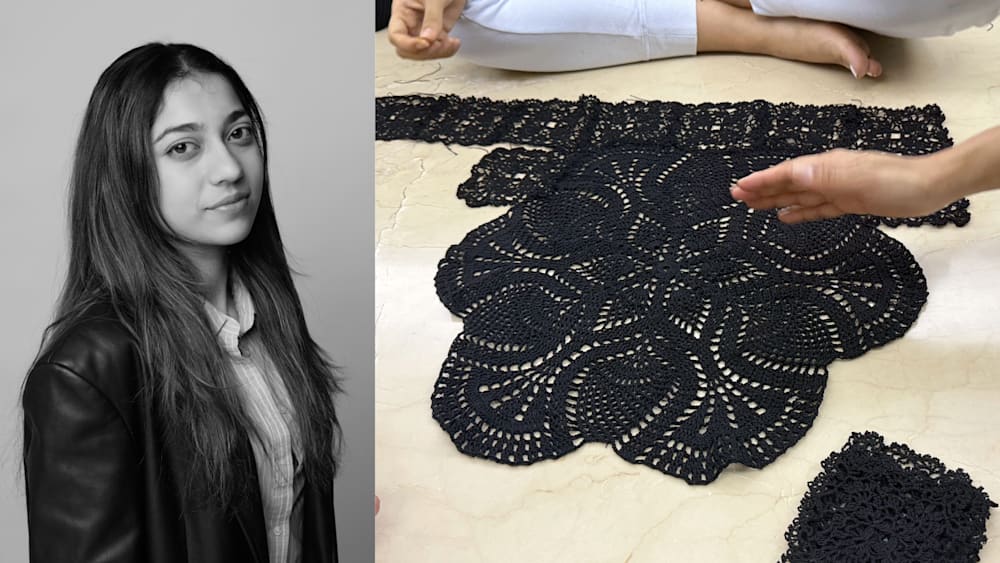
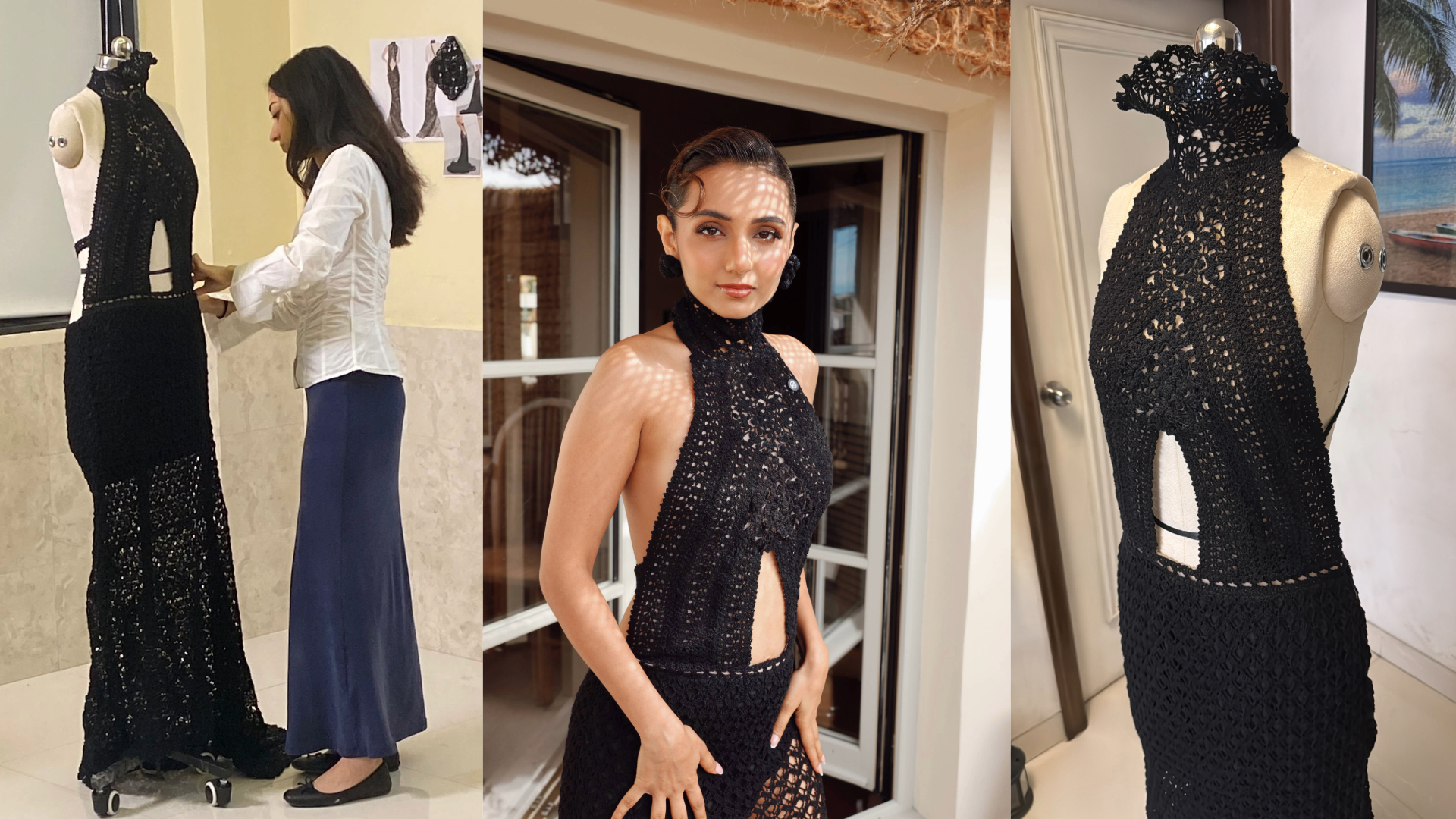
Rising Designer and London College of Fashion (LCF), UAL BA (Hons) Fashion Textiles: Knitwear alum Anushka Sanghvi was thrust into the spotlight at the 2026 Cannes Film Festival when entrepreneur and influencer Masoom Minawala wore her custom, hand-knitted crochet gown, showcasing her eponymous label on an international stage. We caught up with Anushka to discuss the creation of the piece, her fusion of modern knitwear and traditional Indian craft techniques, and how her LCF studies have shaped her creative identity.
Hi Anushka! Congrats on your success at the Cannes Film Festival. How did the collaboration with Masoom Minawala, come about?
Alongside my full-time role at Chanakya International and its in-house label Chorus, I was also working towards building the foundations of my own label. While I was gaining invaluable experience professionally, I always knew that establishing my own brand was the long-term goal. Outside of work, I spent evenings and weekends developing ideas, refining my creative direction, and connecting with people within the industry.
As part of that process, I reached out to a number of stylists, editors, and creatives whose work I admired. One of those conversations was with Dolla Baruah, Masoom Minawala's stylist, who responded positively to my work. Shortly afterwards, she approached me with the opportunity to create a custom crochet gown for Masoom to wear at the Cannes Film Festival.
The project came together within a month and involved extensive development, sampling, sourcing artisans, fittings, and a highly collaborative creative process with both Dolla and Masoom. Balancing the project alongside a full-time role made for a busy few weeks, but it was an opportunity I was excited to take on. Seeing the finished piece on the Cannes red carpet was incredibly rewarding, not only because of the scale of the platform, but because it marked an important milestone in the early stages of building my own brand.
What was the process of collaborating with women artisans in India to bring the piece to life?
Indian handcraft has always been central to my creative practice. While studying at London College of Fashion, I wrote my dissertation on the impact of industrialisation on Indian craftswomen within the context of cultural sustainability. Through that research, I became increasingly interested in how traditional crafts can provide both economic opportunities and creative agency for Indian craftswomen.
Crochet and knitting are skills that exist in countless Indian households, often passed down through generations from mothers and grandmothers. Yet they are rarely recognised within the wider luxury fashion conversation. Many of the artisans I work with today create from their homes, allowing them to earn an income while working within their personal circumstances and communities.
For the Cannes dress, collaboration was at the heart of the process. The piece was developed through continuous dialogue, sampling, and experimentation with artisans who brought extraordinary technical skill and craftsmanship to every stage of production. It is a privilege to work alongside these women and to create opportunities that help sustain and celebrate these traditions for future generations.
How are you positioning this traditional Indian craftsmanship within a global luxury market?
Indian craftsmanship is known to be celebrated internationally through embroidery techniques such as Aari and Zardozi, and during my time at Chanakya International I witnessed first-hand how highly these techniques are valued by luxury fashion houses around the world.
However, crochet and knitwear represent another area of exceptional craftsmanship that remains underexplored within the global luxury landscape. My goal is to elevate these techniques beyond their traditional associations and reimagine them through a contemporary lens. Knitwear is not traditionally associated with India due to the country's climate, yet the level of skill and craftsmanship that exists within these techniques is remarkable. By combining artisanal handwork with modern design, I hope to showcase the versatility and sophistication of these crafts to an international audience.
Tell us about your time at LCF. How did your studies help you to discover your own creative identity?
Studying Fashion Textiles: Knit at London College of Fashion was a transformative experience, both creatively and personally. Coming into the course, I had a limited understanding of the possibilities within knitwear. LCF opened my eyes to the technical and creative potential of the discipline and encouraged me to experiment, question conventions, and develop my own perspective.
Being surrounded by students from diverse cultures and creative backgrounds pushed me to think more critically about my work and where I wanted to position myself within the industry. It was also during my time at LCF that I began reflecting more deeply on my own heritage and how Indian craft traditions could be interpreted through a contemporary design language.
Most importantly, LCF gave me the confidence to trust my ideas. It provided the foundation that has enabled me to launch my own label and pursue the vision I had always imagined for myself.
What specific skills did you master at LCF that you still rely on today?
Beyond the technical aspects of knitwear and textile development, one of the most valuable things I learned at LCF was how to build a strong creative point of view. The course encouraged us to think critically, research deeply, and develop concepts that extended beyond aesthetics alone.
I learned how to translate research, cultural references, and individual experiences into a coherent design language, something I rely on constantly today as I build my brand. Whether I'm exploring Indian craftsmanship, heritage techniques, or ideas around femininity and identity, the ability to develop a narrative and communicate it through design stems directly from my time at LCF.
The course also taught me to question conventions, experiment, understand the importance of development, and approach design as an ongoing process of discovery. Those skills have become just as important as the technical knowledge itself, particularly when creating a brand with a clear perspective and long-term vision.
Where do you see your label heading next?
Right now, I'm focused on the launch of my debut collection and on building the foundations of the brand. A large part of my work involves exploring knitwear, crochet, and Indian craftsmanship in a contemporary way, while continuing to collaborate closely with artisans across India.
As I think about the future of the brand, I'm also interested in exploring how these crafts can be incorporated into a more ready-to-wear offering without losing the value of the handwork behind them. Finding ways to make artisanal techniques more accessible while preserving their integrity and craftsmanship is something I'm particularly excited about. For now, my focus is on creating meaningful work, refining my voice as a designer, and continuing to learn and grow with every project.
Finally, what piece of advice would you give to current LCF students looking to shape their own creative voices?
One of the things I valued most during my time at LCF was saying yes to opportunities beyond the classroom. I also spent time as a Student Ambassador, which gave me the chance to meet prospective students from around the world, work closely with different teams across the university, and develop confidence in communicating both my work and my ideas. Experiences like these can be just as valuable as the university projects themselves.
Take advantage of everything LCF has to offer, whether that's collaborating with other students, attending talks, entering competitions, or simply having conversations with people from different disciplines. The more perspectives you expose yourself to, the stronger and more authentic your own point of view becomes.
Most importantly, put your work out into the world. Opportunities often come from taking initiative and making connections. The collaboration that led to a dress on the Cannes red carpet for me began with a simple message. You never know where one conversation might lead.
- Find out more about BA (Hons) Fashion Textiles: Knitwear
- Connect with Graduate Futures
- Read more LCF Stories