Project timeline and budget
Funding period: February 2022 – January 2024
Value: £35,928
Co-funded by: Economic and Social Research Council
Project summary
The Digital Documentation of Materiality in Painting: The Case of Contemporary Korean and British Abstract Art.
The project investigated how cultural organisations can represent and disseminate paintings digitally whilst respecting their inherent qualities and ensuring they do not misrepresent artworks due to cultural insensitivities and biases inherent in digital visualisation.
The importance of the digital realm is not in question. However, when sharing and disseminating ;paintings several issues arise. This may be due to the material subtleties that act against simple photographic representation of such works. But it may also be because of a more fundamental imposition that has its roots in Western ocular-centrism and the primacy of the mind and the eye.
Photographic representations of artworks stress a disembodied visual reading as opposed to an embodied and material experience. Visual documentation is dependent on ambient lighting, which again introduces other cultural presuppositions and biases. Even when moving images are employed to represent paintings, the model used is the cinematic scanning shot and close-up and quite foreign to how we look at and experience paintings.
Project aims and approach
Aims
- Investigate the digital and cultural biases associated with digital documentation and dissemination of modern and contemporary paintings from the UK and South Korea.
- Compare the distinctive art historical contexts of UK and Korea, where experimental movements of painting, such as Op Art in UK and Dansaekhwa or monochrome painting in Korea, emerged as the predominant paradigms of art in the 1960s-'70s.
- Explore non-ocularcentric approaches to the interpretation of painting.
- Examine how to better digitally reproduce paintings, of which material impact, perceptual experience and formal components are hard to represent by digital media.
- Trial innovative approaches to reproduce paintings and build up a virtual environment that simulates the actual museum experience.
- Initiate a collaborative international partnership between: University of the Arts, London (UAL); POSTECH (Pohang University of Science and Technology), South Korea, Dankook University, South Korea, the National Museum of Modern and Contemporary Art, South Korea and the Korean Cultural Centre UK.
Approach
The project was underpinned by a cross-cultural interrogation of materiality. This established a comparative framework between UK and South Korean painting traditions. It prioritised the haptic, affective and material dimensions of painting. This ensured the 'human' sensory experience was preserved within virtual environments and that the digital platforms fulfilled their educational roles without compromising the work’s emotional and physical impact.
A series of workshops informed experimental technical trialing. The team collaborated with filmmakers and digital scientists to develop and test non-standard approaches to digital reproduction. These were designed to simulate the haptic perception and the formal and conceptual complexities of physical painting. The workshops facilitated a critical knowledge exchange between the fields of art history and digital imaging sciences.
The international network that was established acted as a springboard for iterative knowledge transfer.
Research outputs
Exhibition
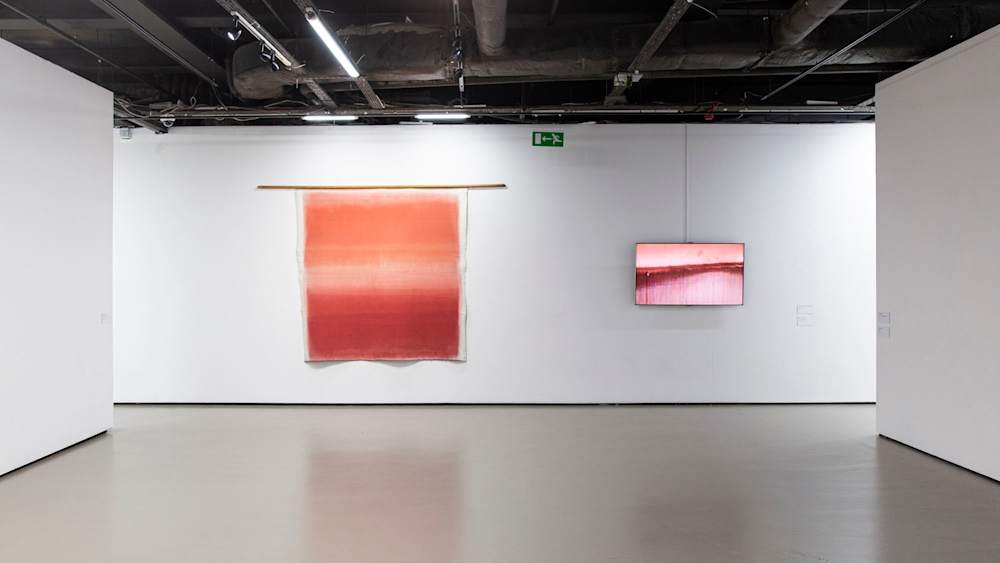
TRANSFER - Korean and British Abstract Painting and the Digital Document
Dates: 24 February 2023 – 14 April 2023
Location: Korean Cultural Centre, London
A workshop-style exhibition that explored the digital documentation of painting. It consisted of paintings juxtaposed with forms of digital documentation. Works from both the UK and South Korea made over the past 30 years were exhibited.
By contrasting paintings by artists from a European and an East Asian nation the goal was to foreground commonalties and differences, and to ask questions about cultural influence in relation to the norms of the digital documentation of painting in general.
Artists:
- Simon Eaves
- Sooyeon Hong
- Alan Johnston
- Michael Kidner
- Inyoung Kim
- Simon Morley
- Anna Mossman
- Rafaël
- Kim Taek Sang
- Daniel Sturgis
- Lee Ufan
Publication
Exhibition catalogue
Authors: Simon Morley, Daniel Sturgis, Jung-Ah Woo
Title: Transfer: Korean and British Abstract Painting and the Digital Document
Publisher: London: Korean Cultural Centre
UK ISBN: 978-1-3999-5914-8
Conference
Painting in the Age of Digital Reproduction
Date: 13 May 2023
Location: Art Sonje Theatre Centre, Seoul, South Korea
Participants:
- Juan Bolivar (UAL)
- Ji Hoon Gu (Changwon National University)
- Jan Um Kim (Art Sonje Centre)
- Minseo Kin (Kaist)
- Im Sue Lee (Hongik University)
- Simon Morely (Dankook University)
- Anna Mossman (UAL)
- Jaeyeon Park (Aju University)
- Jieun Rhee (Myongji University)
- Daniel Sturgis (UAL)
- Ana Teles (UAL)
- Jung-Ah Woo (Postech)
Journal articles
The Journal of Art Theory & Practice
- Minseo Kim, 'An Inquiry into the Advancement and Utility Value of Digital Art History', The Journal of Art Theory & Practice, 2023.
- Anna Mossman, 'Some Light in the Shadows: Touch, Time and Movement in Real and Digital Space', The Journal of Art Theory & Practice, 2023.
- Daniel Sturgis, 'Flat Paintings and Intimate Screens, The Journal of Art Theory & Practice', 2023.
- Ana Teles, 'Painted Copies, Digital Reproductions and Originals: A Case Study of Copying Frank Bowling’s Lent', The Journal of Art Theory & Practice, 2023.
Journal of the Association of Western Art History
- Juan Bolivar, 'How to Look: Ad Reinhardt's Black Paintings', Journal of the Association of Western Art History, vol 60, 2024.
- Lee H, 'Open Circuit and Open Mind: Art for Cybernated Life or Humanized Art', Journal of the Association of Western Art History, vol 60, 2024.
- Lee I, 'Pictorial Discourse and Image-Generative AI: VAE, GAN, Diffusion Models and the Artistic Regime of Painting', Journal of the Association of Western Art History, vol 60, 2024.
- Simon Morely, 'Reflections on a digital photograph of a painting by Lee Ufan', Journal of the Association of Western Art History, vol 59, 2023.
Impact
Innovative curation
Through the exhibition TRANSFER, the project proposed an innovative way for museums, galleries and artists to reproduce or translate paintings to the digital environment, whilst respecting their materiality and recognising the bias in visual translation.
In defense of human agency
The symposium Painting in the Age of Digital Reproduction (2023) established core questions around painting, materiality and digital reproduction. Since the project’s inception, the discourse surrounding materiality has gained significant cultural and ethical urgency.
In the context of burgeoning anxieties regarding the 'anti-human' trajectories of painting and Artificial Intelligence (AI), our research into painting as a material practice has transitioned from a specific aesthetic inquiry into a defense of human agency.
UAL research environment
The project has further catalysed a vibrant, outward-facing research culture in Painting at UAL and centered at Camberwell College of Arts, specifically by synthesising the materiality of the medium with cross-disciplinary discourses.
This culture is institutionally formalised through the UAL Research in Painting Network, which serves as a hub for these expanded dialogues.
Research findings were disseminated to the BA and MA Fine Art curricula.
For participants
Conceptual impact
The project challenged and reshaped participants' understanding of materiality in the digital age.
Professional development
Enhanced the research capacity and profile of early-career researchers and practitioners.
Network building
Facilitated new international collaborations and cross-disciplinary partnerships that did not exist previously.
Project team
- Project investigator: Professor Daniel Sturgis, Professor in Painting, UAL
- Lead International Co-Investigator: Professor Jung-Ah Woo, Associate Professor in the Division of Humanities and Social Sciences, POSTECH (Pohang University of Science and Technology), South Korea
- Additional International Co-Investigator: Professor Simon Morley, Associate Professor in Fine Art at Dankook University, South Korea
Partners
- POSTECH (Pohang University of Science and Technology), South Korea
- Dankook University, South Korea
- National Museum of Modern and Contemporary Art, South Korea
- Association of Western Art History, South Korea
- Korean Cultural Centre, UK