The Afterlife of Art: Campus Exchange in Berlin

- Written byStudent Communications
- Published date 06 October 2025
This year’s Shared Campus summer schools gave UAL students the opportunity to travel to Athens and/or Berlin and participate in themed programmes, “Extractive Realities and Ecological Resonances” (Athens) and “The Afterlife of Art in the Age of International Art Biennales” (Berlin).
We caught up with Erika Tan, Course Leader MAFA and Co-Leader of Berlin’s summer school along with 2nd year MA Fine Art, CSM students Evie Torkington and Marina Trani on their recent trip to Berlin.
How would you describe Shared Campus and why was it important for UAL students to take part?
Erika: Shared Campus is a fantastic opportunity to meet with students from other disciplines, across different art schools in Asia, Europe and the UK. The combination of exchange, collaboration and contextual engagement in the summer schools creates an exciting diverse and dynamic group to share experiences and discussions.
Whilst English still dominates as the main language of communication, the reference points culturally, historically, politically and in relation to bodies of art historical knowledge and art ecologies is refreshingly broad.
In your own words, what was the main aim for this summer school?
Erika: The summer school was organised to use the Berlin Biennale as a reference point to the way in which art, politics, cultural and historical events find themselves in constant dialogue. The Biennale theme of ‘fugitivity’ and a focus on the human and more then human interactions and mutual existences gave us a good starting point to imagine the idea of an expanded school or field as the site of this year's summer school.
The ambitions were that we might find for ourselves, students and staff, new ways of coming together across various spaces to engage in reflexive research, conversations and encounters.
How did the location shape the experience and learning outcomes?
Erika: Berlin was a central figure – being both location and subject. Much of the cultural activities in Berlin and steeped with the history of Berlin’s ‘past’. This legacy provides an extremely rich, complex and not always comfortable socio-political cultural site within which we were located.
Why do you think it’s important for UAL students to engage in international, collaborative projects like this?
Marina: Certain issues are viewed and felt differently internationally and it is important to be exposed to a broader set of views and emotions, allowing for a more confident and considered position on these issues.
The group of students spanned nationalities, age groups and disciplines and it was enriching to see how different students gravitated to different interest areas and were affected in a different way by the stimuli provided during the summer school.
Evie: I think that in my experience, UAL and certainly the MA Fine Art Course at CSM encourage students to think about accessible and subversive ways of showing and engaging with art. I think it’s really important to have the opportunity to see that happening in different geographical contexts.
It has really expanded my thinking around how I can create and disseminate art and also how I can financially sustain a practice. Working collaboratively with students from different courses, universities and contexts exposes you to different lived experiences and ways of thinking which force you to both question why you think the way you do and critically engage with viewpoints you may not have encountered previously.
I think having opportunities to engage with people, places and artwork outside of the institution are crucial for developing a robust practice and creative network.
What were some of the most inspiring responses or projects developed by students?
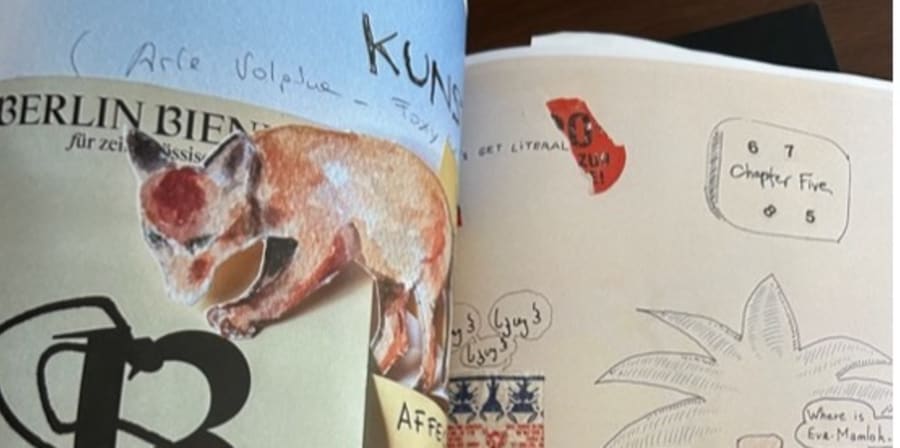
Erika: Students were given an A4 sketch book to journal their movements and experiences. At the end of the 2 weeks, a sharing session took place in the form of verbal presentations, passing round material to look at, performances and instructions. This was then collated and produced as a zine to share with each participant and the people we had met such as curators, artists, gallerist over the two weeks.
Did you notice any shifts in students’ perspectives or confidence over the course of the programme?
Erika: 2 weeks went by in a flash. Students were getting used to a new city, each other, sharing space in dorms and intel on Berlin. The summer school’s focus on fugitivity and movement meant at times there was indeterminacy and openness built into the modes of curated encounters. Students were expected to also do the work and recognise that although there was design in the choice of venues and people they were programmed to meet, some of the sessions necessitated student input to drive the focus of the questions.
Over the course of the 2 weeks, students could be seen to be more personally directed and confident in also identifying what threads of connections they found useful or interesting. The sharing session at the end was wonderful in terms of its range of responses and how people had picked up on various locations and encounters and taken these forward to engage with further.
Evie: Yes, I felt that as time went on and I had a richer understanding of the context of Berlin as both a city and a site for artwork and I engaged with more artists, students and locals, I felt much more confident in my ability to contribute to the discussion, capture invaluable insights, navigate the city and develop my own understanding and responses to the work we saw. I was certainly forced out of my comfort zone, but that was absolutely worth it.
Marina: My understanding of Berlin's complex history and contemporary challenges improved dramatically during the two weeks. I became more able to read some of the difficult dynamics being processed by the art community in Berlin today. While one could think that certain issues such, as the reduction of funding for the arts, an indiscriminate and often destructive gentrification process or the occurrence of horrific genocides around the world, I would offer that these were even more strongly felt in Berlin because of its very complex historical make up.
Could you share a memorable moment or highlight from the programme?
Erika: Towards the end of the summer school, no one had encountered one of these famous foxes that both the biennale referenced and that have become quite famous and specific to Berlin. Having bemoaned that the only foxes we had encountered were ourselves in fox masks, we then suddenly found that collectively the group started seeing foxes everywhere!
Evie: Whilst it is hard to choose just one moment in an extremely busy and exciting couple of weeks, I would have to say hearing from Zasha Colah about the curation of the Berlin Biennale. Not only did this contextualise the show we were there to see, but Zasha spoke candidly, passionately and put forth a concrete rationale for the show and its curatorial decisions. She was the only speaker to consistently reference and acknowledge the holistic political state of our world, ongoing genocides, xenophobia and other urgent problems and violence we are facing globally. Zasha’s conviction was inspiring and her curatorial approach was rigorous in representing global talents, whilst acknowledging that we share the responsibility to document, protest and resist.
Marina: There were many significant moments, the discussions about the Biennale with Zasha Colah and about Arts of the Working-Class Publications with Maria Ines Plaza Lazo were hugely informative and inspiring. Furthermore, there was a moment, when we stood outside the American Library, with Alexandra Weltz-Rombach, when she offered some valuable perspective on the local population mindset and culture right after the end of Second World War. The role of cultural interventions and art in repairing, healing and helping to redefine the future became very clear to me, clearer than ever before.
If you could summarise what participants gained in 3 words, what would they be?
Erika: Fugitivity / Foxes / Berlin!
Marina: Knowledge / Inspiration / Foxiness!
Evie: Open-mindedness / Inspiration /Context!
For more information or to register your interest, please visit the UAL Shared Campus Webpage.