Discover: INOASIS
- Written byGiada Maestra
- Published date 08 January 2026
Share story
We spoke with Star Su (MA Interior and Spatial Design, Camberwell College of Arts, 2021) and her business partner, artist Alex Long Yuan (MA Fine Art, Chelsea College of Arts, 2021), about their project INOASIS.
The project was awarded second prize in the Google Gemma 3 Artificial Intelligence Competition for its evidence-based design solutions addressing mental wellness through spatial experience.
Hi Star, tell us more about yourself and your background.
I studied Traditional Chinese Garden design, then came to the University of the Arts London (UAL) for an MA in Interior and Spatial Design at Camberwell College of Arts. That experience deepened my focus on the narrative of space.
What do you most enjoy remembering about your time at UAL?
Having time to step away from day-to-day realities and explore ideas freely. Those experiments later fed back into my work, pushing me to think beyond the obvious. It was also a great period to try things with friends, trust the process, and let passion lead.
How did the MA Interior and Spatial Design course shape or change your practice?
It sharpened my design thinking—asking what, why, who, and how. Interior design involves extensive behind-the-scenes work: generating an idea is one part; communicating, coordinating and realising it is the challenge. The course encouraged innovation but also taught me to be proactive in articulating new ideas and securing resources. Live projects built my confidence in networking and cross-disciplinary collaboration.
Did you already have a project in mind when starting your MA?
Yes. I wanted to create spaces that evoke emotional experiences, and I explored this in film and set design. I had a clear sequence in mind from the start.
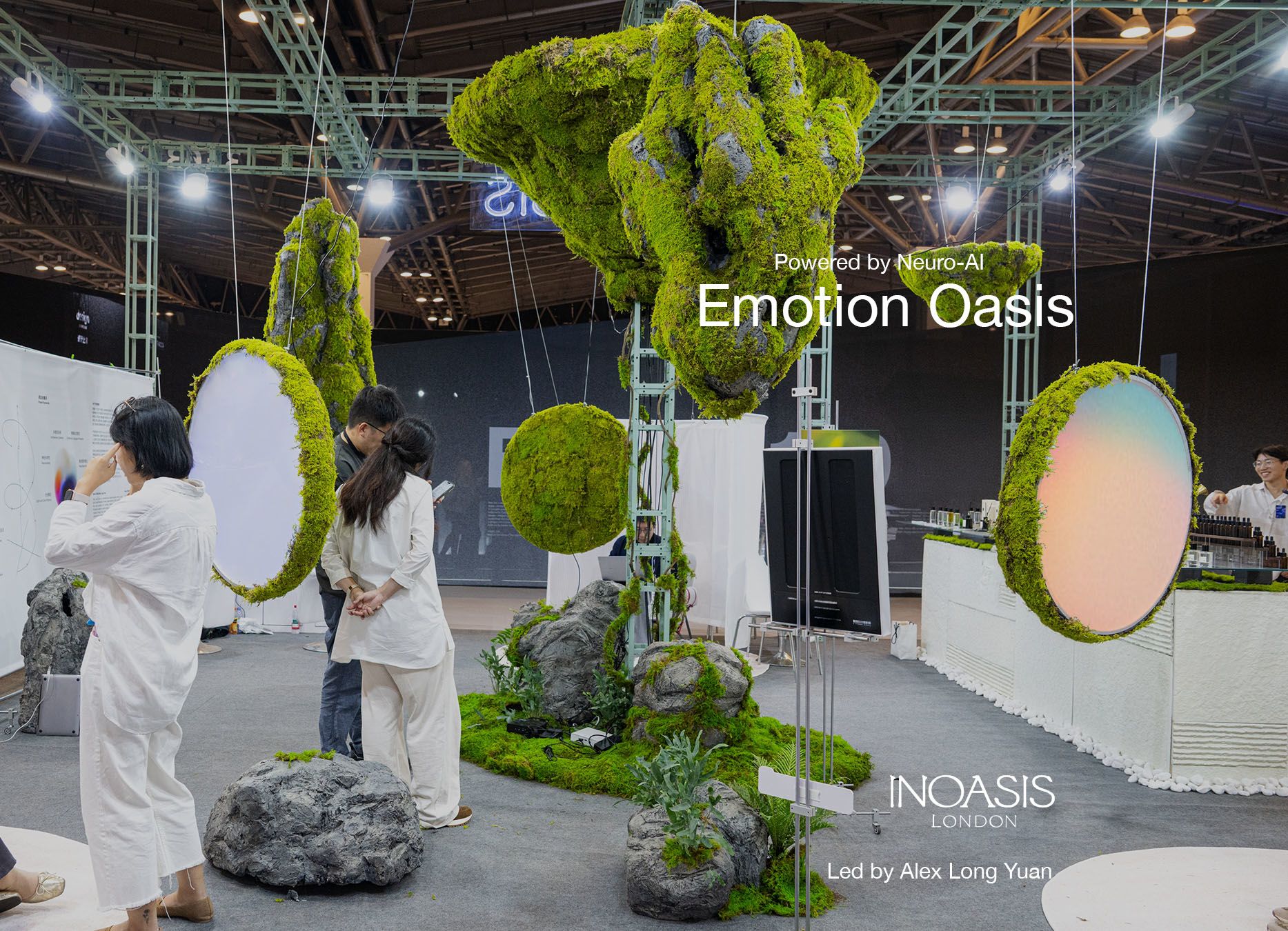
Tell us about your project INOASIS, which was showcased at Design Shanghai and received the Google AI Gemma 3 Award. How did you come up with the idea for the project? What was the biggest challenge?
We’ve invested in art, design and technology to innovate emotional experience. Last year, we worked with neuroscientists, an IT engineer and a perfume team. With this year’s support from the UAL Creative Business Accelerator, we quickly pivoted to a scalable, industry-connected multisensory system for commercial and hospitality settings. Drawing on installation art and interior design, we presented an installation at Design Shanghai as a proof of concept. The biggest challenge was keeping the team running smoothly while testing so many new elements.
Your business partner, Alexiong Yuan, is also a UAL alumnus. How did you 2 meet?
We met at UAL during lockdown and connected over creating spatial experiences with emotional impact. We became friends and housemates and later founded INOASIS to create “emotional oases."
How would you describe the experience of working with a business partner?
Energising and grounding. We bring complementary skills, challenge each other constructively, and rely on clear roles and regular, honest communication.
What are you working on at the moment?
Stage 3: developing sensory motion graphics and expanding our digital solutions for business clients.