From classroom to client: how a live brief helped Shreya think like a professional creative
- Written byPetra Harrison
- Published date 13 April 2026
Share story
In today’s tough jobs market where careers and employability are front of mind for most graduates, some of you might be wondering “will a postgraduate degree really boost my career and prepare me for the real world?”
Well, to offer some insight, we spoke to Shreya Tawade, MA Graphic Media Design graduate, who completed a live industry brief whilst studying at London College of Communication.
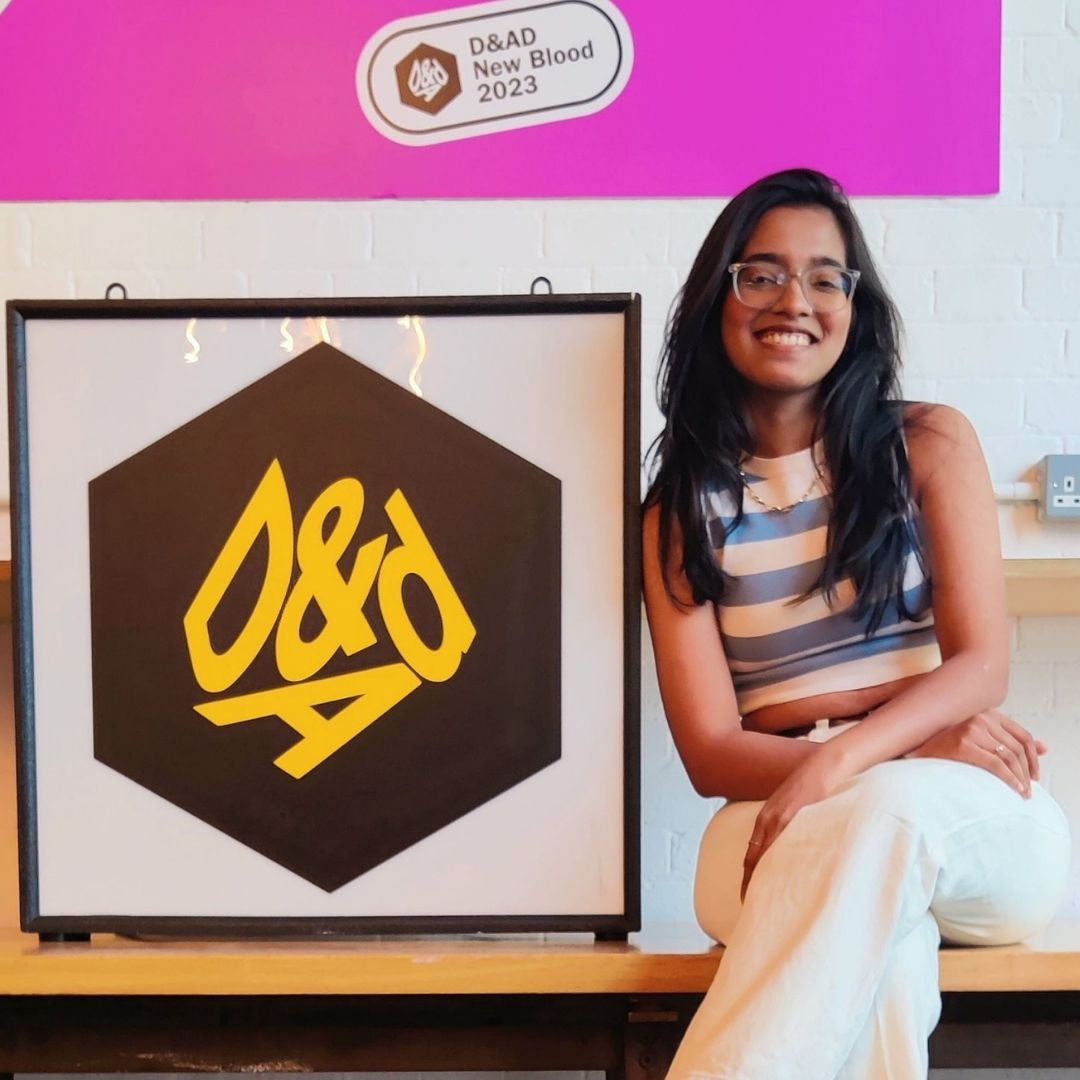
Her experience working on a D&AD Pencil brief for Penguin Random House shows how live projects can connect you to real industry clients, build professional confidence and accelerate your career readiness in today’s competitive climate.
The beginnings of a graphic designer
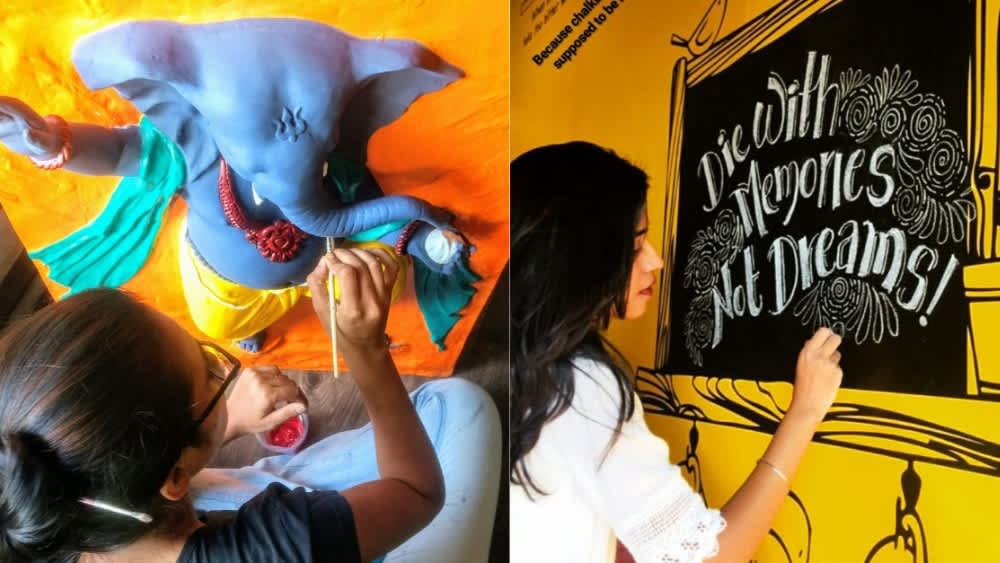
Before starting her postgraduate studies at UAL, Shreya already had years of experience in design. Growing up in India, she describes herself as “the crafty kid” who was always drawing, making and experimenting through various projects.
This curiosity led her to complete a 5-year diploma in graphic design, specialising in typography, followed by internships and agency roles working on branding, marketing and motion design projects for clients including OPPO and Disney+ Hotstar.
Despite this strong professional background however, Shreya felt something was missing.
“I had the practical skills, but I didn’t always understand the 'why' behind my design decisions. I wanted to strengthen my research skills and develop a more critical, conceptual way of thinking.”
That desire to deepen her practice led her to MA Graphic Media Design at London College of Communication, where she was drawn to the balance between structure, experimentation and industry-facing work. One experience in particular stood out: working on a live brief with a real external client.
Inside a live brief with a world leading publisher
Through D&AD Pencil, the live brief that Shreya worked on was set by Penguin Random House, asking creatives to design merchandise concepts that could help the publisher connect more meaningfully with Gen Z audiences.
“Penguin has such a strong legacy, but the question was how to make reading feel relevant to a generation with so many distractions,” Shreya explains.
Unlike typical coursework, the brief reflected a genuine business challenge that would be judged by industry professionals. Knowing this immediately shifted Shreya’s mindset in terms of how to approach the project.
Alongside her MA, Shreya took on a collaborative brief with fellow postgraduates from UAL. She explained that the project proved intense yet deeply rewarding, closely reflecting the pace and realities of professional creative practice.
When teamwork and insight spark into ideas people care about
Working in a team of five, the group began by researching Gen Z reading habits, using questionnaires, discussions and visual mapping to uncover key insights.
“We realised that people want to read more, but they feel overwhelmed,” Shreya says. “Choosing what to read and finding time were big barriers.”
Their final proposal centred on making reading feel achievable and rewarding. The team designed three interconnected concepts:
- a mini library of curated book excerpts, i.e. ‘Book Tastings’
- An interactive tear-off poster that visually logs progress
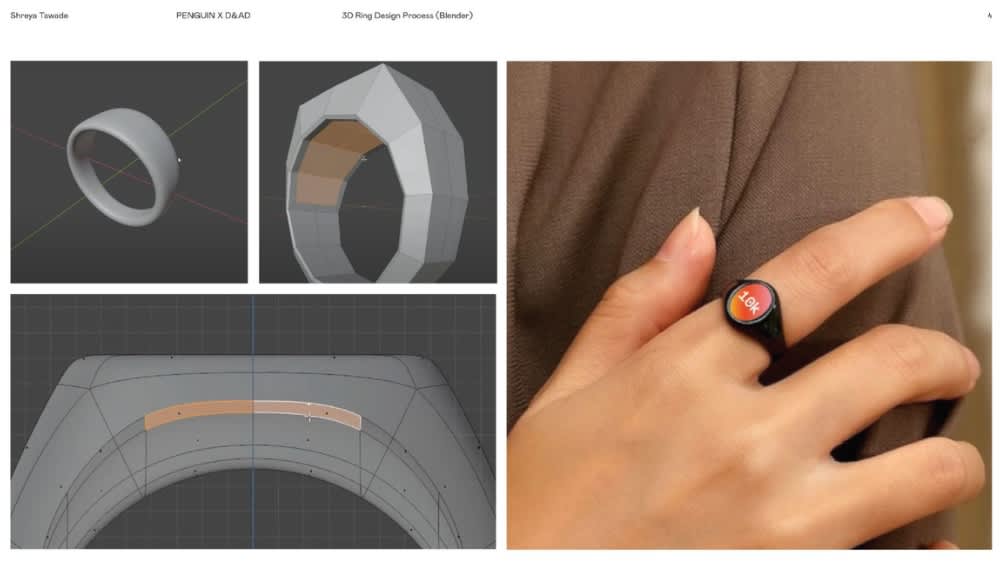
- and a reading ring tracker that counts the reader’s hand gestures as they flip the page.
The ideas were grounded in insight, playful in execution and clearly aligned with the brief – a combination that would prove successful for Shreya and her team.

Stepping outside your comfort zone builds confidence
One of the most defining moments in the project came just before submission. The team planned to show the reading ring through simple mock-ups, but Shreya felt the idea deserved more.
“If you don’t present something convincingly, it loses its value.”
Despite having no prior experience in 3D design, she decided to model the ring herself using the 3D creation suite Blender, drawing on skills she had picked up through UAL workshops and self-directed learning.
“It was a little stressful. I was learning a completely new tool under time pressure. But it taught me that adaptability is a professional skill in itself.”
Support from peers, technicians and tutors helped Shreya push through, resulting in a fully realised product visual that elevated the entire proposal.
Industry recognition and unexpected opportunities
As a result of the team’s hard work, the project went on to win the D&AD Yellow Pencil award for that year, with judges praising both the innovative concept and its beautiful execution. For Shreya, receiving direct feedback from the Penguin Random House team was a standout moment.
“They were so happy and really advocated for our project throughout, so that validation really meant a lot.”

Another unexpected benefit was that the experience also opened professional doors. Shreya was able to connect with a senior marketing manager at Penguin, who later supported her during a job application process, offering advice, reviewing her cover letter and sharing industry insight.
“That connection came from genuinely engaging with the brief, I think. Networking isn’t always about events; it’s about the work you put into projects.”

Looking ahead - building a creative life beyond university
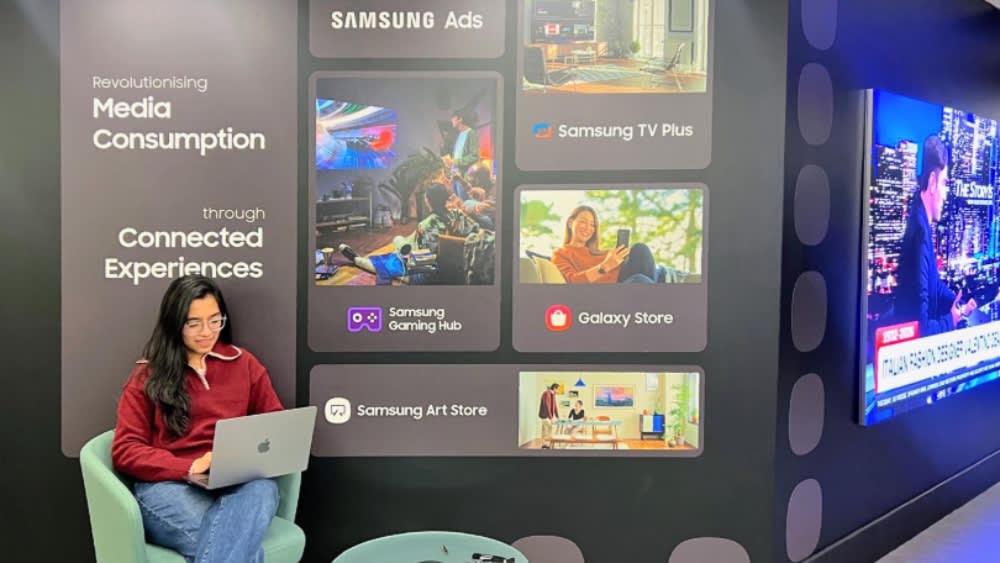
Shreya now works at Samsung UK as the sole designer for their Galaxy Store team, creating a range of digital assets across multiple campaigns. With the stability of full-time work, she’s also excited to return to something that she had put on hold during her studies – personal creative projects.
“As a student, your priorities are different. Now I’m really looking forward to developing my own practice again; working on passion projects, experimenting and maybe even going back to uni on weekends just to make things.”
For Shreya, living and working in London continues to inspire her. While she acknowledges the competitiveness of the design industry, she sees the city’s creative energy as a motivator rather than a barrier.
“The design scene in London is just so vibrant,” Shreya says. “Yes, it can be tough, but it just takes cutting through that competition and managing to be a part of that which I think is incredibly exciting.”
From Shreya’s perspective, ‘there's still there’s so much to do’ and so many different agencies she aspires to work with in future, from DesignBridge and Pentagram to How&How.
This curious mindset and sense of possibility is exactly what keeps Shreya motivated. Her career story is an inspiring reminder that postgraduate study is not a finishing point, but rather the continuation of a much longer, and much more colourful, creative journey.
What about your next steps?
Live briefs don’t just simulate industry - they immerse students in it. For Shreya, working with real clients sharpened her creative thinking, strengthened her professional confidence and supported the direction she wanted her career to take.
Building industry-ready work during postgraduate study not only gives you a better understanding of the skills needed as a professional creative, but also a clearer sense of what comes next.
If you’re interested in a career like Shreya’s, UAL has many postgraduate courses that will help develop your graphic design and communication skills and test your ideas in real-world contexts.
- MA Graphic Media Design (London College of Communication)
- MA Graphic Design Communication (Camberwell College of Arts)
- MA Graphic Communication Design (Central Saint Martins)
- MA Graphic Branding and Identity (London College of Communication)
- MA Graphic Design (Online)
Learn more about postgraduate study at UAL.
Related courses
-

Image: MA Graphic Media Design 2026, London College of Communication, UAL.
College: London College of Communication Level: Postgraduate
MA Graphic Media Design
MA Graphic Media Design explores graphic design as a tool to research and respond to the complexities of contemporary society, helping you build critical, interdependent practices
-
MA Graphic Design Communication, Camberwell College of Arts, UALCollege: Camberwell College of Arts Level: Postgraduate
MA Graphic Design Communication
MA Graphic Design Communication at Camberwell College of Arts helps you shape engaging and imaginative design solutions through material, media, technologies and systems of public engagement.
-

Clockwise from top left: Anna Niklova, Off The Grid; Stephanie Jin, Lorem Ipsum, Where’s Your Daddy?; Sachi Patil, Decaying: Conversations with Machines on Human Life; Lily Kong, I’m Fine; Matt Urpani, An Array of Constraints; Owen Lewis, Eating Ortolan in the Hammock of Reality; Klara Blazek, Self-Cities, Work by Wanying Chen, Gayatri Sheth, Banruo Chen, Runlan Lin, Zichuan Wan, Kismat Shree, 2026 | MA Graphic Communication Design, Central Saint Martins, UAL.
College: Central Saint Martins Level: Postgraduate
MA Graphic Communication Design
MA Graphic Communication Design brings critical depth and rigour to an increasingly noisy and disorienting visual landscape.
-

Julie Van Milders, MA Graphic Branding and Identity, London College of Communication, UAL.
College: London College of Communication Level: Postgraduate
MA Graphic Branding and Identity
Create diverse, relevant, ethical and socially-aware brands for clients, corporations, communities and cultures. MA Graphic Branding and Identity will help you go beyond visual identity, typographical and logo design to become a force of innovation, insight and production.