
Ramma Pande on her experience with the Social Purpose Innovation Fund
- Written byStudent Communications
- Published date 05 November 2025
Share story
Following last year’s successful pilot, the Social Purpose Innovation Fund (SPIF) is back and open for applications until Friday 5 December. The Fund supports students and staff across UAL to co-create imaginative responses to strategic challenges through a participatory grant-making process and you can read more about it on our website.
We caught up with Ramma Pande, who graduated from MA Innovation Management at CSM earlier this year, to discuss her experience taking part in the pilot as part of her project group, Compost Collective.
For any would-be applicants, we hope you find Ramma’s story a useful insight into the Fund and its potential for helping your development.
Hi Ramma! Can you briefly introduce yourself and your project team?
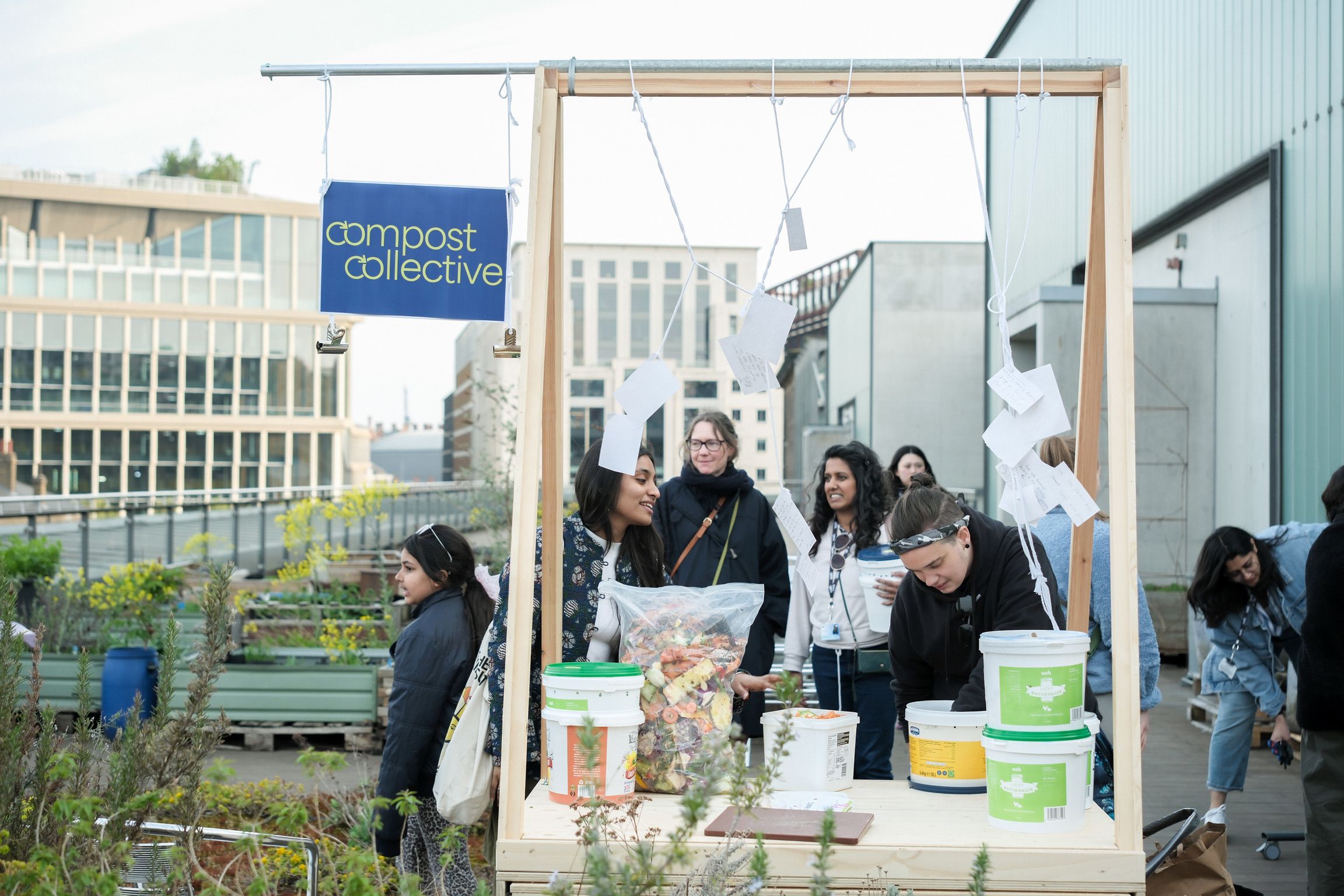
I met Hannah Ogahara, who studied MA Regenerative Design, at a UAL Hackathon in 2023. We came together to look at how we might tackle food waste within our UAL accommodation. I grew up in India whilst Hannah grew up in Japan and in both countries, there’s more of a culture of composting so I think we were both shocked at how much food waste we were experiencing at the time. We came up with a three-pronged approach looking how food waste is segregated at UAL, how we could utilise dead spaces on campus and how we could educate students so that composting felt more approachable for them.
Off the back of this project, we formed Compost Collective and shortly after, Yoshimi Hata joined. Yoshimi studied MA Design for Social Innovation and Sustainable Futures and she is our compost queen! Yoshimi was the one who built our first big composter, which wouldn’t have been possible without David Leigh, Associate Lecturer at LCF and a mentor we met at the Hackathon, sharing his space with us. The final member of the group to join was Aly Tobin, who was on the same course as Hannah and after discussing issues around sustainability together, they realised what a good addition she would be with her talent for outreach and partnerships.
Compost Collective really came together organically and I feel we have a great team assembled.
Where did you hear about the SPIF?
I was already on the lookout for things that we could apply for and came across the Fund via my student newsletter. We thought it sounded like a great opportunity as it called for projects that would positively impact the UAL community, which we were already trying to do. It was a straightforward application process and we had absolutely no problems with getting our application in.
What advice would you have for those considering applying to the SPIF?
I think make sure that you really consider how your project can impact the UAL community before you worry about making a wider impact. It's easy to try and tackle issues far larger than the UAL ecosystem but I think the best approach is to focus on UAL specifically and the impact you can have here before you worry about reaching beyond the University. If you have an idea in mind, definitely look into the Fund because it can really help.
Did you develop relationships with other groups at UAL as a result?
Most definitely. We had previously connected with the roof bug society at CSM to see if they would be interested in collaborating at some point as we saw crossover with our work. We also linked up with a dye making group so we could supply them with compost they could use to help grow plants and herbs for their natural dyes.
For us, having the funding definitely helped us escalate these conversations because before securing our funding, we didn't really have the means to be able to collaborate the way we wanted to. Once we could let other groups know how we could use our funding for different things, it was a lot easier to demonstrate the value of collaboration.
We attended a group session for applicants and there that we met Sana Jazeer, who studied MA Material Futures, and her project was to test compostable bio-bricks that she had designed. It was a cool coincidence that her project linked to ours so well and so we offered to run an experiment using her bio-bricks to see which technique would help the bio-brick disintegrate faster.
So yes, the Fund really helped us build connections which was a really nice experience.
Can you talk a bit about the work you completed as part of your project?
As well as our bio-bricks experiment, in which we tested 4 different composting techniques to measure their effectiveness at breaking down the bio-brick, we also collected excess calico from MA Fashion and Textiles to measure whether it was more effective to break the calico down using enzymes or without.
We also worked with the CSM canteen to collect food waste from them across a week so that we could set up a ‘Bokashi’ system as a pre-composting process to improve composting efficiency with our existing wormery. Bokashi is a process in which you ferment food waste with bran that is inoculated with beneficial microorganisms such as lactic acid, bacteria and yeast, which helps it to mature quicker. We’ve since had students reach out to us to ask us to compost materials for them and it’s great to have connections still forming as a result of this project.

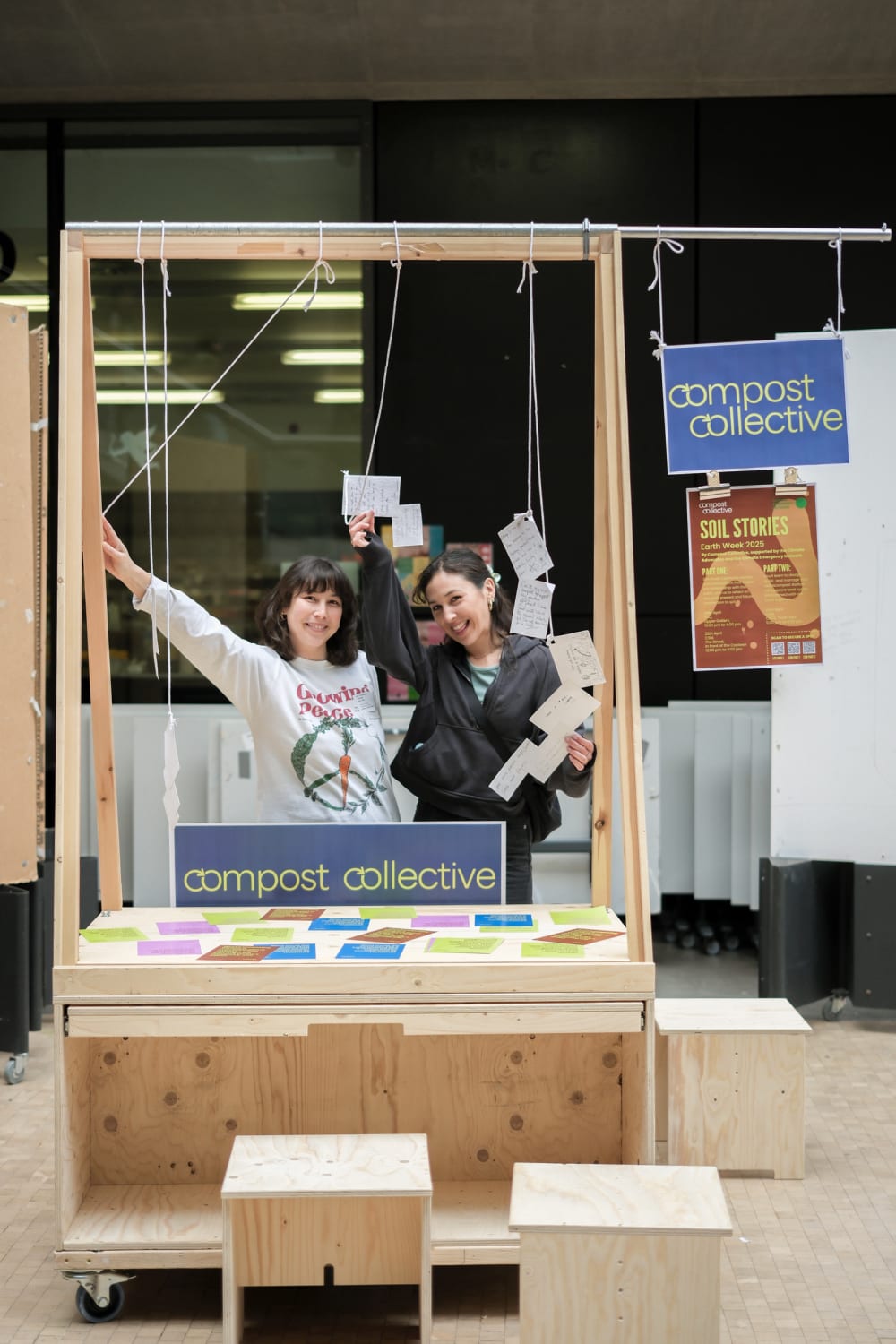
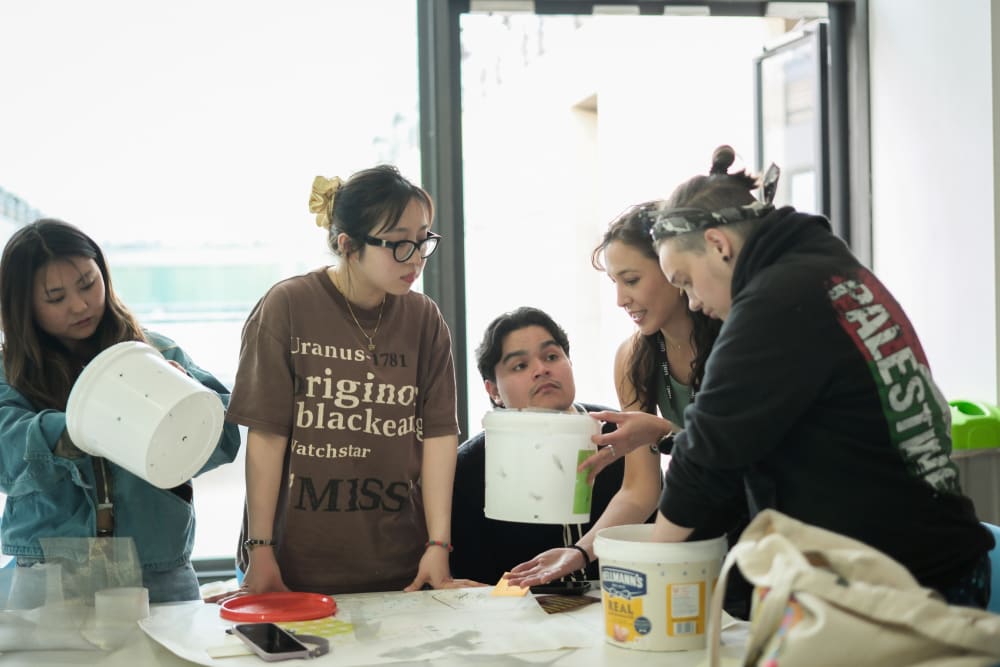
Finally, we hosted a series of workshops as part of Earth Week titled ‘Soil Stories’. In the first one, we encouraged participants to think back to their first memories of soil. By examining and reflecting on personal experiences, participants considered how they could nourish and care for soil moving forward and work towards more sustainable lifestyles. The second workshop was more hands on as we worked with participants to develop their own compost station by utilising found and discarded materials. This workshop aimed to educate people on the ease and accessibility of personal composting. As part of CSM’s Staff Development Week, we hosted a table to share our ongoing experiments and invite staff into dialogue around compost and soil as part of creative practice.
Why was it important to you to have a physical workshop people could take part in?
As a team we have a lot of energy for this topic but trying to get other people to take interest in food waste can be a difficult thing. Rather than just saying “Hey, food waste is interesting!”, we felt we needed the workshops to bring people together and have two-way conversations about food waste and how it impacts us all.

What have Compost Collective been doing since then?
We recently won a Climate Change All Change award, providing us with £5,000 and a partnership with a primary school in Camberwell. We are co-designing a six-week workshop to help their students learn more about what it’s like being a designer, how design thinking works and how it can be used to solve problems. We’re really excited about that and I think our next plan is to figure out if we can develop an educational kit that students can use to learn more about things like food cycles and biodiversity.
Interested in applying for the Social Purpose Innovation Fund?
Check out the Social Purpose Innovation Fund webpage to watch a recording of our information webinar and sign up to upcoming drop-in sessions.