Faye Lok: Entering the world of Ladon’s Feast
- Written byAlexandra Kytka-Sharpe
- Published date 19 December 2025
Share story
What distracts us from our own quests? This question sits at the heart of Ladon’s Feast, the immersive final project by Faye Lok (BA Hons Technical Arts for Theatre and Screen), featured on the cover of this year’s UAL Prospectus.
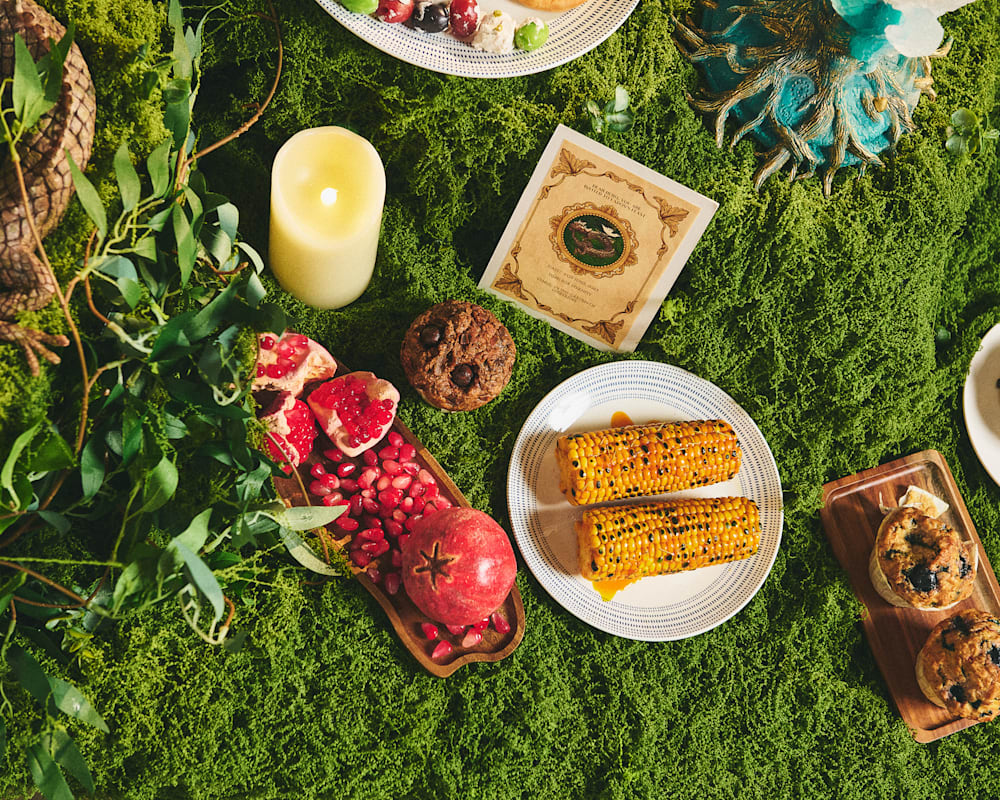
Inspired by Greek mythology, the installation invites visitors to step into a forest scene that feels both enchanted and quietly unsettling. “Imagine stepping into an ancient Greek mythology tale as a daring hero,” Faye says.
Reimagining myth
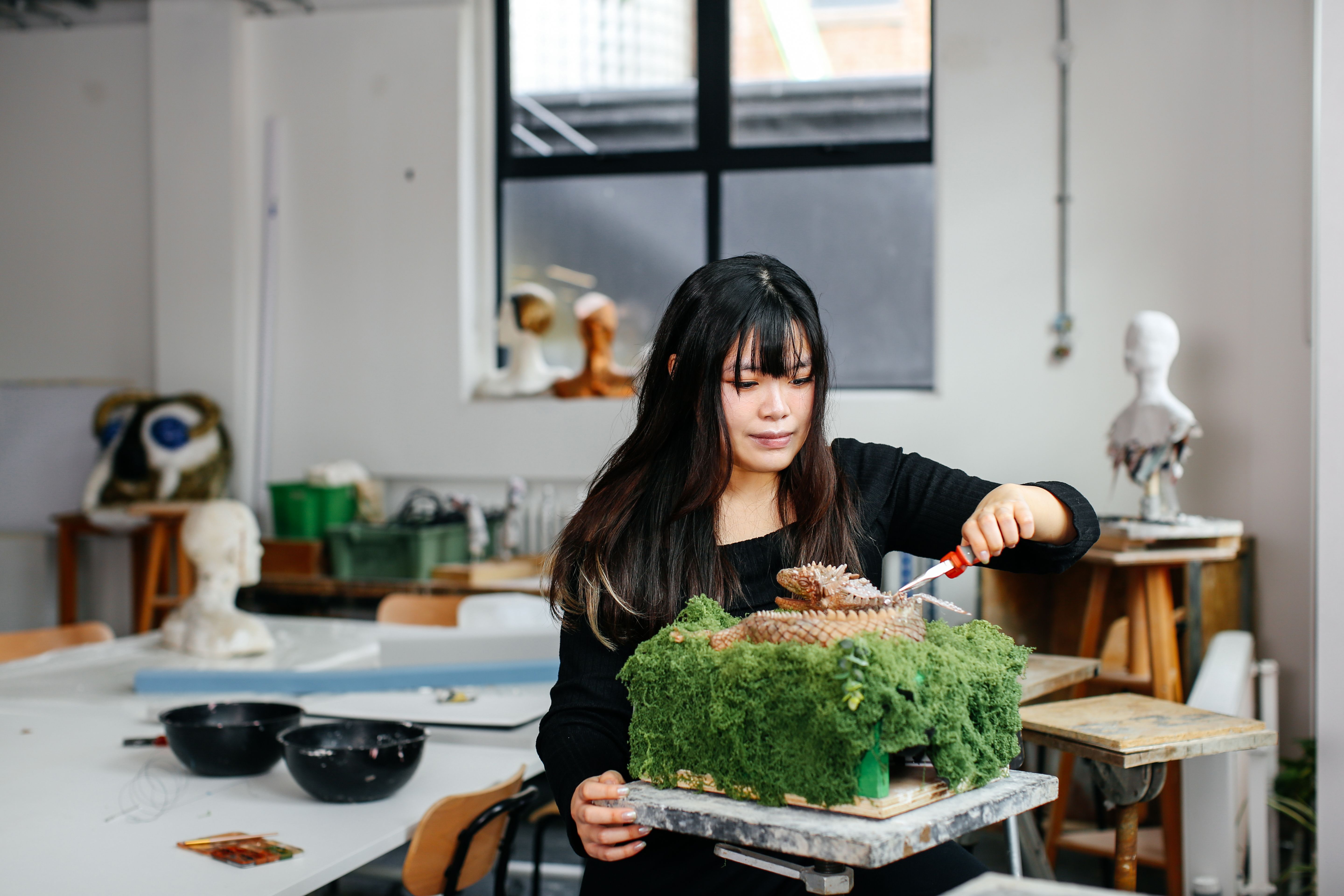
At the centre of the space lies Ladon, the mythical dragon traditionally tasked with guarding the golden apple trees. But in Faye’s reimagining, the creature is not fearsome. “You come in as a Greek hero thinking you're going to fight a scary dragon, but it's actually just a baby dragon, so he's not the true test.”
Instead, visitors are confronted with something far more familiar: temptation. “The true test is the lavish feast that stretches out before you, tempting anyone who approaches,” Faye explains. Goblets, fruit and food spill across the scene, including a pomegranate referencing Persephone and the underworld. “The temptations that draw you away from a quest are the true obstacle,” she says. The installation ends by asking: “Will you be able to resist the hypnotising feast and remember your quest? Or will you lose focus and remain in the never-ending feast?”
Worldbuilding as storytelling
Storytelling sits at the centre of Faye’s creative approach. “Storytelling is central to my practice because I believe narratives have the power to bring reflection and evoke emotions,” she explains. Her interest in immersive experiences was shaped by a range of influences, including working as a skipper on Disneyland’s Jungle River Cruise during the summer of 2023. “It inspired me to connect with audiences through narratives and electronics,” she says, alongside a growing inspiration drawn from nature.
Making Ladon’s Feast
For Ladon’s Feast, Faye set out to draw together everything she had learned during her degree. “I wanted to demonstrate how I'm capable of using a lot of materials, so I tried to put everything I learned in the past three years on my course as well as personal research,” she says.
The installation was built using a wide range of techniques. “For the goblets I used polyurethane resin, and I made the mould out of silicon and Jesmonite.” The dragon itself was sculpted by hand: “For the dragon, it's sculpted of wet clay and then I made a mould and cast it in a softer silicon so it's soft and imitates real skin texture.” Food elements were created using wax and thermoplastics, while the forest environment was constructed from “expanding foam, clay, plaster, wires.”
Inviting interaction
Material experimentation extends beyond visual realism into touch. During her degree show, Faye noticed how strongly people responded when they were invited to interact with the work. “I invite them to interact with it and let guests feel my sculptures because some materials you don't really learn about normally,” she says.
This approach was shaped through experimentation beyond the studio. “The idea of letting people interact with my piece came from taking my dragon and tree setup to the park,” she explains. Powered by a battery pack, the installation attracted passers-by. “People passing by interacted with it,” she recalls. One child asked if the dragon was real. “I told her it was real, and she was happy.” Seeing these reactions changed how she approached her degree show. “Seeing how sweet it was, I started inviting children at the degree show to touch my piece.”
Learning at Wimbledon College of Arts
Studying at Wimbledon College of Arts played a key role in shaping Faye’s balance between imagination and technical confidence. “My course focuses on the technical side of theatre and live performances, and the atmosphere at Wimbledon is theatrical and creative,” she says. “It encouraged me to experiment with diverse materials and fabrication methods.”
Over the course of her degree, she developed skills in “sculpting, moulding and casting, model making, head and cam, and traditional woodworking techniques.” She also emphasises the importance of technical understanding alongside creativity. “Doing an art course, we have a lot of ideas and we're creative people, but our course shows there's a technical side, technical precision,” she explains. “It's not just artistic expression but learning about fabrication techniques and materials and the possibilities from a single material.”
From university to industry
Alongside her studies, Faye gained industry experience through live projects and placements. She took part in The Herds, a large-scale global touring project travelling from the Congo Basin to the Arctic Circle. “I learned how to make puppets and how the joints work,” she says, working with Walk Productions and Uganda Puppets.
She also worked as a set designer assistant at Theatre Peckham on Sunnyside Up, performed at Soho Theatre, where she developed practical prop-making skills for live performance. Since graduating, Faye has continued to build on those foundations through freelance work. “I've been doing 3D printing, laser cutting,” she says, and her work now spans “show and advertising campaigns.”
Advice for future students
For students considering applying to UAL, her advice is simple. “Experiment. There's so much you can learn,” she says. “UAL offers a lot of opportunities and workshops. The facilities—make use of them.” Reflecting on her own experience, she adds: “I wish I would have used more 3D printing and laser cutting.”