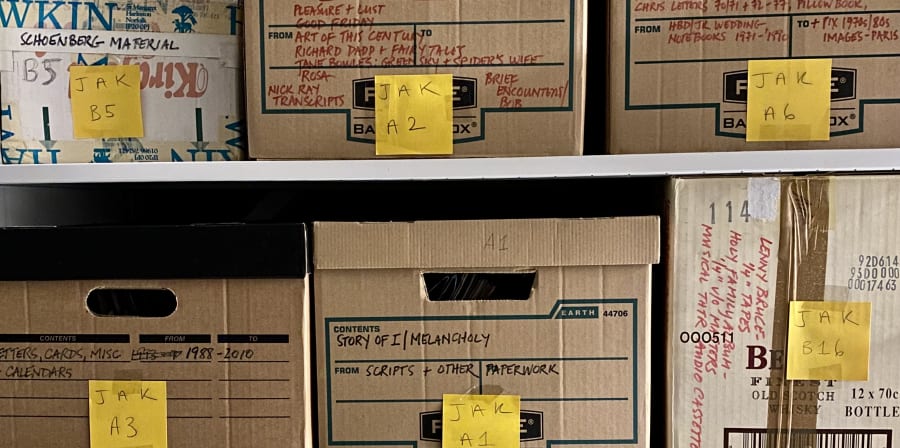
I’m Leola Wade, Archive and Special Collections Assistant, working in the UAL Archives and Special Collections team. For the past month, I’ve had the privilege of delving into Jo Ann Kaplan’s life and artistic practice. My task has been to meticulously box list her entire uncatalogued archive.
About Jo Ann Kaplan
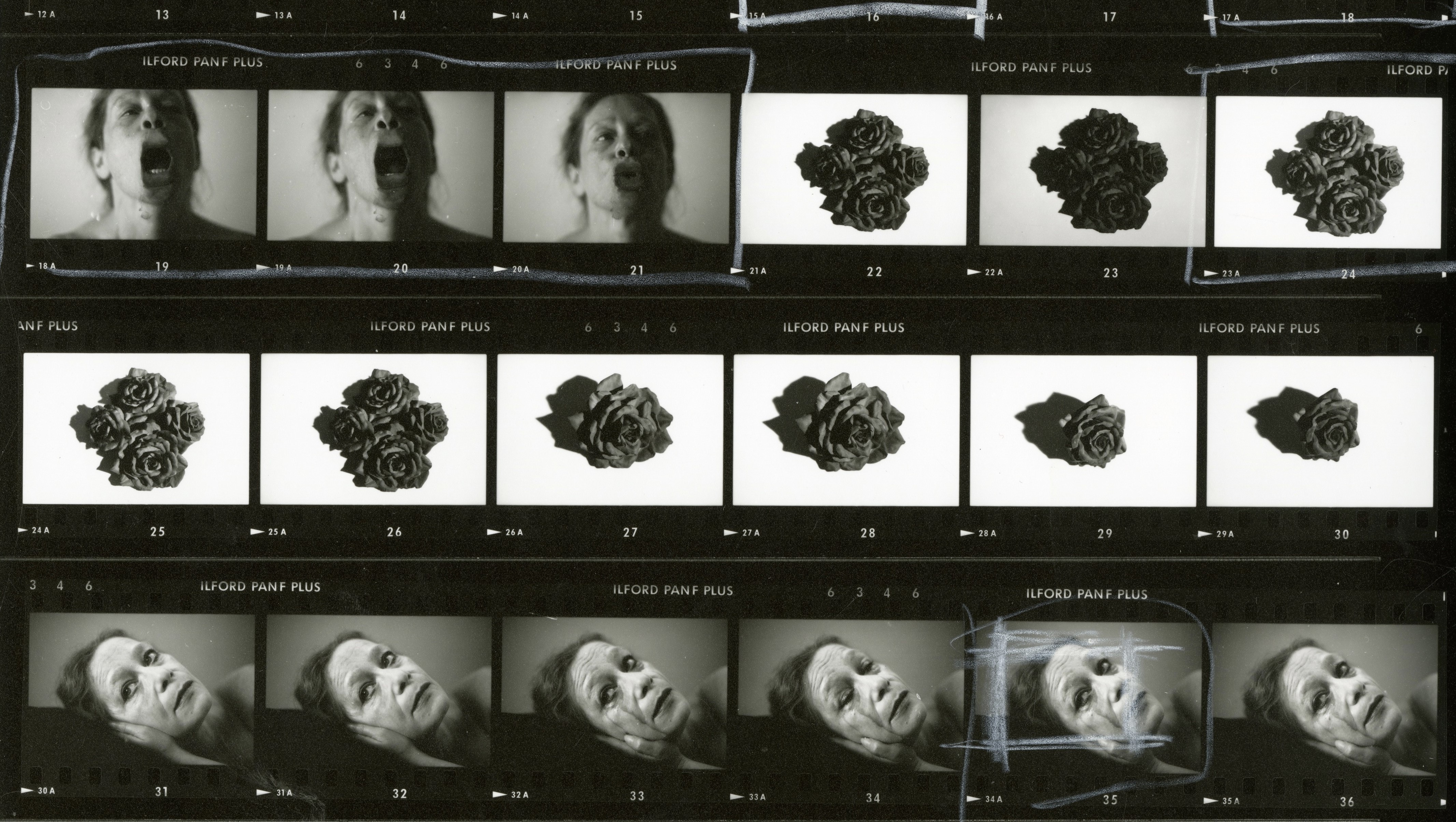
Kaplan was a multi-disciplinary artist, filmmaker and lecturer (1945-2016). The archive covers Kaplan’s formative years as a student in New York in the 1960s to her later moves to Paris and then London, where she lived and worked for the rest of her life. Kaplan’s life is documented through personal photos, letters, working journal notes and exhibition/film preview invites, alongside her original works of art. Her archive shows evidence that she was a highly social person and embraced life to the brim. She poured her stream of consciousness into all her creative practices.
Her main body of work was as an artist-filmmaker. Spanning from 1986 to 2016, Kaplan often explored mysticism throughout her career, incorporating esoteric imagery into her work. Her films serve as a mirror reflecting the nuances of femininity, myth, and the dance between artistic expression and the cyclical nature of existence. This is most evident in her visual representations of gothic anatomical and floral hybrids. Perhaps, these were inspired by the passing of the seasons; cycles of life and death that she witnessed as an avid gardener.
Kaplan’s films include, The Story of I (1997), and An Anatomy of Melancholy (2000) OneTwoThree (2010) and Watching Paint Dry (2010). Kaplan also collaborated with the magical realist and feminist writer Angela Carter on Holy Family Album (1991). In addition, she created a documentary (Invocation: Maya Deren, 1986) celebrating the pioneering work of Maya Deren, an innovator of experimental avant-garde films from the 1940s/50s. It is obvious from the mass of material concerning both Carter and Deren that they both served as profound sources of inspiration for Kaplan’s artistic journey.
The project
While this project has been intellectually and visually stimulating, it also presented significant challenges. The archive was donated after Kaplan’s death, so we could not ask her any questions about the content or context of the material. In addition, many items arrived to us loosely, in plastic bags. This complicated efforts to maintain the original arrangement of material, which is an important archival principle. However, with attention to detail and planning, I was able to respect the order of her material as far as possible.
One highlight of this project has been reaching out to LUX, an arts organization holding the copyright to Jo Ann Kaplan's films. Their generosity in granting us permission to access the films has been invaluable. Organizing a screening for our new UCL Cataloguing placement student, Jamie Jackson, ensured that he could gain knowledge of Jo Ann's work firsthand and to contextualize the material in the archive. This helped him to create a suitable plan for arrangement and the future cataloging of this inspiring archive.
The cataloguing of the Jo Ann Kaplan archive is now in progress.
Find out more
Find a summary of the collections held at the ASCC on our website.
For any other questions about Archives and Special Collections more generally, please email archive-enquiries@arts.ac.uk