A Wealth of Stories: Exploring Wealth Inequality through Storytelling

- Written byHayley Davis
- Published date 09 February 2026
Share story
This line from season 3 of HBO’s ‘White Lotus’ launched a thousand memes. Victoria Ratliff, a wealthy, southern mother of three, states plainly that she would prefer death to losing the family money. The scene was clipped and shared across social media, with the consensus that while the delivery was a touch hysterical, she was sharing a seemingly undeniable truth: we’d all rather be living like her than like us.
While White Lotus often portrays its wealthy guests as shallow, fickle and ridiculous there is an unshakeable sheen of glamour and aspiration – lines like this, delivered by beautiful, glamourous people are a wink to the audience, a signal that, yes, she may be dramatic but she’s also kind of right? Who wouldn't want to live like this? Pampered, cosseted, shielded from the challenges and indignities endured by the less well off. Sure, Victoria has a small issue with Lorazepam but the bedsheets she lies on are plush, the clothes she wears are high end and her jewellery is expensive.
At the AKO Storytelling Institute we understand that the ways that stories are told is not accidental. No story is neutral. Beneath every plot lie assumptions about who deserves opportunity, what constitutes meaningful effort, and whether obstacles arise from individual shortcomings or structural conditions.
Many of us in the Western world grow up with stories that celebrate wealthy individuals as deserving their success and promote the idea that opportunities to accumulate wealth are there for the taking. The language of meritocracy seeps through our culture, inviting us to explain poverty as personal failure and to see extreme wealth at the top as normal, deserved, and unavoidable.
If we could all be rich, the glamorising of wealth might not be so problematic. But we can’t be. Research shows that the narrative that ‘everyone can be wealthy if they just work hard enough’ is not only untrue but perpetuates an unequal society.
Further wealth inequality does not fall evenly. It intersects with gender, race, disability, and other structural disadvantages where the relationship runs both ways. Wealth is not peripheral to poverty; it determines its depth, persistence, and reproduction. The UK is a wealthy country but there are big gaps between the people who have a lot of wealth and the people who have very little or none.
Exploratory labs
At the Institute we run exploratory labs that connect social research with creative practice, enabling researchers and storytellers to share insights directly and shape new narratives around some of the most pressing issues of our time.
For one of our labs, we’ve partnered with Joseph Rowntree Foundation (JRF) an independent social change organisation, working to support and speed up the transition to a more equitable and just future, free from poverty, where people and planet can flourish.
A Wealth of Stories: Exploring Wealth Inequality through Storytelling, (commissioned by Joseph Rowntree Foundation and produced by AKO Storytelling Institute) brings together academic researchers in wealth inequality and creatives working in entertainment to explore how stories shape the way we understand wealth and inequality; and how those narratives might be reimagined. Drawing on narrative framing research, this lab creates space for writers, filmmakers, journalists and other storytellers to engage directly with research insights and test how they can be applied in creative practice.
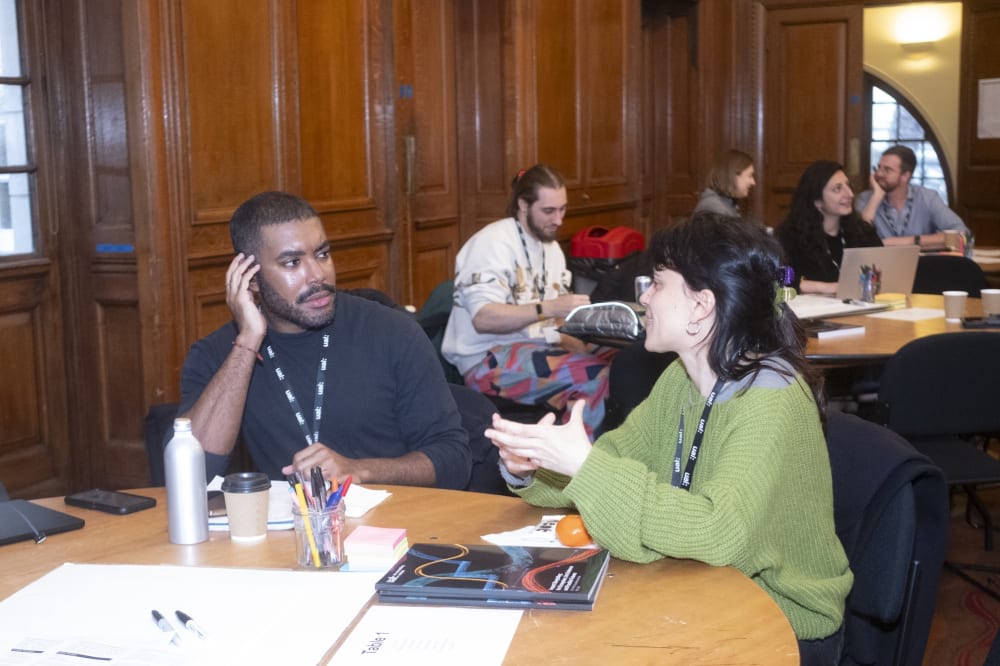
On 21 January 2026 we kicked off Part 1 with our Insights and Imagination Day.
This day convened a carefully curated group of people. We brought together key voices from the wider topic sector and creative industry gatekeepers: from BBC commissioners to those working to change how wealth is invested, to those researching the consequences of inequalities worldwide.
Insights
Participants heard about the latest research and thinking on current wealth narratives and were allowed space for discussion and reflection.
The first panel of speakers spoke about current narratives on wealth inequality and public perceptions. Sarah Kerr, Narratives and Policy Lead, Transforming Wealth Lab, Joseph Rowntree Foundation, Michael Vaughan, Research Fellow, International Inequalities Institute, London School of Economics, and Annalena Oppel, Research Fellow, Atlantic Fellows for Social and Economic Equity, London School of Economics shared insights from their research on the effects of the framing of wealth inequality.
Dominant wealth narratives depict inequality as the natural outcome of meritocracy – portraying wealth as deserved, admirable, and a legitimate reward for individual effort.
They also provided a narrative framework which functioned as a lens through which cultural examples can be assessed. It allowed loosely grouping narratives into helpful and less helpful framings so that participants could see how existing stories can convey different messages about what wealth inequality means and which roles of wealth get promoted or critiqued.
Quantity
Less helpful narrative: Stories that barely show inequality and by hiding the inequality making it not exist.
More helpful narrative: Stories that show inequality are huge and interdependent – showing the rifts and contrasts between rich and poor people.
Blame
Less helpful narrative: Stories that show inequalities as deserved and fair, because life is a competition – wealth is the reward for winning that competition, or 'part of the natural social order'.
More helpful narrative: Stories that show how inequalities are largely dependent on luck, privilege and structural advantage. Inequality is unfair.
Harm
Less helpful narrative: Stories that show inequalities as harmless (and consequently can be enjoyed) or beneficial (so can be tolerated).
More helpful narrative: Stories that show how inequalities damage our economy, society, democracy and environment. They harm all of us.
Action
Less helpful narrative: Stories saying nothing meaningful can be done about inequality.
More helpful narrative: Stories of collective action and illustrating how better rules can change outcomes.
Tamsyn Hyatt, Director of Evidence at FrameWorks UK, then shared insights on the “system is rigged” narrative - a widely shared belief that economic and political rules are set up to benefit the already-wealthy and powerful, with outcomes feeling predetermined and unfair, resulting in a sense of hopelessness. She was able to offer three potential narrative responses to move audiences from apathy to agency. These were:
- rather than simply saying that the system is rigged, explaining how they are rigged
- moving away from narratives about individual heroes and villains to stories about collective power
- instead of offering individual or generic solutions stories should suggest systemic solutions that match the scale of the problem.
Tessa Bartholomew-Good, Head of Impact Campaigns at Movember, presented masculinity research insights on the dominant narrative of being relentlessly “ripped and rich” at all costs’.
We then moved to group conversations which, when shared back into the room, showed a striking level of overlap.
Key discussion points
1. No solutions (or too neat solutions)
Stories that provide examples of the unfairness and damage caused by wealth inequality rarely offer solutions.
Examples such as Dopesick were discussed as powerful but almost “too perfect”, while Triangle of Sadness was cited as a grotesque, allegorical portrayal of wealth that ultimately offers little hope beyond collapse. In both cases, participants questioned how stories might acknowledge structural injustice without reinforcing despair.
Participants noted that many narratives either:
- resolve too neatly, reinforcing ideas of individual heroism or meritocracy, or
- tip into fatalism, leaving audiences with a sense that change is impossible.
2. Narrative conventions
Several participants reflected on the tension between traditional storytelling principles and the realities of structural inequality. One writer explained that ‘good’ storytelling dictates that a protagonist must be active rather than passive in any story. This rule can make it harder to tell stories where harm is systemic rather than moral or personal.
This individualistic framing — common in examples like Erin Brockovich or Mr Bates vs the Post Office — risks obscuring collective responsibility and structural solutions. Participants questioned whether new narrative forms are needed to move from individual blame or heroism towards shared responsibility.
3. Structural barriers
Discussion repeatedly returned to the systems surrounding storytelling itself. Participants highlighted a matrix of interlocking barriers, including:
- a lack of diversity among gatekeepers and decision-makers (and the responsibility creatives have to question what gatekeepers assume audiences want)
- declining media plurality and concentration of ownership
- risk-averse commissioning cultures
- pressure from the attention economy and fast news cycles
- shifts in where and how audiences consume media
- industry practice of extractive storytelling
- shaping work to meet commissioners’ expectations.
One of the lab creatives reflected that foregrounding love, dignity and complexity — rather than poverty alone — resonated strongly, as did concerns about how audience sympathy can depend on concealing “unpalatable” aspects of people’s lives.
4. Inequality not visible
A strong theme was how wealth often operates invisibly in narratives — both obscured and hiding in plain sight.
Participants noted how:
- financial power is rarely foregrounded as a system
- political figures can perform relatability while being bankrolled by extreme wealth
- audiences are often unaware of who funds or benefits from powerful systems.
There was also discussion on the narrative sophistication of the political right, particularly its ability to combine information with emotional triggers.
5. Avoiding fatalism and disempowerment
A key provocation from the narrative frameworks discussion was how narratives can unintentionally trigger disempowerment. Participants explored how different framings can push audiences towards resignation or engagement, and how stories might shift from:
- individual to collective power
- individual solutions to systemic responses
- inevitability to possibility.
This was framed as a way of bypassing fatalism without resorting to false optimism.
6. What feels possible now
Across roundtables, there was enthusiasm for experimenting with:
- reframing wealth as structural rather than personal
- portraying extreme wealth as isolating, grotesque or socially corrosive
- hyperlocal storytelling rooted in everyday economic realities
- genre-mixing and formal experimentation
- narratives that ask what wealth is for, rather than who “deserves” it.
Participants were also keen to explore how research on wealth might become genuinely useful to storytellers and what this would look like practically.
What next?
The day opened up a set of live questions that participants were keen to keep exploring. The project now moves into a development and experimentation phase. In February the creatives and researchers will meet again to unpack the themes, tensions and challenges that surfaced during the Insights Day and test how they might inform new narrative approaches, story ideas or creative directions.
To keep up to date with the Institute keep an eye on our UAL Stories page.