
UK Rave Flyers 1988/1989: An interview with Phatmedia’s Dave Nicholson

- Written byTim Gibney
- Published date 10 March 2026
Share story
Central Saint Martins PhD Candidate and member of UAL’s Subcultures Interest Group Tim Gibney, interviews Dave Nicholson of the rave flyer archive Phatmedia
Every now and then a book comes along that is so handsome by content and design, rich in cultural detail and purpose that it screams ‘buy me’. Phatmedia Presents UK Rave Flyers 1988/1989 is one such publication. Curated and researched by Dave Nicholson of phatmedia, the internet’s largest database for rave flyers, and designed by UAL alumnus Alfie Allen, the weighty tome does what it says on the tin. Yet it is more than just an exercise in cataloguing. Rather it’s a visual and narrative love letter to these once ephemeral and often thrown away or lost artefacts – in some cases highly-collectable and valued now – from one of the most momentous periods in British cultural and subcultural history.
Before we discuss the book itself Dave, tell us a bit about your personal interest in rave flyers.
In 1991, aged 13, a friend handed me a flyer for a rave called Alpha at the Plymouth Warehouse, and I knew straight away I had to collect these things. They felt different to anything else: bold, unusual, psychedelic designs, sometimes badly printed, sometimes beautiful, but always full of energy.
My cousin used to collect flyers from Bassbox Records in Essex and post them down to me in Devon, which felt like gold dust at the time. None of my mates had access to those flyers, so that really kicked off the obsession. We’d also spend hours going round Plymouth record shops like Rival, Music Box and Essence, collecting whatever we could find.
The designs instantly hooked me. When I was first handed a flyer I’d never seen anything like it, they were our way into this underground culture. They had the look and feel of something only we could know and understand. Many still hold strong memories for me, but these days it’s a mix of the visual aesthetic and their place in the wider history of UK house music that keeps me drawn to them.
By the late ’90s I realised these bits of paper were disappearing fast, so in 1998 I began scanning my collection and putting it online. I’d just completed a web design course, which allowed me to build what became phatmedia.co.uk. Originally it was a small portal to showcase my photography documenting the local skating and graffiti scenes, with a few pages featuring rave flyer scans. Those pages quickly proved popular, and over time the site grew into what it is today.
So were you a raver then?
I was too young to experience the original acid house explosion of 1988-89, so my entry point came a few years later through the early hardcore and breakbeat events happening regularly in my hometown of Plymouth. The city had a strong scene and I was lucky to experience everything from legal clubs to warehouses and outdoor parties. That first-hand experience has always shaped how I’ve approached the archive not as an observer, but as someone who was there, living it.
Speaking of the archive, can you tell us more about how phatmedia came about, as well as your own creative background?
After my GCSEs I was drifting a bit. I managed an A in art and stayed on to try A-levels, but it quickly became clear they weren’t for me. Around that time I took part in a Devon schools project that offered a week-long photography course at the local art college. A friend and I were the only two from our school to attend, but we both really excelled, and that experience made me realise I wanted to work with imagery.
I went on to study photography and design at what was then Plymouth College of Art & Design, where I became increasingly drawn to visual culture. As part of my HND I also studied web design, which led me to build the first version of phatmedia.co.uk using Dreamweaver and Flash.
Initially the site was a place to showcase the urban imagery I was interested in at the time, graffiti, skating, derelict spaces and gritty fashion shoots with a small section for my growing rave flyer collection. Over time, that side project completely took over.
At college, phatmedia began as a simple archiving exercise, scanning, categorising and preserving but it quickly became clear that these flyers weren’t just adverts, they were cultural artefacts. That art-school mindset has stayed with me ever since. Even now, I see the archive as a living visual record rather than nostalgia.
After graduating in 2002, I moved to London, working first in a still-life photography studio and later within fashion catalogues as a photographer, retoucher and layout designer. In 2018 I left to become a freelance self-employed retoucher, which I continue alongside phatmedia today.

How many flyers are now on the database? Do you have a favourite?
The archive now hosts over 22,500 flyers, uploaded by myself and hundreds of contributors. It’s a fully searchable database and has become a useful resource for designers, researchers and ravers alike. My personal collection sits at around 15,000 flyers, stored alphabetically in cabinets in my home office.
Choosing a favourite is almost impossible, but I often come back to the rough early ones, badly printed, misspelt, sometimes with no phone number at all, maybe just a date and a hand-drawn map. They feel raw and honest, capturing the moment before things became commercial.
Examples include the early Trip City parties put on by Ratpack in 1988, or Rave at the Cave later that year under the arches at Elephant & Castle. I also have a real love for the early West End house music nights just before the acid explosion, Hedonism, Shoom, Rage and Spectrum, many of them designed by artists I’m now lucky enough to call friends.
How did all of this then turn into UK Rave Flyers 1988-1989?
I think I’d always known, somewhere in the back of my mind, that a book would eventually come from the flyer archive. Given my background in collecting, design and archiving, it always felt like the natural end point.
The first serious conversation about a book actually came nearly nine years ago, when Bitmap Books, best known for retro gaming, got in touch. Unfortunately, that project was cut short after a warehouse fire in Hong Kong destroyed much of their stock, meaning they couldn’t take on any new publications.
After that, life took over. Covid, relocating back to Devon, and the birth of our daughter all pushed the project into the background. It wasn’t abandoned, just waiting for the right time.
Everything finally came together when I started working with Velocity Press. With the support of Colin [Steven, owner of Velocity Press, a specialist publisher of electronic music and club culture books] and Alfie Allen’s design vision, the book became what it needed to be. A visual document first, built around the flyers themselves, and supported by first-hand voices from DJs, promoters, designers and ravers.
It’s not intended to be a definitive history of house music; that’s a different book entirely. Instead, the timeline is led by the flyer images, with the narrative shaped by the people who were there. It’s history retold by those who lived it.

Was it hard work to research and get the people you wanted to talk to on board with the project?
Yes, it was definitely hard work, but also incredibly rewarding. Everyone who contributed was a pleasure to work with, and most people genuinely wanted to talk. There were definitely a few strong personalities involved, and some people could talk for hours but it was always gold.
Tracking people down 35 years later wasn’t always easy. Some had stepped away from the scene entirely, others were surprised anyone still cared, while some were still DJing, promoting or designing. But once people understood the intention of the book, the response was overwhelmingly positive.
What really brings the book to life are the personal stories, small memories, throwaway comments, moments that never made it into official histories. Those human details give the flyers context and meaning beyond the artwork itself.
I was fortunate that phatmedia had helped me build a wide network of contacts over the years, and through those introductions I was able to reach many others. In the end, almost everyone I approached was happy to contribute. Some of my favourite inclusions are the short, one-paragraph anecdotes from ravers themselves, honest recollections of nights and mischief that capture the spirit of the time perfectly.
Is there a flyer or interview that ‘got away’?
There were a few, although thankfully not many.
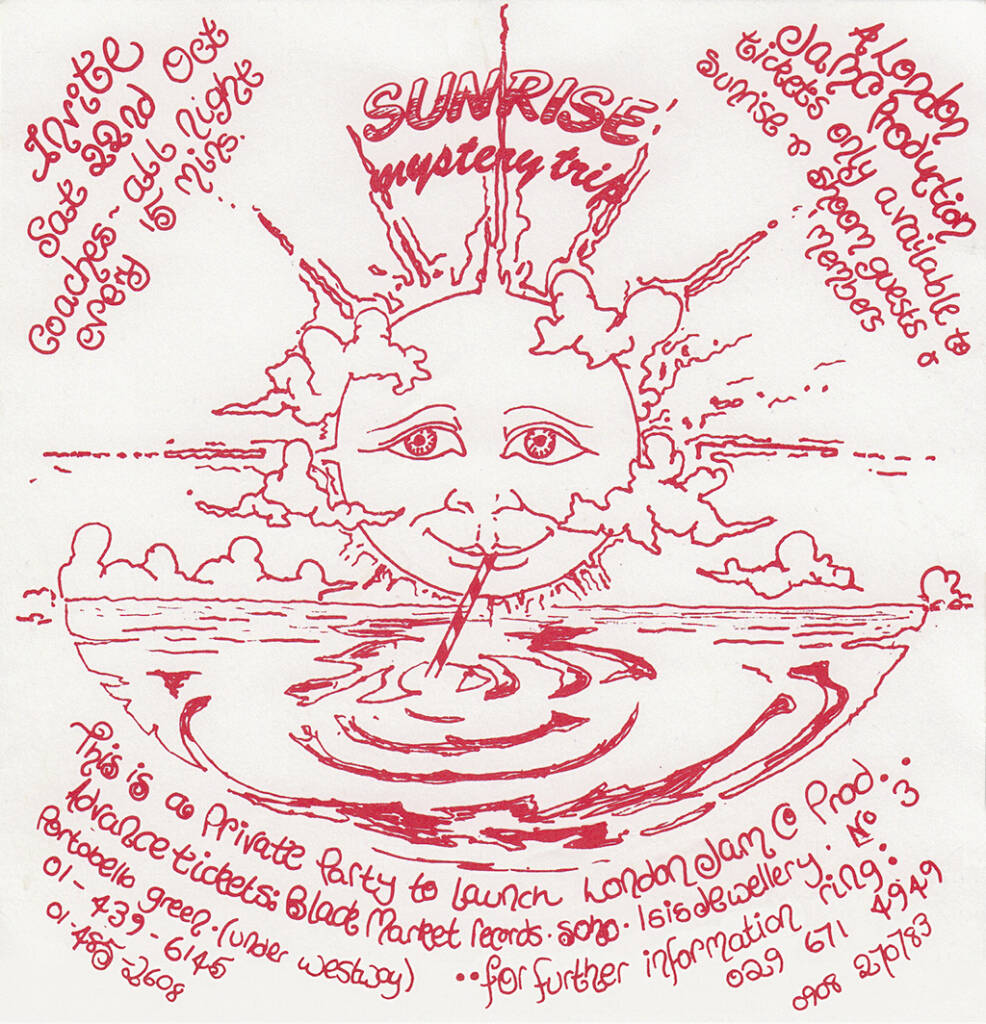
Tony Colston-Hayter would have been an incredible contribution. As the main organiser behind the Sunrise raves, he was famously labelled ‘Acid House’s Mr Big’ by the tabloids. He wasn’t available at the time, but his sister Charlie was incredibly generous and provided some heartfelt writing that I was very grateful to include.
Lenny Dee, who put on the smaller-scale but equally legendary Unit 4 parties in 1988 and 1989, was off-grid while I was researching the book. I was still able to gather some brilliant first-hand accounts from people who attended, but frustratingly, Lenny reappeared online just after publication. We’ve since spoken at length, he’s a lovely bloke but the timing simply didn’t work out.
There were also one or two promoters who chose not to contribute. In one case, the organiser of the RIP parties felt that the wider M25 orbital events had brought unwanted attention to the scene and ultimately played a part in his Clink Street venue being raided. I respected that decision, even though it would have added another important voice.
As for flyers, almost everything I was actively searching for eventually surfaced. That’s probably the result of nearly nine years of research. Inevitably, a few have appeared since publication that I would have loved to include, but with hundreds already left out from early drafts, some difficult decisions were unavoidable.

You’ve said previously that you were inspired by the work of Alfie Allen, who designed the book and is a graduate of UAL’s Camberwell College. What is it about his work that grabbed you?
Unbeknown to me at the time, Alfie was already a long-time phatmedia follower and a huge fan of rave artwork. Knowing that he genuinely understood the culture made him feel like the perfect fit for the project from the outset. His back catalogue was also incredibly strong, not just in volume, but in the quality of work and the artists he’d collaborated with.
Handing a project like this over to a designer was difficult. I’d become very attached to it. I could lay pages out, but I couldn’t create concepts or transform layouts into something that echoed the creativity of the flyers themselves.
Alfie understood restraint, knowing when to step back and let the artwork breathe. He didn’t try to modernise the flyers or over-design the pages. Instead, the book respects the original material while still feeling contemporary and beautifully structured. That balance is incredibly hard to achieve, and it’s why the book feels timeless rather than retro.
Working with Alfie also taught me that less really is more. Once we’d gone back and forth initially, we settled into a shared direction that we both trusted. He still kept a few special touches to himself, and when I finally saw the finished book I was completely blown away. I could never have imagined it turning out the way it did. I’m incredibly proud of what we created together.

Apparently you are working on volumes two and three now. Can you tell us more?
Volumes two and three continue the story chronologically, picking up where the first book ends. We hope to have book two out around October this year and three will be early 2027 all going well.
Volume two will focus on 1990-1991, beginning with the Freedom to Party rally in January 1990, when thousands of ravers protested against the introduction of anti-party legislation. From there, the book follows a pivotal period in which rave culture began to shift back indoors, as a small number of venues were granted all-night licences and legal rave clubs started to emerge.
Musically, it was a hugely important moment. The original house sound began to compete with the faster, harder breakbeat styles that were developing in the UK. At the same time, free parties and early sound systems were beginning to take shape like DiY, Spiral Tribe and Circus Warp. By 1991, large-scale legal outdoor events such as Weekend World and Book of Love had arrived, and these will form key features within the volume.
Volume three will cover 1992-1993, with Castlemorton acting as a central turning point culturally, politically and socially. Often described as ‘the rave that changed the law’, it became a catalyst for the Criminal Justice and Public Order Act 1994, including the now-infamous clause banning unlicensed gatherings featuring music defined as ‘repetitive beats’. This period also saw promoters such as Fantazia pushing outdoor event organisation to unprecedented levels at sites such as Bournemouth’s Matchams Park for Summertime and Donnington Park for One Step Beyond where around 25,000 ravers partied all night.
Finally then Dave, more than 30 years after the emergence of acid house and rave in Britain, what do you think is the enduring appeal of this culture both by those who were there and also those who weren’t?
For people who were there, the appeal is huge. It was a defining time in their lives. Rave culture offered freedom, connection and a sense of belonging that felt completely new. When people see these flyers now, they don’t just see design, they remember specific nights, places and moments. They act like emotional time capsules. Flashbacks.
For younger generations, I think the draw is different but still powerful. There’s an honesty to that era that really stands out today. Nothing was polished or planned long-term; it was DIY. People made flyers, parties and scenes because they had to, not because there was an industry around it, at least the very early days.
The artwork plays a big part in that. The flyers feel urgent and expressive cut and paste, rough printing, strange ideas, trippy visuals, psychedelic colours and that still connects with students and creatives now. I’ve sold many flyers to art students and creatives at various events to the younger generation and they are drawn to the artwork first – the history often comes later.
At its core, rave culture was about creating community through music. That idea hasn’t dated. Whether you lived it or are discovering it for the first time, it still represents a moment when people believed music could bring people together and I think that’s why it continues to resonate across generations.
You can buy Dave's book here.
Post-Grad Stories
Post-Grad Stories is a thriving online platform of postgraduate voices. Here you can share thought-provoking experiences, practices, thoughts and articles about what matters to you.
Do you have a story you want to share? You can email us at pgcommunity@arts.ac.uk.