
Successful AER applicant, Rudy Loewe, shares letter of motivation for the LABVERDE, Amazon, Brazil residency
- Written byPost-Grad Community
- Published date 25 April 2023
Share story
Rudy Loewe, PhD Fine Art Practice student (CCW) has been selected for the AER residency at LABVERDE, an established residency programme based in Amazon, Brazil
Set up by Professor Lucy Orta UAL Chair of Art for the Environment - Centre for Sustainable Fashion in 2015, The Art for the Environment International Artist Residency Programme (AER) provides UAL graduates with the exceptional opportunity to apply for short residencies at one of our internationally renowned host institutions, to explore concerns that define the 21st century – biodiversity, environmental sustainability, social economy, and human rights.
Read Rudy's successful proposal
Background
Over the last decade I have cultivated a socially engaged practice: facilitating and nurturing community spaces, whilst using painting, drawing and print to share radical knowledges and histories. In my work I encourage dialogues around Black histories, gender & sexuality, accessibility, colonialism and climate justice. I combine archival research and collected lived experiences, such as oral histories, to envision alternate futures centring Black queer and trans lives.
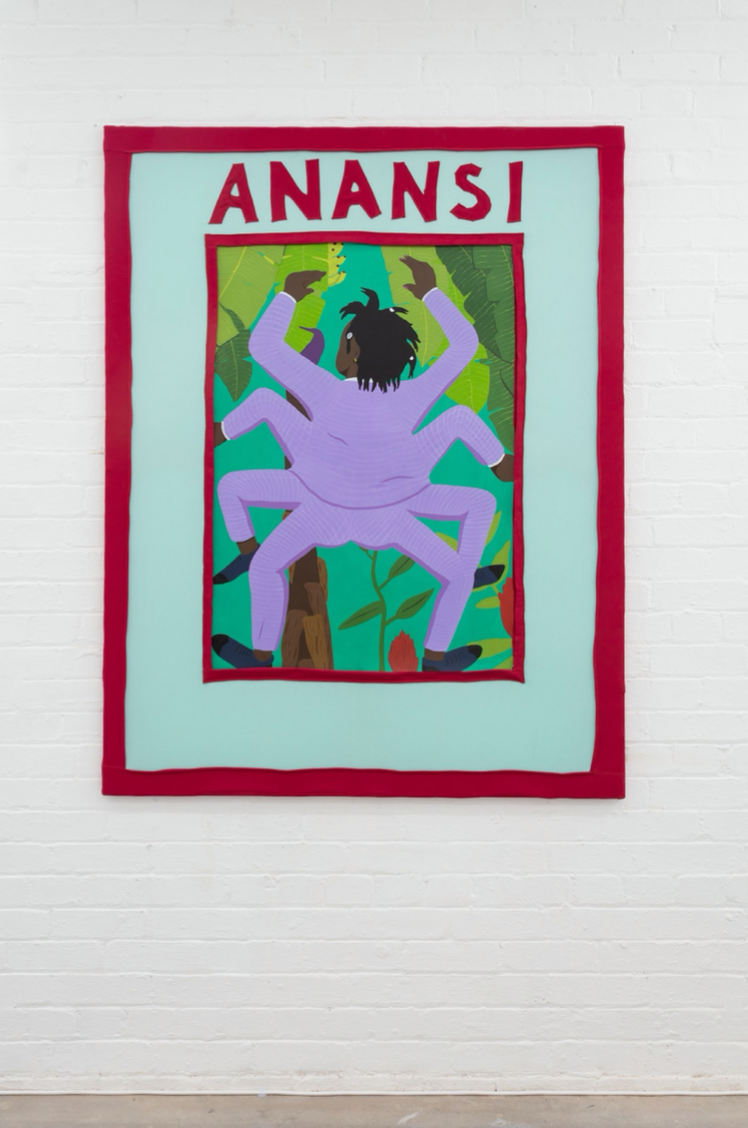
Within Black queer and trans communities we rely on forming systems for our mutually supported co-existence: sharing access to medication, financial aid, and lifesaving knowledge in a society not made for us. In my practice I am using Anansi, a character from the Caribbean folklore of my childhood, to envision a nourishing and sustainable future in which trans people not only survive but thrive. Anansi is known as a trickster, often underestimated or overlooked, acting cunningly to get his needs met. In my paintings Anansi features as a gender non-conforming shapeshifter, moving between spider and human, embodying ‘trickster technology’.
Folklore and mas (masquerade) are also a way of addressing the relationship between colonialism and the climate crisis. An ongoing research thread in my practice is examining the devastation caused by extraction in communities already ravaged by colonialism. A beginning point for this was learning about the Jamaican bauxite industry — which has caused environmental destruction, severe health implications and displacement of local residents. The sculpture I am currently creating for the 2023 Liverpool Biennial includes Moko Jumbie, spirits of ‘fate and retribution’ to confront Britain’s colonial legacy in the Caribbean, which did not end with independence.
Part of my practice is collective, having collaborated as a member of Brown Island, Collective Creativity and Grounding Future(s). Within all three collectives a central element of our work has been fostering community resources and building networks for BIPoC (Black/Indigenous/People of Colour).
I have an ongoing collaboration with Jacob V Joyce at the Serpentine. In 2020 Jacob and I created Power Pack: Climate Emergency as Artists In Residence. The pack, made for children, platforms young BIPoC climate activists making a difference in their communities. It offers drawing activities to playfully engage children in climate justice, inspiring them to become activists in their own context.
In our collaboration at the Serpentine, Jacob and I participated in the Back to Earth exhibition in 2022, addressing climate colonialism through a poster we created. We also spoke at Queer Earth and Liquid Matters about our ongoing work with the Power Pack. And we contributed to 140 Artists’ Ideas for Planet Earth published by Penguin in 2021.
For the residency I bring my critical, collaborative approach. I will build upon my work with Anansi and spiders; alongside this, I am particularly interested to learn about the history of the Amazon Forest, botany and entomology, creating sustainable practices for mutually supported co-existence. My practice would benefit greatly from being in an environment of specialists with scientific and site-specific experience; allowing me to engage with indigenous knowledges and practices from the wider natural world.

Framework of Project
Édouard Glissant refers to an ‘archipelagic world of Relation and rhizomes’, posing archipelagoes and ‘globality’ as a means of connected, localised networks that resist globalisation and capitalism. Nature offers countless examples of these networks, as well as models of resistance and mutuality that we can learn from when envisioning alternatives, leading us away from climate catastrophe.
During the Labverde residency I will develop my work with Anansi, looking towards examples within arachnology, entomology and botany in the Amazon Forest that teach us about generative networks of resistance and sustainable community practices. I intend to collaborate with local experts to examine systems in the Amazon environment that glimpse modes of being outside of extractive, capitalist structures.

I will present the research collected during the residency by drawing with ink on textiles, creating a web that can be used and shared in other contexts. This research will consider: How can we envision life beyond capitalism centring indigenous knowledges and the systems present in our natural environment?
This research will then be used to continue the Anansi painting series after the residency is completed, embedding scientific perspectives not previously present in the work. This would be greatly beneficial to this ongoing series, adding in important conversations.
Plan
- Series of walks and site visits in the Amazon Forest with local experts to identify examples within botany, arachnology and entomology that can be included in the research
- Drawing and writing in response to the research, including what can be learned from the examples and what frameworks can be formed around this
- Create artwork on textiles, which will be used as a basis for paintings to be created after the residency is completed
I am very interested in the potential for unexpected collaborations as a part of this residency. Although my primary interest with applying is researching systems of mutual co-existence within the Amazon Forest, I would like to remain open to opportunities to collaborate with other researchers and local experts, in ways that take me outside of what I could have imagined possible for my practice.
As Jacob and I will be creating the second iteration of the Power Pack with young people in London later this year, I would like to include the work created during the residency as a reference point for the project with the Serpentine. This could be included in the publication, which will go out to thousands of young people and will be available for download online.
Related links
UAL Post-Grad Community
Established in 2013, Post-Grad Community is an inclusive platform for all UAL postgraduate students to share work, find opportunities and connect with other creatives within the UAL and beyond. Find out more