Quick thought: Sentimental Value
- Written byPost-Grad Community
- Published date 08 March 2021
Share story
By Emily Grant - MA Arts and Cultural Enterprise at Central Saint Martins.
I, like many people, watched ‘Tidying Up With Mari Kondo’ on Netflix. I must say that it was addictive, watching many, many people go through items that they have held onto for years and letting them go. In fact, it started a craze; charity shops all over the world were suddenly inundated with items that just didn’t ‘spark joy’.
Now I know what you’re thinking, what in heavens name does this have to do with sentimentality in art? Okay, well, first I have a confession to make. I sometimes can’t sleep at night and on one of these nights I got to thinking about why we hold on to certain things for years on end, and why we just let others go? It made me want to assess how we value things, especially art.
Now I am someone who believes that all art has value, but why? Why do we value art? And how do art dealers, experts and critics around the world value art? I mean it’s a lot to think about when you can’t sleep, but it’s not the reason why I can’t sleep, thank god! But I digress, let’s start with sentimentality; something we keep because it means something a little different to us, the individual, not necessarily the collective. However, sentimentality is often demonised as a way of continually looking back into the past, into memory; true, it might ‘spark joy’ but it might just break your heart.
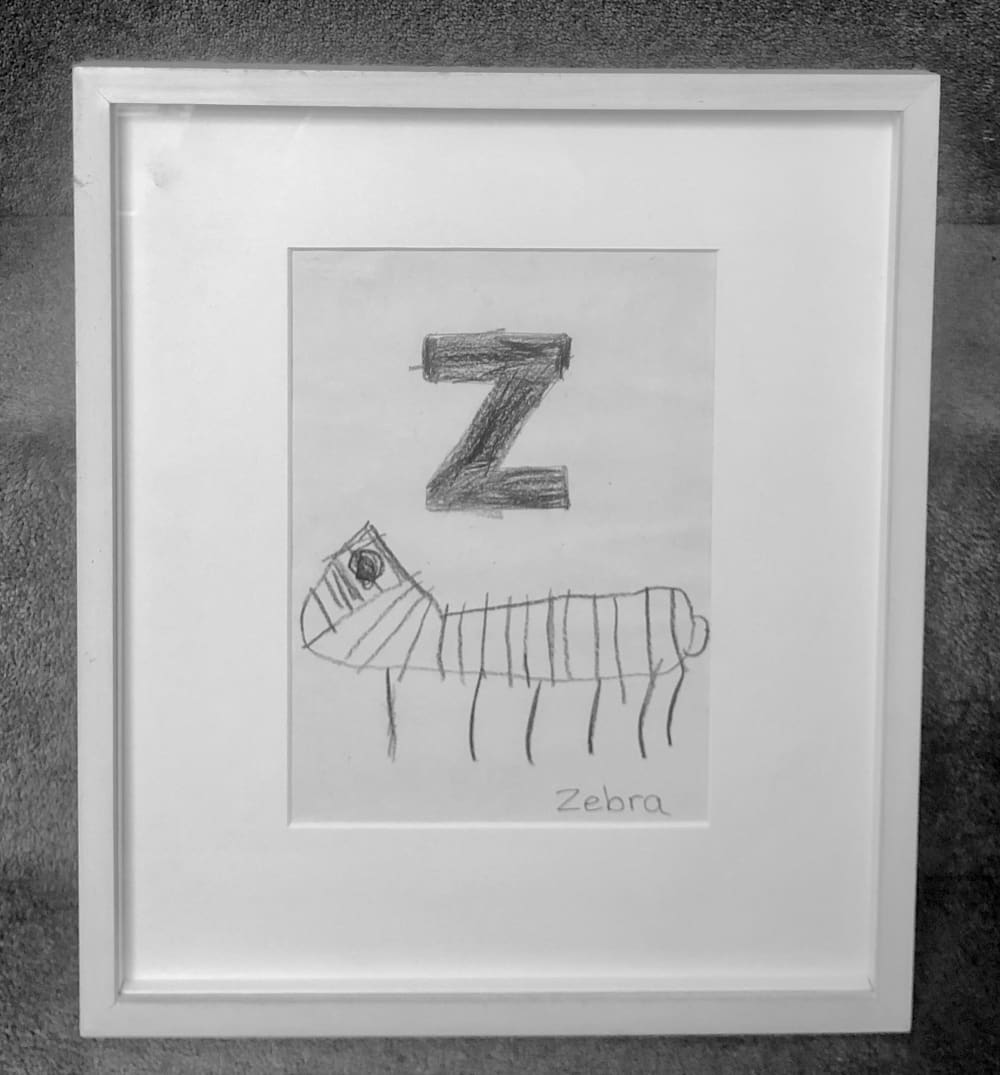
As such, let’s take a trip down into memory lane. Now, I’m sure it’s not for aesthetic reason, but the six-legged zebra I drew when I was four has value to my parents because I drew it when I was four. My mother framed it. It’s on the wall along the stairs. I guess she liked it? Parents often talk about ‘The Fridge’ (I’m not a parent so I have no idea about this) But, when they like the crayon or pasta-felt-tip-glue-mess made drawing and crafts, it makes it to ‘The Fridge’. In pride of place. Where all can see how great the pasta thing art piece is. It’s almost mythic. But why ‘The Fridge’?. Well, simply put there can be an exchange of art. Think about it, there are fridge magnets! You don’t have to faff around with blue tack or other what-have-yous in order to stick art around the place. Also, magnets don’t leave marks on the walls when you take the art down, thus leaving incriminating evidence to the arts demise. See, the beauty of fridge magnets means you can replace the old art with new art, shopping lists, doctors’ appointments- you get the picture (pun intended).
However, what happens to the old art is anyone’s guess. I’m not a parent, so I guess I’ll find out. Yet, the child doesn’t really notice that the art changes, what the child notices is the performance of the parent putting up art in the first place. Its saying, I think this piece of art is great and we’re going to display it for all to see! See the kitchen is the place where everyone hangs out. Food is in there. So, people gather at all times of day: morning, noon and night.
The kitchen is a place we all return to, it’s the hub. And, as its the hub, it’s the beating heart of the family home. Please excuse the cliche, but they say ‘home is where the heart is’ for a reason. Art on the fridge is more than just a performance of appreciation, it’s an act of love. Sentiment, therefore, happens when our children grow up, maybe they move away or when life just happens to move on. It's a reminder of the love that was felt during a time you’ll never be able to get back. There’s a bittersweetness to it, it’s not necessarily a bad thing. At all. It’s really quite lovely. It could be a sign of a life well lived?
But back to my Zebra, when my mother loved a piece I did as a child and FRAMED it?! It was like winning the lottery. But why? I recently asked my father, very pointedly, why the heck did he and my mother keep that zebra? “Because you do!” Meaning? “Well, it might be a birthday card, get well soon card, something that has a reason behind it. Something that had a conscious effort put into it. It may also be the first time that you drew a card or maybe it was something that was finally recognisable!” I would like to add that my father did say that if the house was on fire and he had to choose between a drawing I did when I was four and a Rembrandt. He’d save the Rembrandt, not because he doesn’t like my art, but… it’s a Rembrandt. There is monetary value there. Fortunately for my four-legged zebra we don’t own a Rembrandt. So, hypothetical fires aside, sentiment can only take you so far. At least with my Dad.
Sentimentality is not just restricted to family memories, there is sentiment to a nation. Now I live in London, and if you lived here, visited or taken a trip on google street view, then you’ll know that we have many fabulous (some not so) statues and buildings that make up this majestic city. Take, for example, The Royal Albert Memorial. It may not be the prettiest monument in the world, in my humble layman’s opinion, but my! It is monumental. I’m sure some of you know, that this monument was made out of grief after the death of Prince Albert, commissioned by a Queen who loved him very, very much. It is a magnificent example of Victorian craftsmanship and aesthetics. As such, it still stands here today in Kensington Gardens out of sentiment to the love of a Queen.
I must admit, there is one slightly fundamental difference though, between my zebra and The Albert Memorial, and that lies in its contribution to human history, same with a Rembrandt. Both Queen Victoria and Rembrandt have contributed quite a considerable amount to human history that has had a far-reaching impact. Queen Victoria ruled a quarter of the globe at one point and Rembrandt… well his paintings are worth up to $180 million and are showcased in art galleries and museums all over the world. Now, if $180 million doesn’t ‘spark joy’ I don’t know what will. On the other hand, I can also understand if Queen Victoria’s contribution doesn’t ‘spark joy’. Hindsight is a funny thing. But I digress, as much as I would love to talk about ‘value to human history’ that is a subject for another article for another time. Otherwise, we’ll be here all day.

But let’s think about The Albert Memorial for just a second longer, now that monument has sentimental value to the nation, and the Queen. But that doesn’t mean it’s shared by everyone, it might serve a purpose for the collective whole as a nation, but if I asked someone who lives in, say, Chile whether they share in Queen Victoria’s sentiment? I have strong feeling the answer will be no. they may understand the sentiment behind it, but they won’t necessarily share in it. It was, after all, deeply personal for Queen Victoria. In a way, a monument to him was a reminder of a past that can never be regained, a reminder of what has been lost. Sentimentality is a deep emotional state, but we have to be careful not to reflect too deeply on them. Think about what Nietzsche said, ‘if thou gaze long into an abyss, the abyss will also gaze into thee”. Nope. Does not ‘spark joy’.
So perhaps, Mari Kondo has a point with the whole ‘spark joy’. I mean we have charity shops and antique stores that are full of objects that, for some people, no longer ‘sparked joy’, but they may do for someone else. In this manner we have a whole new level to sentimentality, it’s not shared but passed on. Let me explain, I have here a book about cacti (don’t ask me why I chose cacti) now this book has been great, told me everything I need to know about Cacti (I know nothing about cacti) but, alas, it has fulfilled its purpose and off it goes to the charity shop/second-hand bookshop. My sentiment for that book has come to an end and I have let it go.
Now in the charity shop someone, a cacti enthusiast no doubt (I’m not a cacti enthusiast) finds my book and boom! A new journey of sentimentality begins, the book has been used, served its purpose (I don’t actually own any cacti) and this new person knows that it has been appreciated, but in need of a new home. Thus, the sentiment has been passed on. Equally I could have talked about family heirlooms, folklore, rites of passage, but no. I chose cacti.
On that note, I should probably conclude this brief-ish meandering piece on sentimentality. Congratulations if any of this made sense to you. However, sentimentality is an odd, curious, multi-dimensional idea. It’s sort of negative, but slowly becoming a key thought in the world of aesthetics and to them do I leave the question of ‘spark joy’.
The thing is, can you really apply the madness of ‘spark joy’ to sentiment? Oh, what do I know? I wrote this after no sleep and many, many cups of coffee and an entire packet of jelly babies. Yet, if it’s all the same to you, my six-legged zebra remains on the wall. It’s been 22 years and it still hasn’t made it to the fridge. That does not ‘spark joy’.
Post-Grad Stories
A thriving online magazine of our postgraduate student voices sharing thought-provoking experiences, practices, thoughts and articles about what matters to them.
Download the PDF Guide to writing articles for Post-Grad Stories
Want to write an article? Get in touch with the Post-Grad Community team PGCommunity@arts.ac.uk