Open Call: SURGE III - Deadline: Friday 26 May, 2023
- Written byPost-Grad Community
- Published date 09 May 2023
Share story
Expression of Interest Deadline: Friday 26 May, 2023
Explore surgical technology and techniques of the future alongside your artistic practice - and what this means for patients and society.
We are inviting UAL postgraduate artists and UCL healthcare technology researchers to come together for SURGE III, a funded art and engineering project that will conclude with an exhibition of your work in 2024.
You’re invited to submit an expression of interest (250 words) in developing a project that will bring together artists, scientists, surgeons and the public.
This is a commissioned project. Successful applicants will receive:
- 8 months to develop and deliver their project
- Collaborative workshops
- Funding of up to £3000
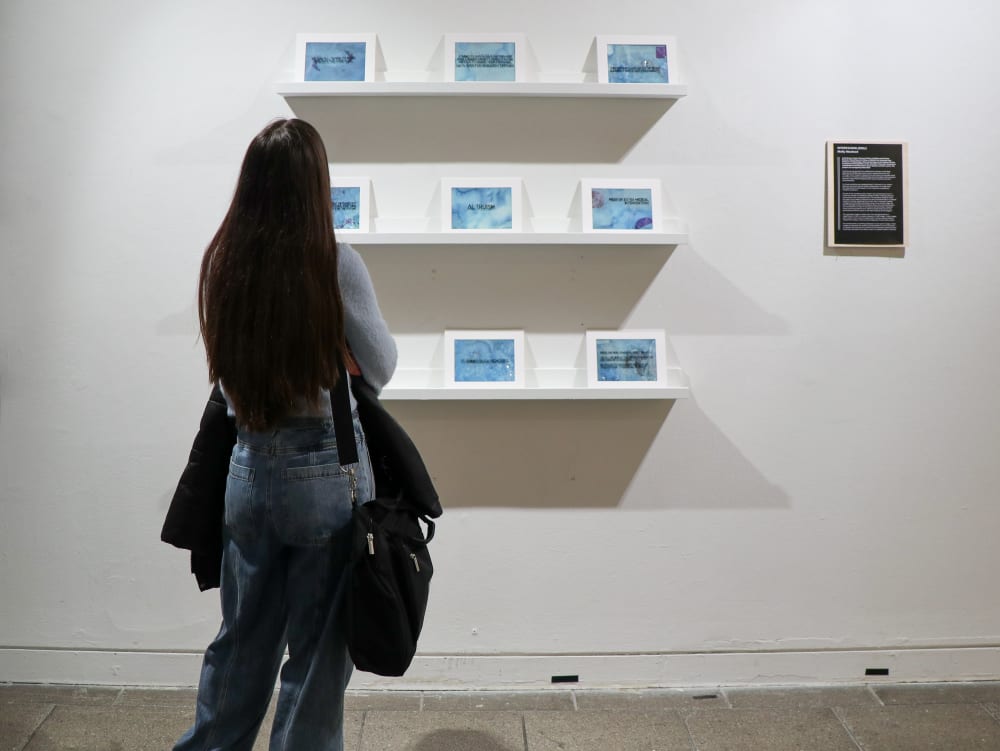
- Final work displayed in a UAL gallery, at various locations across London, and online on the UAL WithoutForm.space platform
Together, you will explore some of the complexities of technology in surgery, as well as their societal implications. Previous themes have included the ethics of informed consent, patient autonomy, and the wider ramifications of invasive application.
We are seeking artists to create meaningful partnerships with academics that explore themes in ways that engage patient groups. Workshop findings will produce new artwork to be publicly displayed next year.
We will consider visual artists from any discipline and are especially interested in those with a socially engaged practice. Researchers will be sought across healthcare engineering disciplines, including medical physics, computer science, mechanical engineering and surgery.
SURGE III will be the third edition of a partnership between with UCL’s Wellcome / EPSRC Centre for Interventional and Surgical Sciences (WEISS) and UAL’s Post-Grad Community.
Explore previous successful SURGE projects and discover Simon Watt's (WEISS) Practical Guide to Science/Art Collaborations.
SURGE I online exhibition
Process
We will be recruiting UCL academic researchers alongside artists, though it is not yet confirmed what specific research interests they may have. WEISS brings together engineering, computing and medical staff. This includes research into medical imaging, robotics, Artificial Intelligence, sensors and much more.
Artists and researchers will be shortlisted and invited to a matchmaking session as a chance to meet and build relationships, followed by time to discuss and apply for a collaboration grant.
WEISS knows the benefits to involving public and patient groups in exploring topics that affect them and so, where appropriate, will also seek chances for you to meet with and involve patient groups. If this is not possible, we will ask that your practice seeks to explore topics with a more general public too. We hope to cultivate as socially engaged practice as possible.
After our initial matchmaking event there will be some time for artists to put together a project proposal with their matched scientific collaborator. We appreciate the level of work required to do this and so all submitted proposals will be granted a £40 honorarium.
Project map for commissioned partnerships:
Project stage | Who? | ||
Artist | WEISS Researchers | Publics/Patient group | |
Project Development | Artists and WEISS Researchers develop an arts facilitated workshop.
| Public Engagement professionals support the collaboration to find and recruit the kind of participants needed for the workshop | |
Workshop | Workshop lead and facilitated by artist. | WEISS Researchers and members of chosen public take part in workshop creating their own art and taking part in discussions together. | |
Artistic output | Artist creates final artwork(s) using the materials and/or ideas, opinions and questions generated in the workshops. | ||
Final sharing | The final piece is shared with all involved in the project and the wider public, inviting further reflections and the potential for further development. | ||
Timeline
Expressions of interest submitted by | 26 May 2023 |
UCL and UAL Matchmaking event | 16 June 2023 |
Application deadline (for funding) | End of June 2023 |
Projects announced | End of July 2023 |
First project development workshop | August/September 2023 |
Project development | August 2023 to March 2024 |
Projects completed by | End of March 2024 |
Collaboration outcomes displayed | April 2023 |
Expression of Interest
We are not asking you to spend too long on an application at this stage, the process (outlined above) is designed to select partnerships through a process of meetings, discussion, a joint written application, and funded collaborative research.
In order to be transparent and to help understand if this process is likely to suit you, we will be looking for evidence of your preparedness for becoming an involved artist through this process. It is expected that you will demonstrate one or more of the following attributes:
- An interest in exploratory practice with healthcare technologies
- An ability to respond to research in your thinking
- An ability to collaborate in your art practice
- An established approach to working with publics, patients and/or communities
- Where possible, experience of socially engaged practice and connections
Fill out and submit this form to express your interest. This is due by Friday 26 May, 2023: Expression of interest form
Any questions or enquiries, email:
Simon Watt (UCL): simon.watt@ucl.ac.uk
Catriona Mahmoud (UAL): pgcommunity@arts.ac.uk
Eligibility
Applicants must be UAL postgraduates (Ma and PhD) and also have a right to work in the UK.
Post-Grad Community at UAL
UAL is home to more than 5,000 postgraduate students working across the fields of art, design, screen, communication, fashion, media and performance. Within our six world-renowned colleges, we aim to form a creative network of artists, designers and innovators.
Post-Grad Community is an inclusive platform for UAL postgraduate students to share work, find opportunities and connect with other creatives within the University and beyond.
WEISS
At WEISS, engineers, clinicians and computer scientists work together to develop technologies that enable safer and more effective treatments for patients across a wide range of conditions.