
Text and images by Noemi Gunea,
MA Performance Design and Practice, Central Saint Martins

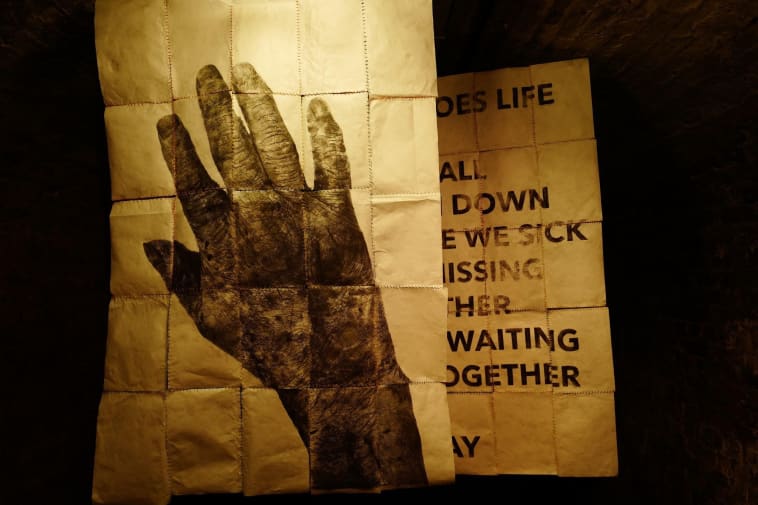
image: Jina Lee, What does life mean?, 2017, Conté on paper, hand sewn, (200x150cm)
Beyond the Borders exhibition at the Crypt Gallery in Kings Cross looks at the subjective meanings of borders, territories and identity. Tucked away in plain sight in a crypt in Euston, the space feels immersive. Rugged, moist and cold, the environment reflects the themes of the artwork. We are not in a conventional white box, but you have to step outside of your comfort zone to experience what it is like to take an active role in building a society, but being placed outside of it. The artworks are more than an individual creation housed in a gallery, they are part of a network that seeks to provoke social change.

image: Opening night of Beyond The Borders in The Crypt Gallery, Kings Cross
Boram Jang , MRes Exhibition Studies student from Central Saint Martins is the curator who initiated this project – funded by the UAL Postgraduate Student Communities of Practice EXTRA Fund, by inviting artists to interact with the Joseonjok community in New Malden. Ethnically Korean, but of Chinese nationality, the Joseonjok people are a very deprived population that have been affected by migration. By engaging with the community through workshops, dinners and sharing of stories, the artists sought to build connections and talk about community issues.
How did you meet and start working on this project?
Jina Lee: I think it was early February, Richard Layzell, the director of Fine Arts Print based Media in Wimbledon College of Arts invited me to do my teaching hours there. He was organising the exhibition Korea Town about a Korean town in New Malden, so after the teaching hours he invited me for a presentation that he was making for the Korean Day. I did my presentation about my research there there about my PhD work with the Joseonjok community, Boram worked as the exhibition assistant and she thought my research was quite interesting as it related to her subjects. She asked if she could use your research to create an exhibition about borders so i handed out all my resources about Joseonjok and she started gathering other participants.
Were all the artists involved already familiar with the Joseonjok community?
Boram Jang: No, this was specifically Jina’s interest, the others had practices relating to conflict, minority issues, dislocation, borders, and I thought it was closely relevant to the topic. I also encouraged them to get to know the Joseonjok, organised meals together, so they were able to draw inspiration from the same ideas.

Jina Lee, Food Workshop, 2017
What role does cartography play in your practice?
Jina Lee: My PhD is based on critical cartography, which started around 1980’s, when some artists refused to use conventional maps. Using an artwork they make new networks, and especially my work is integrating critical cartography with fine art. I interviewed Joseonjok people and then transposed their stories into artworks.

Jina Lee, Destiney/Decision #1,2,3, 2017 Conté on paper, printed on OHPfilm, (130x130cm)
Which artists inspire you?
Jina Lee: William Kentridge – he uses moving image, draws very fast, and he also deals with minorities and labourers, so it’s not directly cartographic images that he uses but he’s always been one of my inspirations.
How did you research the Joseonjok?
Jina Lee: Well, Boram will know, but it’s actually quite difficult to contact Joseonjok people. I knew there were a lot of them living in New Malden but there was no chance for me to personally contact any of them, so I just went on the street with my sketchbook and started to sketch the scenes. In the winter it was too cold so I would go in a cafe, a train station, anywhere warm – so it was a more of a detailed drawing, but as the weather got warmer it became more like a quick esquisse. Sometimes it rained, or i got food marks on my paper. But that way i was able to see what i couldn’t see before. If you just stay there for more than one hour you start to see the hidden spaces. For example there’s always a newspaper stand on the street for a Korean newspaper and I never thought who fills it up – but there is a person who does it in the morning and the afternoon, and those kind of things that we normally don’t see. People keep recreating the scene, always hidden. It’s been 20 years now that New Malden is becoming a Korean town and I think Joseonjok had a big role to play, because they did the hard works that South Koreans wouldn’t do .

Jinseon Kim, Hands, 2017, Photography
Boram Jang: For me, it was very important for me that Joseonjok community is involved in this project. The most difficult was to make the project visible for them, to reach them. I did an interview for a Korean radio channel that people in New Malden listen to, I put leaflets all over the streets, I flyered.
Jina Lee: When they first arrived in the 90’s people were working non stop, they had debts because they had to pay a broker, to get a visa, get a flight ticket, and they had to pay all of this off – a woman only Skype’d her family after 5 years. London was an ideoscape for them – we all have in our imagination an ideal space – the Joseonjok thought London was a dreamland that will get them lots of jobs, but as you know that is not the reality. Now the situation is a bit better, but 20 years ago their lives were very harsh, they were very poor and badly treated. Now there are less Joseonjok people as well because of visa difficulties, lots of them were sent back.

SuJeong Paik, Memory Drawings: Daerim-Dong, 2017, Ink on Korean paper- sizes various
How is the Joseonjok community viewed in Korea?
Boram Jang: They are very disregarded. ‘The Yellow Sea’ is a very popular film that does just that – vilify them, portray them as dangerous and inferior. Although they are Chinese nationals, they are of Korean origin, so it’s very strange that they are looked down on like this by Koreans. That is why I chose the Crypt Gallery, to show how the Joseonjok are hidden under plain sight, and often live in harsh conditions. It didn’t make sense to me to put this work in a fancy white cube.
I’ve worked at the Tate Exchange and learnt the importance of engaging with audiences and this is what I’m trying to ask with this project – what is the artist’s role and responsibility in society. Accessibility was also important. Prior to the exhibition we had food tastings and workshops, but the location in New Malden was quite tricky for the public, we invited many people but they cancelled last minute because of low accessibility.
Background to Beyond the Borders:
Funded by the UAL Postgraduate Student Communities of Practice Fund, Beyond the Borders project aims were to interact with an undocumented minority Joseonjok community in London. To look to understand something of this community’s ambiguity through artistic collaborations in their neighborhoods to attempt to reveal the invisible phenomena. Joseonjok is ethnographically not only in between Chinese and Korean identity, but also South and North Korean.
Find out more about other events and research that happened within the Beyond The Borders project on the Beyond the Borders – Dedicated Project Blog.
Postgraduate Student Communities of Practice Fund
The University of the Arts London makes available funds to assist current postgraduate students in organising academic events and cultural interventions which work to bring together different communities within both Postgraduate Taught and Research student bodies at UAL. Usually the funds are set at a maximum £300, but in February each year, 2 pots of £1,000 are made available for more ambitious projects under the ‘EXTRA‘ banner. This project was 1 of the 2 projects funded in the 2016-20117 academic year.
Download the Exhibition Catalogue
Related Links:
- UAL Postgraduate Student Communities of Practice Fund
- Beyond the Borders – Dedicated Project Blog
- Jina Lee – PhD Candidate – UAL Profile Page
- Wimbledon College Blog Article about Korea Town
- MRes Exhibition Studies course at Central Saint Martins