Meet Sean Dendere: Considering the duality between notions of home and travel
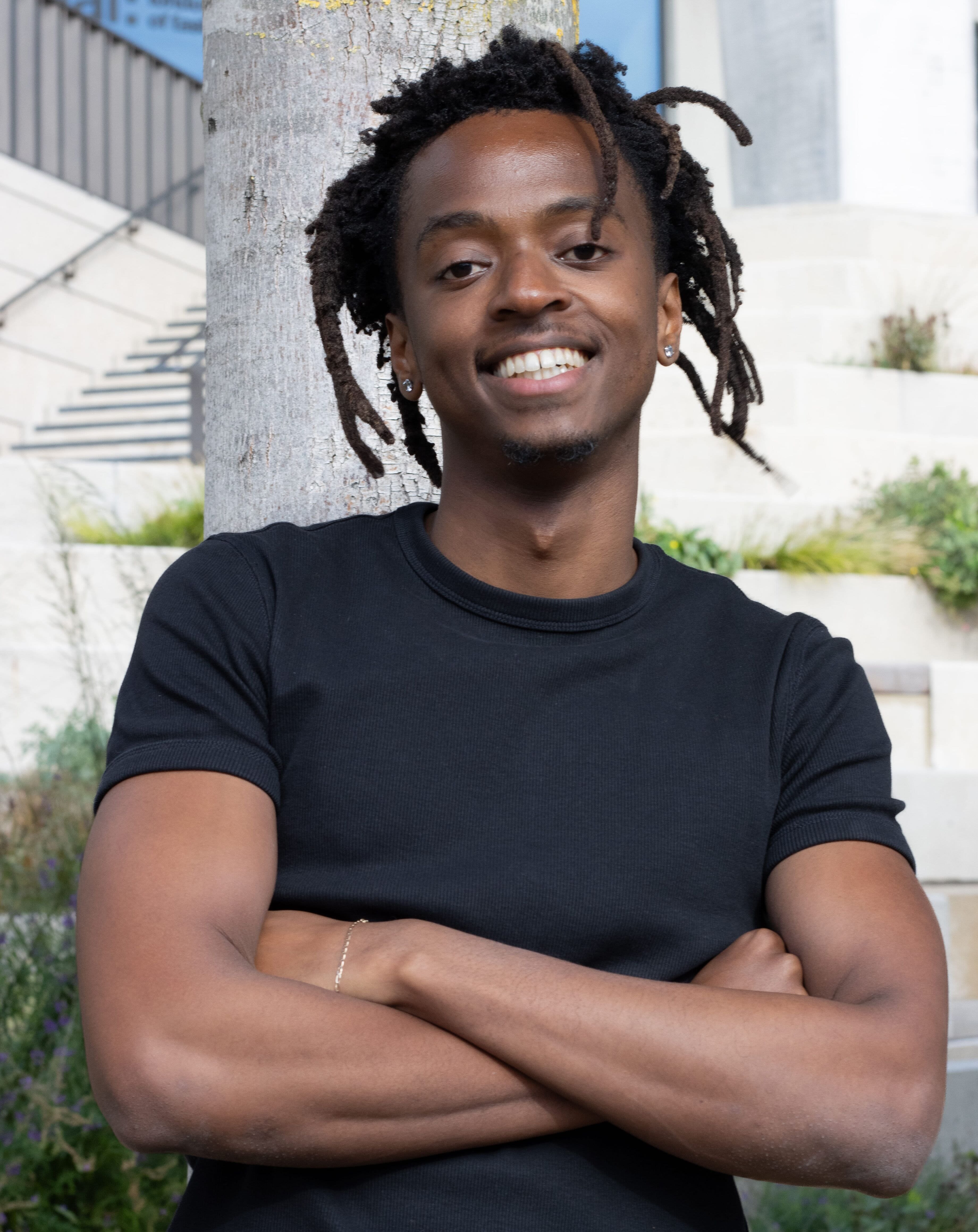
- Written byStudent Communications
- Published date 10 October 2025
Sean Dendere is one of 3 artists who worked with UAL's Brand and Creative team to create the collages used for our 2025 Black History Month campaign.
We spoke to Sean to learn more about the artist behind the work.
Hi Sean! Can you please introduce yourself and tell us a little about your background?
My name is Sean Dendere, originally from Peterborough and I am a graduate of Central Saint Martins. I studied Product Design and graduated two years ago - class of 2023. My background is in product design, but since graduating I’ve been working a lot in film, as well as doing art curation and research for galleries.
How did your journey with art begin?
I’d say my earliest memories have always involved art. I remember being in school doing art club and entering art competitions from a young age. I don’t remember ever starting to like art - it’s always been a constant in my life and I think it’s just snowballed. It’s one of those things I never grew out of; I was kind of silly enough to think that I could pursue it as a career.
Who or what first encourage you to pursue creativity seriously?
I’d definitely say my mum. She’s always been a big tastemaker in my life. She has great taste in fashion, took me to loads of museums and art galleries growing up and played a lot of music around the house. She really has an affinity for the arts.
Ever since I was young, I was surrounded by family who, through their personalities, poured so much art and taste into how I dress and the music I listen to. Culturally, it was a very rich and stimulating upbringing.
How has your identity shaped the way you create?
I feel like my identity extends to my family because I am them and they are me. I always think of them as an extension of myself. Any time I’m creating work, I’m thinking about them as muses - would they like this, or would they like that?
I centre myself and my family throughout my work, using them to test how far I should push certain ideas or what aesthetics I should go for, because that’s what’s true to me. If I create from that space, I’ll always be original - rather than thinking about what people want to like or what audience I’m speaking to. As long as my core 3 or 4 people in my life like it, that’s the best thing I can do.
What themes or messages do your most often explore in your work?
I’d definitely say home and travel. Those are two things I’m always grappling with. I’m always trying to find home and home is such an elastic concept. I’m also always trying to travel, both as a form of education and as a way to find my home, too.
Those are the biggest themes across my work. I’m always thinking about what makes me feel safe and what makes me feel inspired. How can I take other cultures and be inspired by them, but also bring that back home and look at it through my lens and lived experience.
How do you want people to feel when they experience your art?
I want people to feel safe, feel at home, feel peaceful and also feel provoked. I’d rather make someone feel something than nothing. The worst thing, as an artist or creative person, is if you make something and people are indifferent to it.
I’d rather people have an opinion, even a negative one. It’s important to feel something, to be challenged - to challenge people and things.
What has been your proudest achievement so far?
My proudest artistic achievement was getting into Central Saint Martins. That was a big deal for me because I grew up inspired by so many artists who went there, so it’s great to see myself within that lineage.
My final major project was purchased by the university museum, which was a really proud moment. At the time, I was 22 and my work was placed alongside artists I looked up to, people who inspired me to even apply to CSM. Having that come full circle was really special, being recognised for the story I was telling.
That was always my goal - to teach myself how to take something inanimate and infuse a story within it. I feel like that’s a kind of alchemy, a form of magic because something that means nothing objectively can, subjectively, hold deep meaning.
Who or what are your primary inspirations (artist, movements, personal experiences, cultural heritage, etc)?
The first one is definitely Alexander McQueen. I don’t remember any of his products, per se, but I remember the stories he told. I never knew one person could tell such powerful stories through clothes, because objectively speaking, they’re just clothes, yet he was able to be so theatrical and infuse so much context into a garment.
He created fashion shows that still resonate today and make people feel emotion toward pieces of clothing. When he died, I remember my mum being so distraught - his death was such a key moment in my life.
Nifemi Marcus-Bello, a furniture designer from Nigeria, is another huge inspiration of mine. I remember the first time I saw his work, it amazed me because it was inspired by African identity but communicated in a progressive way, looking forward as much as it looked back.
I ended up working with him during my placement year at university as his design assistant, which was the most amazing experience, because he was my idol. One of the projects I worked on with him ended up being purchased by MoMA. Being around him taught me how to tell a story through a product. Even small things. like even hearing how he spoke in meetings, changed my life and shaped the career I have now.
What role do you think Black artists play in shaping wider cultural conversations today?
I think it’s very important to push the conversation forward and move the needle in everything I create and touch.
I also think my responsibility is to tell my story and that story doesn’t always have to be a sad one. Even though, naturally, there’s sadness that comes with being Black, I feel it’s important for my work to spotlight the joy and beauty that come from my continent, my home and my upbringing.
There are already so many stories of Black plight and struggle and those are vital, but I also feel a responsibility to tell the world about our joy and genius.
I’m an amalgamation of all the people I’ve been around, collecting their stories and telling them on their behalf. I’m the orator, using whatever medium I can to give voices to people who may not have the time or platform to articulate themselves on a wider scale.
How do you celebrate your heritage or community through your creative practice?
It’s important for me to celebrate where I’m from. The project that was bought by the Central Saint Martins Museum was about me actively telling the story of Zimbabwe from a pre-colonial context, looking at our rich history. It’s important for me to always celebrate who we were and who we want to become.
You've been selected as part of the Black History Month campaign for UAL - what does this recognition mean to you personally?
Initially, it made me nervous. It felt like a lot of pressure because it’s such a big thing - Black history is huge and I’m representing every Black person, even though my experience is limited by my age.
It’s a lot to think about - how can I represent my people on that stage? UAL is such a renowned institution; people look to us for answers. But at the same time, I welcomed that challenge. Because, I guess if not me, then who? If they think I’m ready, then I’m ready. I’m more than ready.
I don’t think I’ll ever get it perfectly right, but I can be honest about my experience and what I’ve been through. I can’t tell the whole story of Black history, but I can tell my story and I think that’s what they want from me.
The theme is 'Standing Firm in Power and Pride' - how do these values show up in your life and work?
The thing I’ve been teaching myself lately is to be more entitled, to have higher standards for myself and for how other people treat me. I shouldn’t let that drop just because I’m happy or grateful to be in certain spaces. I’m just as deserving as everyone else.
I remind myself daily that I shouldn’t be okay with average just because it was hard to get here. It’s easy to accept mediocrity, so I stay firm in keeping my standards and aspirations high and take pride in everything I do, regardless of outside situations.
What message of power and pride would you like to share during Black History Month?
Don’t feel grateful to be where you are - feel deserving. You deserve to be where you are. This isn’t a mistake or someone taking pity on you, you’re worthy of everything you’ve earned and you should ask for more.
Have the confidence to demand what you deserve and more, because if not you, then who? Historically, so much has been taken from us and it’s easy to feel like everything’s fine now. But it’s important to remember there are people more talented than me who don’t get the opportunity, so if you can, do it twice over. More is more!
What advice would you give to young Black creatives starting their journey now?
Be optimistic. Be the change you want to see in the world. Believe you’re going to be the one who makes it through, rather than asking, what’s the point of even trying.
Your story, your lived experiences, your intellectual property - that’s one thing no one can ever take from you. Your story, upbringing and culture are irreplaceable. No matter what medium you put them in, they’ll always have value, especially if you’re honest, sincere and candid.
Final question! What excites you most about the future of Black art and culture?
I think having more voices on a platform. I look forward to a future with more and more different versions of people, which will alleviate the pressure on individuals to represent their whole lineage, culture, or ancestry.
Hopefully, people will feel like they can just tell their personal stories which is such a privilege, because so often we feel we have to speak for our entire community.
I look forward to being selfish sometimes, creating work that’s simply beautiful, that doesn’t have to be about culture or identity. It can be about something as self-indulgent as my breakfast.
Relevant links
- Find out more about Black History Month 2025 at UAL