Meet Ismael Ali Nasreldin: Critiquing the status quo and accepted societal truths
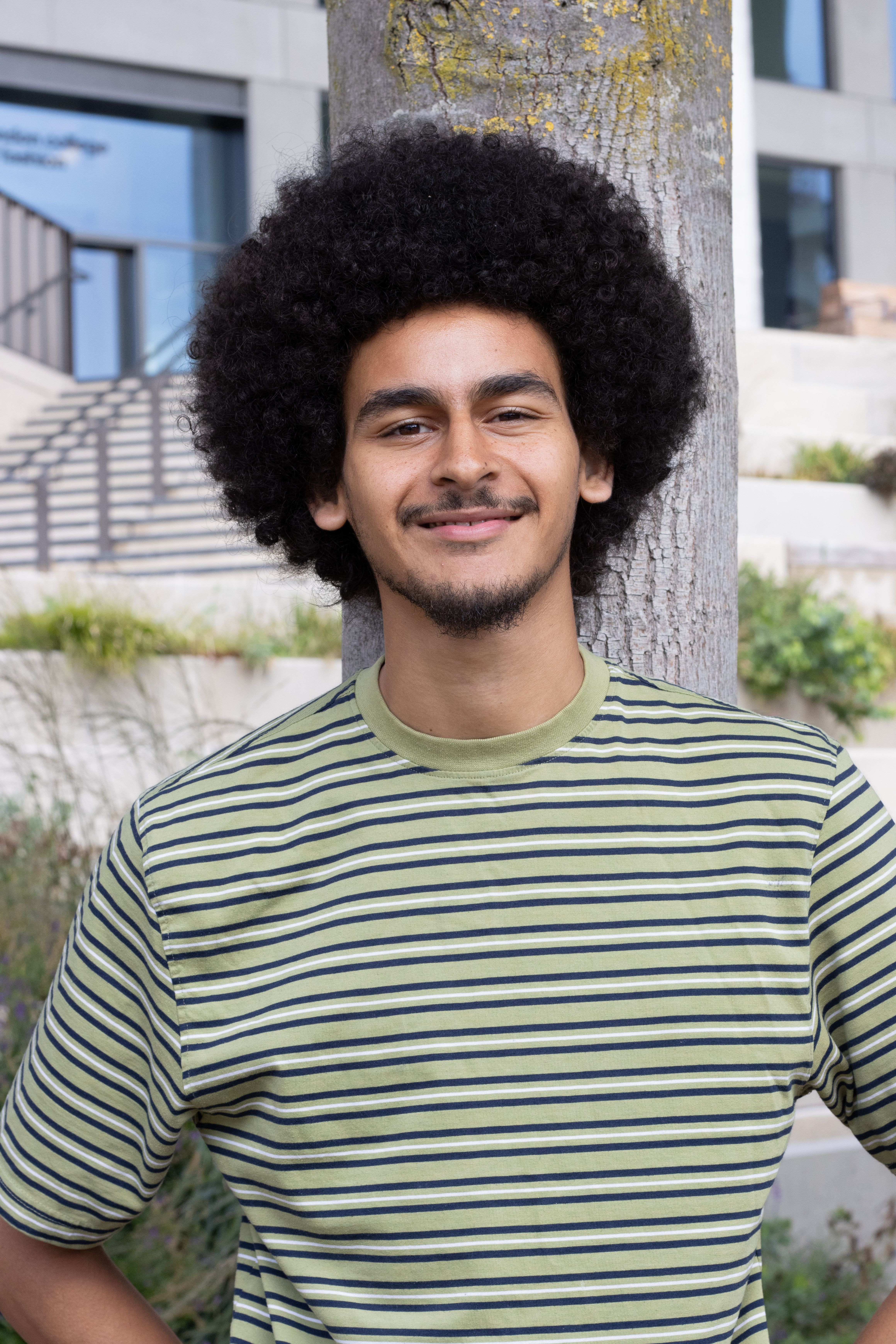
- Written byStudent Communications
- Published date 10 October 2025
Ismael Ali Nasreldin is one of three artists who worked with UAL's Brand and Creative team to create the collages used for our 2025 Black History Month campaign.
We spoke to Ismael Ali to learn more about the artist behind the work.
Hi Ismael Ali! Can you please introduce yourself and tell us a little about your background?
My name is Ismael Ali. I grew up in Preston in the northwest of England, and I came to university at UAL to study Documentary Photography at London College of Communication. Since my degree, I’ve been working in visual arts, youth work and archiving in London.
I’m currently in a workshop space teaching young people photography and different printmaking methods, which is how I’m delivering my practice at the moment. Rather than creating work for myself, I’m facilitating safe spaces for young people to enjoy self-expression.
In terms of my practice, I really enjoy the art of observation and responding to thoughts I have in my head, visualising them through photography and photo manipulation.
How did your journey with art begin?
I began my journey with art as a wider practice through childhood. I always drew as a child - not that I was very good at it, but I’d always doodle. I was also a bit of a performer and wanted to be a rapper when I was quite young, so I guess those artistic worlds of expression came together.
My practice became more serious and intentional just before I went to college. I was given a camera and being quite politicised at that age, I began using it to connect some of my interests through visual stories. I discovered that documentary photography or photojournalism was the best avenue for me to pursue. I ended up developing a finer and more conceptual style that explores photography alongside other art mediums like printmaking.
Who or what first encourage you to pursue creativity seriously?
I don’t think I can name a particular individual necessarily, it was very internal, to be honest. Not to say that no one influenced me, of course. Many people influence me every day, but I didn’t really study art or artists - I was just creating.
At an academic level, I delved more into research and found people who made work like mine, which inspired me there. But at the start, it was rooted within me and allowed me to create something outside of my 4-bedroom walls.
What themes or messages do your most often explore in your work?
Often in my work, it tends to appropriate but also critique or poke holes within an idea, a notion, or an element of the status quo. Some of my earliest works in college were inspired by the Black Panther Party in America and their artist-in-residence, Emery Douglas. He taught me a lot and led me to explore visual messages of resistance, self-sufficiency, community-mindedness and faith in the future.
At university, I was quite disheartened about photography and the modes cameras are put to, so I began questioning the notion that “the camera can’t lie”. Through my work, I forced it to lie and looked at the harsh realities of how cameras were used. I tried to point out the pitfalls in photography and the idea of it being wholly factual, truthful, and a good representation of who someone is just because you can see what they look like.
Ultimately, it’s not about what they look like - it’s about how they feel, what their presence is like. I often look at other visual markers that showcase human essence, like if you hug someone long enough, you might get an imprint of their clothes on your skin and I think about how I can bring that depth into my work.
How do you want people to feel when they experience your art?
I’d say, with the work I’m most proud of are the pieces I’ve put the most time and passion into - I want people to ask themselves questions, to sit with themselves and explore their thoughts. “I think this way - why do I think this way? Where did it come from? Should I think this way? Does this work encourage or challenge the way I think?”
I like the idea of my work encouraging someone to widen their perspective. A lot of my work is very personal to me, but I’d love for someone to look at it and give it time, engage with it, be inquisitive and just a little bit more curious.
What has been your proudest achievement so far?
The most proud I’ve been of a piece of work would be my final project at university, which was actually purchased by UAL. After doing a dissertation exploring the ways a camera can be used as a weapon and feeling a certain way toward photography that wasn’t so positive, I decided to challenge myself to create something with a camera that was personal, richer, and deeper in concept.
I took a series of self-portrait photographs, all intentionally rejecting passport photo regulations and teasing the idea of how we’re supposed to identify ourselves within bureaucratic systems. In these portraits, I’m smiling, wearing a hat or glasses, or even swearing at the camera - all the things you definitely can’t do on a passport photograph! By doing this in my own project, it actually identified me more than a formal mode of identification would.
I wanted to interact with the work longer and take it further than just a printed-out image, so I used lithography to create stamps of solidarity and manipulated the prints further.
How has your identity shaped the way you create?
It has intrinsically, but also fluidly. My identity now might change tomorrow. I keep an open identity; it’s just how I feel, it’s my mood. Sometimes I can be a chatty patty; sometimes I just want time to sit with myself.
I think identity is often looked at as a fixed position, but I don’t see it that way. I allow my identity to get loose within the work I make. I haven’t even developed a specific style as such, because if it came from me, it is my style, even if it looks very different from what I’ve made before. I allow my identity to guide me to be more limitless than restricted, which is why it’s integral to what I create.
How do you celebrate your heritage or community through your creative practice?
I celebrate them by living with them, because I think before I’m an artist, I’m an individual within this world who exists within my community. I’m sitting with my aunties, uncles, parents - just being with them. Whether they’re telling me stories, family history, a joke, or we’re just chilling and being in each other’s presence, that’s me celebrating my community: living with them, breathing with them.
That’s how I naturally and subconsciously integrate them into my work, because it’s just the way I think.
In a more visual sense, naturally I have a camera around, and I love my family, so I take pictures of them a lot and sometimes add more concept to it. I’ve done projects before where I’ve taken portraits of my aunties and uncles and then zoomed in so you can actually see the texture of their skin. You can’t see the whole of them, but you can get a sense of the texture or the fabric of them.
I use ancient hieroglyphics that reference the attributes I believe my aunties or uncles have, like integrity and I emboss it into the image or the paper to suggest that this is what my auntie looks like, but if you get close enough to her, spend enough time with her, this is what she feels like.
You've been selected as part of the Black History Month campaign for UAL - what does this recognition mean to you personally?
I think it’s great that this initiative is bringing in young people with creative skills and lived experiences and giving them the floor to represent Black history how we want.
For example, with my collage, I’m putting ancient things that Black people created, the pyramids, West African masks and I’m rejecting ideas of victimisation to show that actually, Black people have achieved so much. It’s good that this initiative allows us to make the rules and use the medium of colour to literally pick and choose how we want to represent Blackness.
I just want to thank UAL for bringing us in and giving us such freedom within this initiative. The prompt, Stand Firm in Pride and Power, is strong and feels like a bit of a weight to respond to. It made it easier for me to dissect and accept that there’s pride and power in so many actions of people who can be described as Black and that’s what I’m exploring.
Final question! What excites you most about the future of Black art and culture?
It’s very easy to just pick up our phone or put on Netflix and do things that are very passive. So I’d say try to avoid that - use your hands, your feet, your eyes. Be active in this world.
Not active in a way where you feel like you have to be Beyoncé selling out stadiums - but as long as you’re active, thinking, moving, being human, existing, that’s producing art. Every day we create breath, sentences, thoughts in our head - that’s all art. And if you can put that on a piece of paper, even better.
Be outside, or be in your head, but just be somewhere. Try not to distract yourself with passive doomscrolling. The more conversations you can have with yourself, the healthier your mental health can be, and the more confident you may become.
Photography made me much more confident because I came to know myself in a way - though I’m forever uncovering myself. Just do as you feel, ask yourself questions and allow yourself to challenge your assumptions. It’s okay to have a preconceived notion - we all do - but accept that it’s not a fact, and then we can play with it. That leaves more room for wider discussions and more freedom of thought, because not everything is as simple as blue is blue. There are so many hues of blue - pick the one you want for that day, or however long. Just be loose, be free and be observant.
Try to find out the things you don’t know - or even the things you think you know. And if you have opinions, listen to people who have the opposite opinion, because listening doesn’t cost anything. We don’t have to immediately adopt what we hear, but the more we listen, the more we can find relatability and common ground with others.
Be sensitive, be open-minded, be curious, be inquisitive.
Relevant links
- Find out more about Black History Month 2025 at UAL