
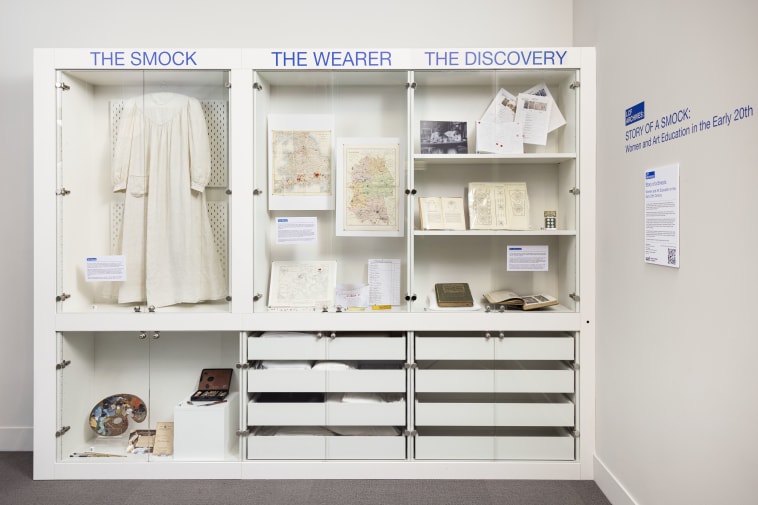
A new display at London College of Fashion Archives (LCF Archives) is now open. It emerges from the Centre for Fashion Curation (CfFC) one-year material culture project about women’s early arts education, funded by the Society of Antiquaries.
Research centered on a single object: a smock dated around 1900, identified only by a woven name tape reading ‘M. Balch.’
A key question of our research was what a close study of the garment’s material composition, construction, and wear could reveal about its original use. The project also situates the smock within the late 19th century ‘dress reform movement’. This movement advocated practical, artistic forms of clothing. It challenged restrictive fashion and reflected shifting ideas about women’s roles in society.
LCF Archives became involved when Alexandra Foxwell (Research Assistant and former student at LCF), visited the service to conduct her own research into smocks. Looking into the depths of our History of LCF Collection, we realised how relevant the garment was to our own collections, and to the history of London College Fashion’s trades schools.
LCF Archives run a collaborative biannual display programme, which is open to both staff and students at LCF. When the prospect of collaborating to create a display around the smock’s story arose, we were very enthusiastic.
It demonstrates how one object can open many lines of enquiry. We divided the display into six thematic sections. The beginning traces the origins of the artist’s smock and its potential wearer through a close reading of the object. In later sections, visitors can explore the broader history of the smock; its social and cultural history; and its connection to trade schools, including London College of Fashion.
We collaborated with textile-mounting specialist, Gesa Werner, to develop a paper pattern and reconstructed undergarments that would have been worn with the smock. This allowed us to study the garment’s construction in detail, using photographs of students wearing comparable smocks as our primary reference.
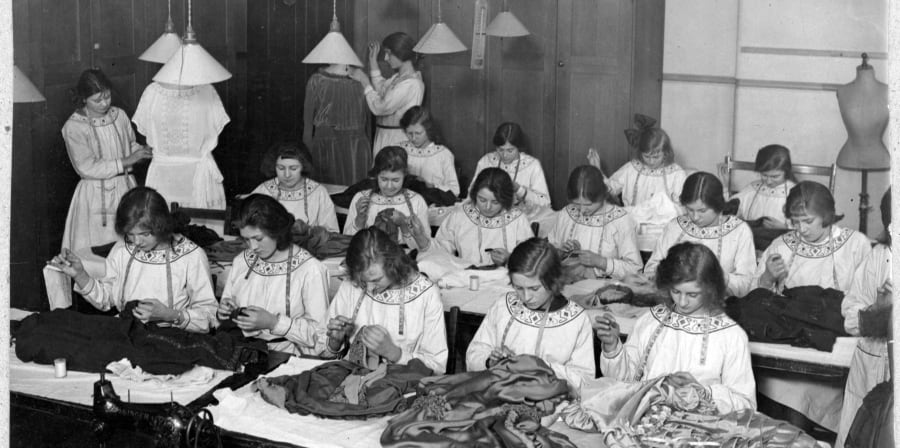
The historical photos in the display, show the student’s skill and identity through their smocks, but also represent women’s expanding role in the workforce, which is a central theme of the display. To highlight the history of Trade Schools, visitors will find past students' works, as well as makers' tools. These show the range of disciplines taught, and the traditional methods used in training.
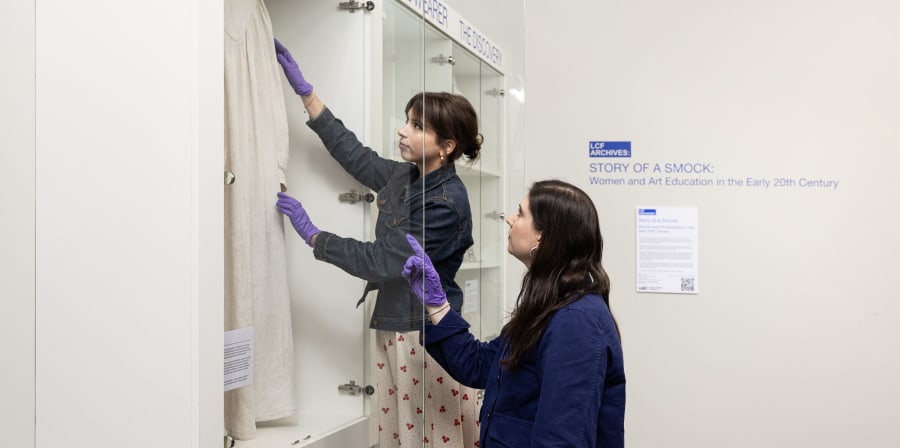
In collaboration with Gesa Werner, we agreed it was essential to present the smock using archival best practice. We hung the garment on a calico-covered hanger allowing it to drape naturally. Fine fishing wire attached to a tulle support beneath the smock anchors the gussets at the side of the hem. This highlights the smock’s distinctive A-line silhouette, allowing movement for the original wearer.
Fishing wire then became a key tool throughout the display. It served both a practical and conceptual purpose. It supports the objects, but highlights how the research developed through fragments. We used pattern hooks and suspension for the smock pattern, to show the volume it occupies when worn. This suggests its form while remaining detached from a physical body. The reconstructed undergarments appear in an almost ghostly manner: They are based on informed interpretation, rather than exact replicas.
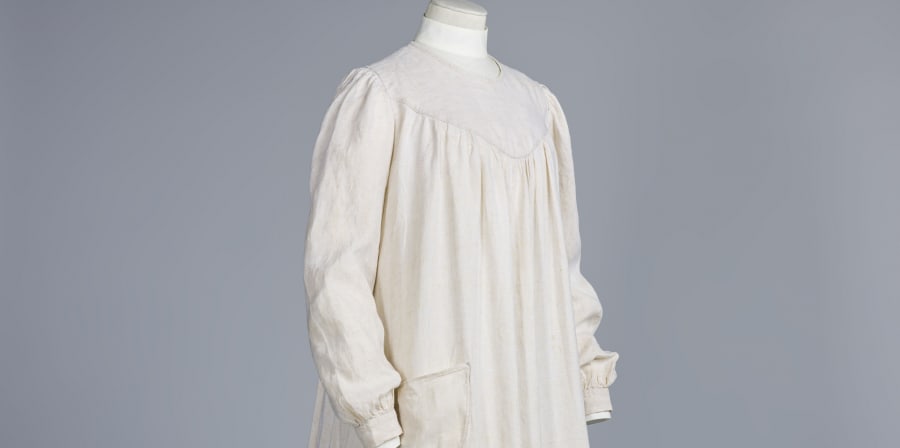
LCF Archives is now formally acquiring the garment, generously donated by Professor Claire Wilcox. It demonstrates how fashion and the arts were taught at a particular time, and how clothing functioned as a form of coded expression.
We are continually exploring ways to collect and preserve the work and culture produced at LCF. This project focuses on the research and perspectives of a current professor and a former student, and documents both the project itself and the object at its core.
‘Story of a Smock: Women and Art Education in the Early 20th Century’, is now open in the LCF Archives, London College of Fashion, from October 2025 – February 2026.
Curated by Alexandra Foxwell and Chloe Gilbert.
Find out more
For information about LCF Archives and its collections, visit the LCF Archives webpage
For enquiries, please email archives@fashion.arts.ac.uk