HairCycle: Challenging perceptions of what waste is considered worthy of recycling

- Written byMadi Hough
- Published date 15 September 2025
Share story
In the hierarchy of what is deemed “valuable” waste, materials such as cardboard, paper, plastic, glass, and metal sit comfortably at the top—those we commonly consider “recyclable.” Others, like wood or certain textiles, occupy a more specialised bracket, requiring unique recycling processes. But materials that fall into the realm of “grossness”—such as bone, seaweed, or human hair—tend to sink to the bottom of waste respectability. The UK produces around 6.8 million kilograms of human hair waste every year—hair that too often ends up clogging drains and filling landfill sites, releasing harmful greenhouse gases. This happens despite hair’s valuable properties: it’s lightweight, compostable (rich in nitrogen), and possesses high tensile strength.
HairCycle steps in as an intervention in this hierarchy, challenging perceptions of what waste is considered worthy of recycling. Focusing on the locally abundant yet overlooked resource of human hair, the project reimagines its potential within a circular, bio-based economy.
HairCycle, an AHRC-funded Design Exchange Partnership between the University of the Arts London (UAL) and the London Borough of Newham, transcends conventional approaches to recycling and waste management by centring behavioural change and community engagement. Through participatory research methods and creative material exploration, the team has successfully sparked curiosity and conversation around the unlikely material of human hair waste.
HairCycle set out to test new systemic methods and models for collecting, recycling, and regenerating human hair waste from local barbershops and hairdressers in Newham. We sat down with UAL project leads Sanne Visser and Rosie Hornbuckle to learn more about this award-winning Knowledge Exchange initiative, which received the R&D Innovation Award at the UAL KE Staff Awards 2025. Together, they share how this groundbreaking collaboration enabled the world’s first systemic social and material innovation approach to recycling human hair waste within a community setting—and why this could signal a shift in how we think about waste, value, and local circular economies.
To start us off, could you walk us through how the project came about?
Sanne Visser (SV): It came out of my long-term work with human hair as a regenerative material resource, which I’ve been exploring for nearly a decade. Just before starting HairCycle, I was doing a residency at the Design Museum, where I worked collaboratively with hairdressers and barbers. With HairCycle, we wanted to expand that ecosystem — bringing in more stakeholders, including the local council.
We partnered with the London Borough of Newham, who supported us and guided us in understanding the community and its challenges — things like poverty, crime, housing, unemployment, and issues around waste and recycling. The project became a way to explore these local issues through a regenerative, community-led lens.
We took a bottom-up approach, really trying to understand who’s in the community and how people might respond to recycling human hair and transforming this waste. We worked not only with hairdressers and barbers but also residents from Newham’s highly diverse communities, each with their own cultural and religious beliefs about hair. That was crucial — because attitudes toward this material can vary widely.
Rosie Hornbuckle (RH): It’s probably worth explaining our roles too. This project really stems from Sanne’s practice — it’s embedded in her material research. My role was to support her, helping guide some of the co-design activities and bring in systems thinking. I acted as a sounding board for academic and methodological decisions, helping to reflect critically on what was happening and how best to approach challenges sensitively.
The project’s outputs really speak for themselves: from diverting over 160 kg of human hair waste from the landfill to running over 15 engagement activities including a short film screened at Vue Cinema, exhibitions, workshops and over 22 collaborations with local businesses and practitioners. Could you walk us through the logistics of the project which enabled these fantastic outputs?
SV: Sure. The goal was to test a local, regenerative model — both in terms of material applications and stakeholder relationships.
After securing funding from the AHRC, we partnered with Newham and established a physical base — the Hair Cycle Hub on Stratford High Street. It served as both a processing hub and a community workshop venue.
We also purchased a cargo bike to collect hair donations from 17 participating salons every two weeks. Alongside collection, we ran co-design workshops involving local residents, students, and creative partners — including architects, community garden collectives, engineers and designers — to explore applications and system mapping.
RH: And it’s important to stress how much work that took. Co-design sounds simple, but it’s complex and labour-intensive. Engaging barbers, for example, meant working around their schedules, cultural events, and trust-building. It’s slow, messy, and requires a huge emotional and logistical investment — far beyond what’s often romanticised about “community collaboration.”
You’ve both mentioned community involvement — how did you approach local partners and make sure the project was genuinely ground-up rather than top-down?
SV: We spoke with three boroughs, but Newham showed the strongest alignment. They were interested in exploring new community collaborations, even though there was some initial scepticism — particularly about how their community might respond, given low recycling rates and limited awareness of sustainability initiatives.
However, the opposite happened. The community became genuinely engaged, ultimately proving the council wrong and opening a relationship between the council and the hairdressing and barbering sector — a major presence on the high street — which the council had little knowledge of and engagement with prior.
RH: Yes, and the partnership worked largely because of relationships. Our main contact, Jahid from Newham Council, immediately saw the project’s potential for his community. Other boroughs had different agendas, but Jahid understood the value of letting the project grow from the ground up rather than imposing a top-down framework. His local knowledge helped us connect with harder-to-reach communities and build trust.
SV: Exactly — trust-building was key, both with the council and with the hairdressers and barbers we collaborated with. We worked with 17 salons and barbershops across different neighbourhoods, genders, and cultural backgrounds, making sure to represent the borough’s diversity. Because everyone’s relationship to hair is different — technically, socially, and culturally — this diversity gave us richer insights.

Were there any standout insights from those collaborations?
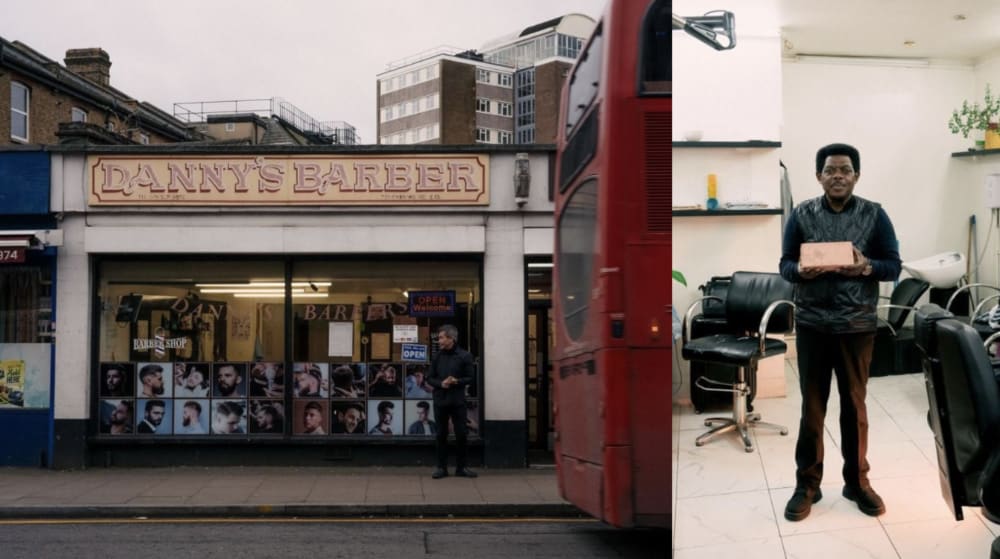
SV: Yes — for instance, we learned that in some cultures, touching someone’s hair is taboo. One Nigerian barber explained that in his culture, people often take their hair home and bury it. Others were open to experimenting once they understood the project’s goals.
We also learned from faith-based discussions that involving community or religious leaders could help build trust, especially when addressing sensitive topics like the reuse of human hair.
RH: What struck me was how some cultural assumptions shifted through participation. Initially, even Jahid was worried people might reject the idea, but once trust was built and people understood the purpose, many became genuinely curious and engaged. It showed that these cultural “boundaries” are often more fluid than we think.
Let’s talk about the material itself. How did you navigate people’s reactions to human hair — which many might find taboo or “gross”?
SV: We focused on three main application areas: textiles, building materials, and agriculture. My background is in textile-based innovations — developing yarn and rope — but we wanted to expand beyond that to create innovative products such as fertiliser, compost, furniture, accessories, and building materials like bricks, tiles, and renders.
We worked with a local community garden to explore agricultural applications, like using felted hair mats as nutrient layers in vegetable beds. One unexpected application was the use of hair as a filtering agent in the garden’s outdoor kitchen, utilising the intrinsic quality of hair as an oil adsorbent. The garden replaced straw with hair in their greywater filtration system — it adsorbed oil far better and the used hair could then be composted.
This project reinforced that there isn’t just one silver bullet solution — the material’s versatility invites multiple uses depending on the context.
That’s fascinating — and it seems people’s perceptions change once they interact with the material.
SV: Exactly. During our felt-making workshops, many young participants initially refused to touch the hair. But once they started working with it, they quickly became absorbed in the process. Making and learning through doing helped overcome that initial discomfort.
RH: Yes, and it wasn’t just about sustainability. Hair is a completely unique material — intimate yet unfamiliar when placed in new contexts. That unfamiliarity sparks imagination. Unlike plastic or wood, hair carries personal and cultural associations, so when you reintroduce it as a material, it provokes curiosity and creativity.

Now, as for student involvement, I am aware one of the project’s outputs was a co-developed GIGA map made with a UAL MA student, Tam Preston. How else was student involvement worked into the project?
SV: Yes. Students from multiple disciplines — architecture, textiles, communication, and service design — participated in our workshops. One group from the MA Communicating Complexity course worked with us for three weeks, using systems mapping tools to visualise the Hair Cycle network.
We also held Open Fridays at the Hub, where students could visit, learn about the process, and see how research translates into tangible community engagement.
RH: Because the project is so interdisciplinary, it speaks to students from many fields. We even had involvement from universities like University of Westminster and London School of Economics. Seeing how different disciplines engage with the same material system was incredibly rewarding.
You also worked on a policy brief. How did that come about, and where do you see it going?
SV: Yes — it’s still ongoing, actually! We’ve been working with a policy expert to identify potential recommendations from the project. For example, we’ve discussed incentives for sustainable business participation — like reduced business rates for salons contributing to a circular economy.
Policy moves slowly, but connecting community-based research with local government action is crucial for lasting impact.
RH: Right — and when a project like this reveals unexpected value, it’s essential to capture and communicate that through policy or advocacy. We learned that having a “wrap-up phase” to reflect on impact and feed it back into wider systems — whether through councils or universities — is vital.
After having run a successful pilot, what is in store next for HairCycle?
SV: Well, interestingly it is now registered as an actual company, so we are trying to raise further funds and investment partners. On a logistical level, we are currently paused as we reevaluate how to operationally run hair collection.
In the long term, we want to continue to work with the community to develop an ecosystem and infrastructure to sustain HairCycle. These things take a long time to develop, but we are hoping to eventually create a more self-sustaining model.
RH: From a research point of view, our reflections on the project have enabled us to write papers and share the outputs of the project more broadly. So hopefully, we have also contributed some more generalisable knowledge and a strong case study for how to run these types of projects. So, rather than being a standalone project, we have been able to generate insights that could benefit other kinds of projects and methodologies.

To follow what the future has in store for HairCycle, visit the HairCycle website at haircycle.org.
- Explore our Knowledge Exchange projects and how we use creativity at UAL to tackle pressing global issues
- Start a creative partnership with us by completing our enquiry form