Forest School: Learning with Nature
- Written byNicole Horgan
- Published date 01 April 2026
Forest School seeks to reimagine education by integrating it with living systems, fostering a deep connection with nature to address the climate and biodiversity crises. This innovative approach is a response to the limitations of conventional education, advocating for a model that aligns more closely with natural ecosystems. Supported by a broad network of partners, the Forest School aims to develop a holistic educational framework rooted in the forest environment.
Forest School aims to cultivate empathy with the natural world through immersive educational experiences. It has facilitated collaborations between students and various environmental and community organisations over the past three years, funded by diverse partners and donors. It has bridged the gap between academic learning and practical application by engaging students in projects that promote environmental stewardship and community involvement.
Since its inception, Forest School has involved over 200 students in interdisciplinary teams working on projects such as designing outdoor classrooms, creating public installations, and conducting environmental research. In recent years, Forest School partnered with Forestry England on a variety of environmentally focused projects. Guided by experienced designers and academics, students from Central Saint Martins have participated in programmes involving co-designing with community members and environmental experts.
In 2023, the Forest School further expanded its outreach by involving students in a series of projects with diverse ecological and social impacts. This included collaborations with expert practitioners from the global south to explore methods of indigenous communities in Colombia, where students worked on sustainable design projects and learned about traditional ecological knowledge. These efforts have had a lasting impact, providing important reciprocal exchange, and offering students invaluable insights.
The idea for the Forest School originated from a desire for CSM to address the climate and biodiversity crises through immersive education. The concept aimed to move beyond traditional classroom settings to foster a deeper connection with the natural world. Forestry England, with its expanded mission to include well-being, biodiversity, and education, became a key partner. This collaboration allowed the Forest School to develop, providing students with opportunities to engage with forest environments and integrate ecological principles into their projects. The Forest School emerged as a pilot initiative, aiming to create a network of collaborations around forest systems and establish a dedicated centre for forest-based education.
Aims
- Facilitating interdisciplinary activities exploring sustainable practices and ecological impacts.
- Building robust networks with organisations such as Forestry England, Communities across Europe and the global south, and international research institutions.
- Involving local communities and fostering connections between students and natural environments.
- Promoting practices that enhance biodiversity, ecological health and planetary wellbeing.
Initiatives and activities
Outdoor classroom at Dalby Forest
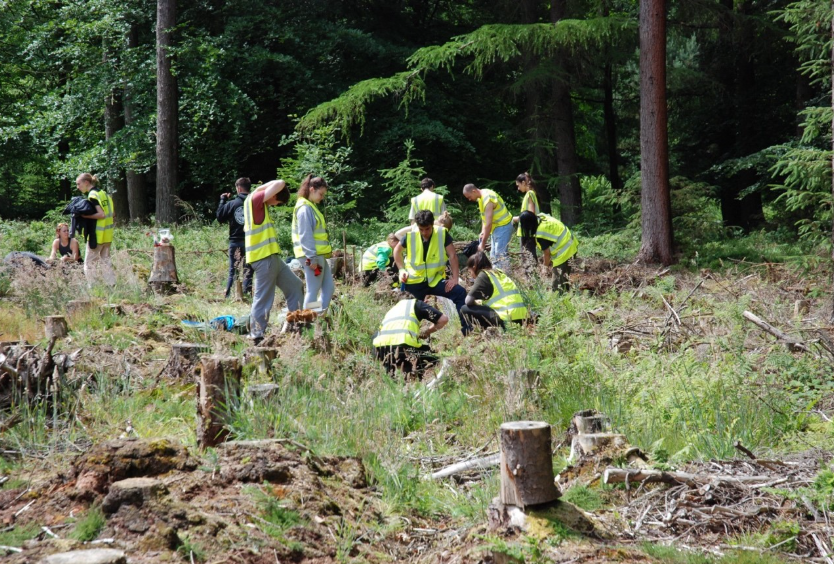
The Forest School's outdoor classroom in Dalby Forest, created in collaboration with Forestry England and the University of York, provided an immersive educational environment that integrated theoretical learning with practical experience. It acted as a living laboratory, where students could study ecological systems, sustainable practices, and the intersection of art, design, and environmental science. By engaging directly with the forest environment, students developed a deeper connection to nature, enhancing their learning and inspiring innovative solutions to ecological challenges.
Ancestral knowledge integration
A collaboration with the Ana María Gutiérrez from Organizmo - Training and Research Centre for Regenerative and Intercultural Knowledge (Colombia), and Catalina Mejia Moreno, Climate Lead at Spatial Practices CSM, explored the incorporation of ecological knowledge by applying design methods that ‘reset’ the starting point for enquiry, offering students the chance to explore their entangled relationships with land, nature and belonging and anchoring embodiment and belonging as spatial and architectural design methodologies. Located in the ancestral woodland of Highgate Woods in London (originally part of the Ancient Forest of Middlesex, Hertfordshire and Essex). This integration not only enriched the students' learning experience but also fostered mutual respect and understanding between different cultural practices and worldviews, highlighting the value of indigenous perspectives in addressing global and personal environmental challenges.
Lecture series and workshops
The Forest School organised a series of lecture series and workshops that brought together researchers, students, and practitioners to explore forest-related topics. These events, conducted in collaboration with Forestry England and other partners, provided a platform for interdisciplinary learning and knowledge exchange. Participants engaged in discussions on ecological systems, sustainable practices, and the integration of art, design, and environmental science. By facilitating these interactive sessions, the Forest School enriched the educational experience, promoting innovative thinking and collaborative problem-solving.
Placemaking outcomes
More accessible
Making education accessible by creating outdoor classrooms, such as in Dalby Forest, benefiting those who struggle in traditional settings.
More equitable
Collaborations with knowledge stewards from the global south to integrate cultural knowledge into the curriculum.
More inclusive
Welcoming diverse participants, hosting events that attract local and international attendees.
More sustainable
Emphasising sustainability with projects using regenerative building materials and practices. Efforts enhance local biodiversity, such as the future ancient forest at Hole Farm.
More innovative
Residency-based learning models that immerse students in nature, and virtual lectures and online workshops broadens their reach. Emergent regenerative construction practices.
More prosperous
Education and training programs and projects that attract investment, supporting local economies.
Nurturing collaborative and sustained engagement
Engaging diverse stakeholders
Securing funding and resources
Integrating traditional, ancestral and emergent knowledge with academic education
Approach: Working closely with knowledge stewards to ensure respectful and meaningful knowledge exchange.Legacy
The legacy of the Forest School project lies in its integrated approach to education, learning with nature to address the climate and biodiversity crises. It sets a precedent for using immersive, outdoor environments to foster a deeper connection with the natural world, enhancing environmental stewardship and sustainability. The project also highlighted the importance of inclusive education by integrating traditional ecological knowledge, thereby enriching the learning experience and promoting cultural understanding. This initiative contributes to a more holistic and equitable model of education, emphasising the value of diverse perspectives and hands-on experiences in nurturing future generations.