In pictures: Professor Helen Storey RDI, MBE's life in fashion

- Written byKatie Moss
- Published date 09 October 2024
Share story
Pioneering artist and designer Professor Helen Storey RDI, MBE recently donated her 30-year creative archive to University of the Arts London (UAL).
Throughout her career, collaboration has been at the core of Storey's work. She has bought together the worlds of fashion and science to explore how design can be used to address some of the world's most significant and complex problems.
In pictures: Helen Storey's life in fashion
The Helen Storey Foundation Archive, carefully curated and developed in collaboration with the LCF Archives team at London College of Fashion (LCF) and the Helen Storey Foundation, will preserve and celebrate Storey’s work across her influential career.
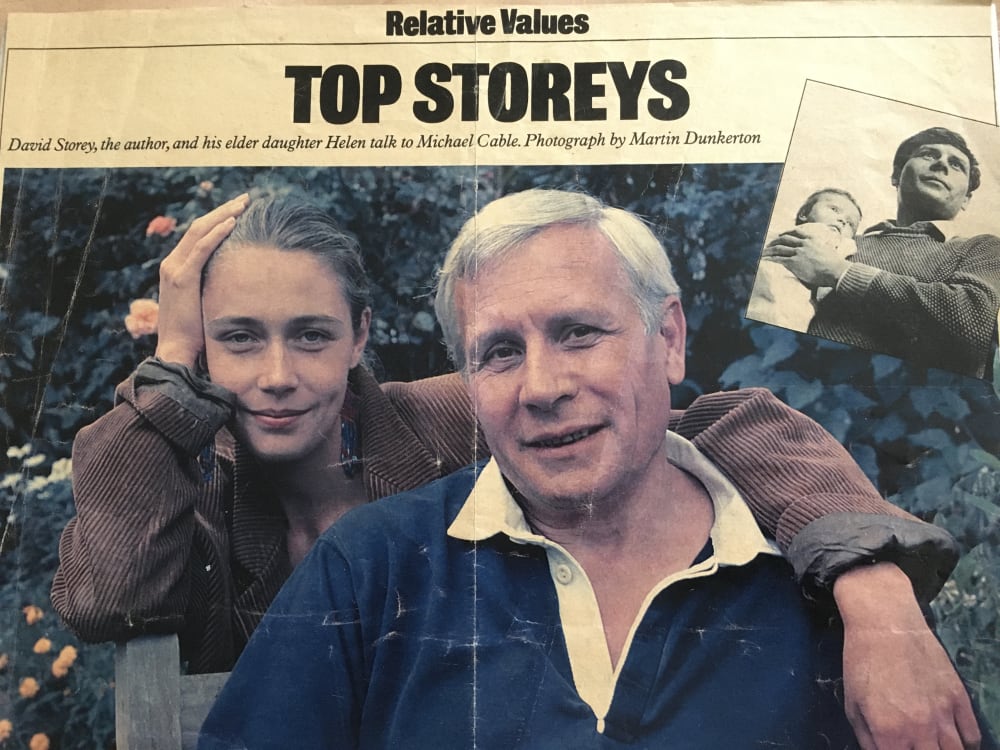
David Malcolm Storey, Helen Storey’s father, was an English playwright, screenwriter, award-winning novelist and a professional rugby league player. He won the Booker Prize in 1976 for his novel Saville.
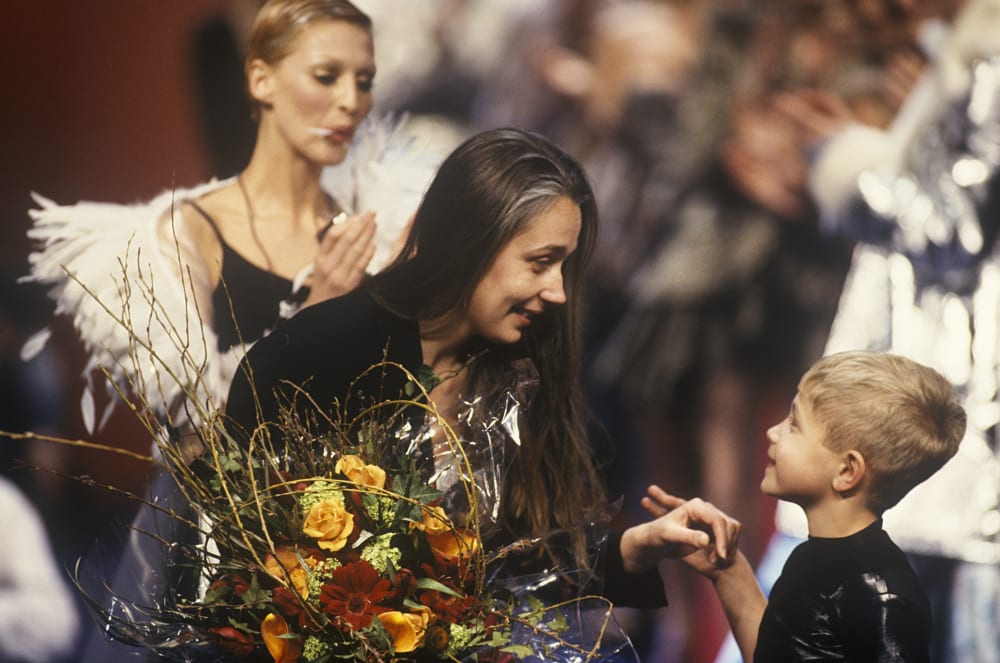
“The catwalk years” – here, Helen is photographed with her son, Luke and fashion designer Susie Cave at the end of the 1995 ‘Rebecca Collection’ catwalk show. The same year, the Helen Storey label closed, and Storey wrote and published her autobiography, Fighting Fashion, chronicling her personal experience within the industry.


Helen and her sister Kate are interviewed about their work on Primitive Streak, their first art and science collaboration in 1997. Primitive Streak elucidated the first 1,000 hours of human life in textile & dress form – touring for 15 years and seen by over 8 million people worldwide.

Wonderland was a ground-breaking collaboration between artist and fashion designer Helen Storey and scientist Tony Ryan. A two-year exploration into biodegradable materials, the project created the world's first disappearing dress. Its fundamental message was to think about new solutions for the problem of excess packaging and waste.

In Wonderland’s first exhibition at London College of Fashion’s exhibition space in 2008, the clothes were gradually immersed in vessels of water. The viewer can see how the fabric gradually dissolves, disintegrating into smaller and smaller pieces, until it completely disappears.

Helen Storey sits with Field of Jeans – part of the Catalytic Clothing collection and potentially the world’s first air-purifying jeans, exhibited here at Manchester Science Festival, 2010. The project was the brainchild of Storey and scientist Tony Ryan (University of Sheffield).
A nano-technologically engineered spray was created to add to the laundry process which will last around ten to twenty washes. Once treated catalytic clothing turns people into walking air purification machines as pollutants caused by cars and industry will be broken down upon impact with the material.

Herself, a highly experimental, “couture” textile sculpture, potentially the world’s first air purifying dress and the first generation of the Catalytic Clothing collection. Intended to illustrate in artistic form, the idea that textiles can eliminate certain pollutants from the air so that we can breathe more beautifully. Here, Helen is pictured with polymer chemist Anthony John Ryan OBE FRSC, who co-developed this project.

“Dress of Glass and Flame” is a collaborative work, between Helen, the Helen Storey Foundation, Royal Society of Chemistry, Berengo Glass, Murano, Venice and London College of Fashion. The dress is lit with live flame within, reflecting on the feminine and long considered questions, as to whether glass is a liquid, or a solid

Dress For Our Time is created out of a decommissioned UNHCR refugee tent that once housed a family of displaced people at Zaatari Camp in Jordan and was gifted by the United Nations High Commission for Refugees (UNHCR).
The first installation of the dress at St Pancras International train station on 26 November 2015 for four days, focused on mapping & projected predictions of climate change. As the gateway to Paris – the host city for the United Nations Climate Change conference COP 21 – it was an opportunity for the delegates passing through the station to come face to face with the world’s first digital couture dress dedicated to exploring climate change and its human impact.

Dress For Our Time by artist, designer and researcher Prof. Helen Storey, uses the power of fashion to communicate some of the world’s most complex issues, notably climate change and the mass displacement of people. The dress is created out of a decommissioned UNHCR refugee tent that once housed a family of displaced people at Zaatari Camp in Jordan and was gifted by the United Nations High Commission for Refugees (UNHCR).

Helen Storey stands with singer Rokia Traore, who wore it on the Pyramid Stage to open the Glastonbury 2016 Festival, as she sang her song ‘Ne So’, written after her own visit back to a refugee camp in Mali, the country of her birth.

In her role as UNHRC’s first Designer in Residence, Helen has worked side by side with refugees living in Zaatari, one of the world’s largest refugee camps, responding to their needs and wishes and co creating projects which nurture entrepreneurship, creativity and financial independence through the lens of fashion.