Undergraduate

Diploma in Storytelling

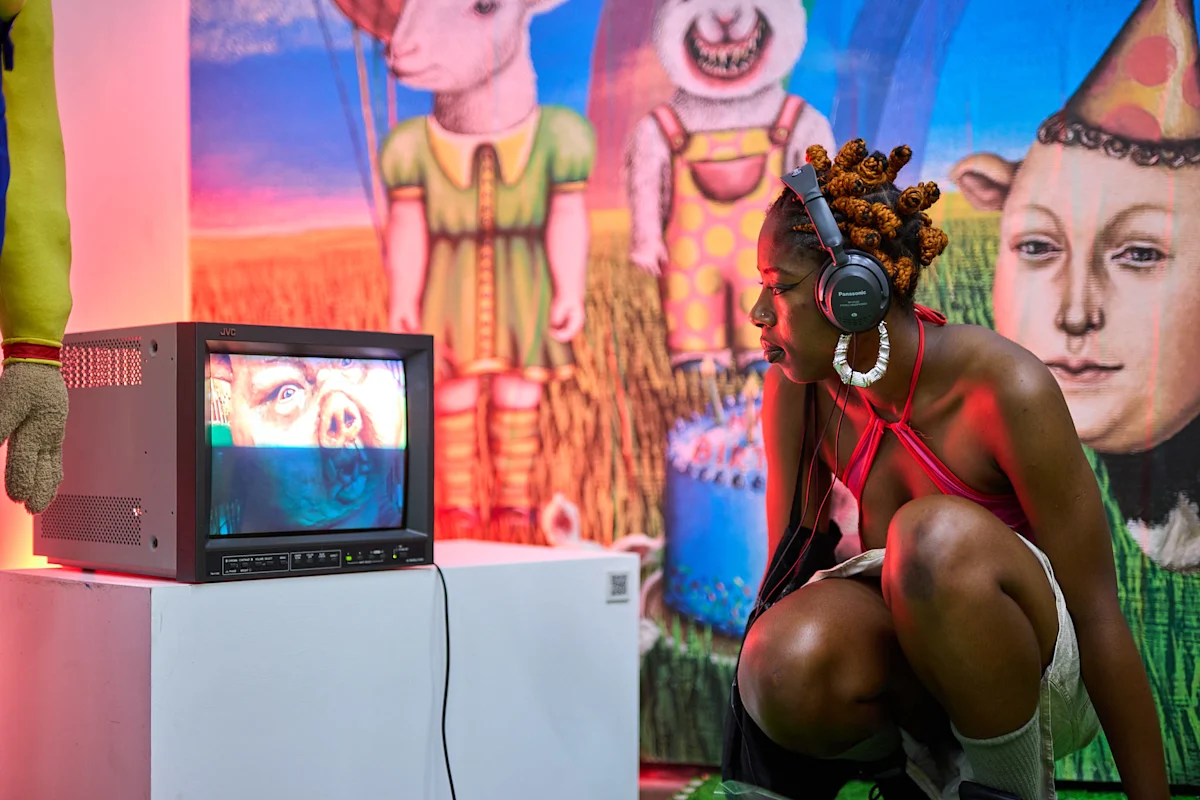
'Danny's Farm', Eva Sykes, 2025 MA Fine Art, Central Saint Martins, UAL | Photograph: Paul Cochrane
College
Wimbledon College of Arts
Start date
September 2026
Course length
1 year

The Diploma in Storytelling enhances your degree between second and third year by developing career-ready skills to craft, interpret and share narratives that engage audiences across diverse contexts.

Course summary

Course overview

Compelling storytelling is fast becoming a key tool for creative and professional success. Graduates with strong storytelling skillsets are in demand across many sectors. The course will provide you with a unique storytelling toolkit that gives you a creative edge in your future career.

The Diploma in Storytelling is open to both experienced and new storytellers. The course invites you to explore how stories can shape culture, spark emotion and drive meaningful change. It combines social justice, critical theory, cultural commentary and creative practice. If you are curious about using your creativity to pursue social change this course is for you.

The course considers existing and emerging approaches to storytelling. You'll connect with communities, creatives and professional storytellers. You'll experiment with and realise impactful stories across a range of media.

Based at Wimbledon College of Arts, you'll study alongside undergraduates from other colleges at the University of the Arts London. We developed the Diploma in Storytelling in collaboration with the UAL AKO Storytelling Institute, which works at the intersection of storytelling and social change.

What is storytelling?

Storytelling (noun)

  • A broad, natural human instinct.
  • A way to connect with people emotionally, on a deeper level.
  • A technique used in all parts of work and life.

(Mirzoyants, Eagle, and Sewell, 2024: 37)

Storytelling can refer to the stories we tell one another, the stories that dominate, as well as those that are unheard or undocumented. Storytelling shapes and communicates the deeper narratives within social structures and cultures.

The modes and media we use to shape and tell stories influence how audiences understand and share them. Storytelling spans fiction and non-fiction, spoken and written forms, and non-text media like objects, images, and live events.

What to expect

  • Crafting impactful stories: Learn how to craft stories for maximum impact to reach and engage new audiences, industries and contexts.
  • Storytelling skills across media: Experiment with the principles and fundamental components of storytelling across various media and platforms.
  • Developing your storytelling voice: Develop your own perspective as a storyteller and consider how your voice could contribute to narrative shifts.
  • Storytelling for social change: Understand how storytelling tools and audience insights can affect social change.
  • Collaborative story development: Co-create with an internal and external network to strengthen your stories and practice.
  • Learning from industry and academics: Access practical and contextual workshops with technical, academic and industry experts.
  • Storytelling using technology: Discover how technologies shape the ways that stories can be created and shared.

Skills development and opportunities

The Diploma in Storytelling develops skills that will enhance your employability. It prepares you for a wide range of creative and professional pathways. Employers value strong communicators who can make an impact.

The course will give you a range of transferable skills. These include practical storytelling techniques, critical thinking and reflective practice. You'll gain in-depth knowledge of methods to engage and inspire audiences. You'll have the tools to contribute to social, racial and environmental justice debates and initiatives.

The course encourages planning for your career and future creative outputs. You'll consider how storytelling can support changemaking roles. This could be across the creative, cultural, commercial, or social sectors.

Mode of study

The Diploma in Storytelling is offered in full-time mode and runs for 30 weeks over 12 months. You will be expected to commit an average of 40 hours per week to your course, including teaching hours and independent study.
Contact us

Register your interest to receive information and updates about studying at UAL.

Contact us to make an enquiry.

Course units

Unit 1: Landscapes

In the first unit, you'll explore the potential of storytelling. You'll have workshops with guest practitioners and technical specialists, as well as site visits. These will introduce you to a diverse range of storytelling techniques and forms. You'll experiment with these and produce a series of creative outcomes.

Contextual studies will help you understand how stories can inspire empathy, build connections and drive social transformation. You'll begin to define what storytelling for change means for you.

Unit 2: Positions

This unit builds on the knowledge of storytelling you gained in unit 1. It introduces you to storytelling networks and the impact stories can have.

Storytelling cannot exist in a vacuum. It requires input from many people during the production and distribution stages. Workshops and expert guidance will help you find your place within the field of storytelling. You'll learn how to co-create content for specific audiences. You'll deepen your understanding of how narratives shape perceptions and audiences.

The unit will help you develop your creative practice, ethical awareness and critical understanding. This will prepare you to plan your self-defined storytelling project in unit 3.

Unit 3: Routes

In the final unit, you'll have the opportunity to enact change through a story of your choice. Workshops, tutorials and guest lectures will support you in the realisation of this project. You'll draw upon the critical, creative and technical skills you have learnt. You'll study audience insights and strategies to help you communicate your work. You'll then show your work at a public event.

As the course comes to an end you'll reflect on your storytelling strengths. You' ll consider future routes and possibilities for your storytelling. You'll identify opportunities for growth, resilience and practice with purpose.

Learning and teaching methods

  • Critical reviews (crits), including work in progress sessions
  • Group discussions and teamwork
  • Independent research
  • Internal and external collaborative practice
  • Lectures, seminars and workshops
  • Oral and written presentations
  • Peer learning
  • Reflection and self-evaluation
  • Self-directed study
  • Site-specific teaching and learning
  • Student-led presentations
  • Study trips and visits
  • Technical workshops
  • Tutorials (individual and group)
  • Unit and project briefs
  • Visiting practitioners and guest speakers

Assessment methods

  • Contextual and critical understanding
  • Development work and processes
  • Formative assessment
  • Practical project outcomes
  • Presentations
  • Written reflections

Introduction to the UAL Diploma in Storytelling

Fees and funding

Home fee

£9,790 per year

This fee is correct for entry in September 2026  and is subject to change for entry in September 2027.

Tuition fees may increase in future years for new and continuing students.

Home fees are currently charged to UK nationals and UK residents who meet the rules. However, the rules are complex. Find out more about our tuition fees and determining your fee status.

International fee

£30,890 per year

This fee is correct for entry in September 2026 and is subject to change for entry in September 2027.

Tuition fees for international students may increase by up to 5% in each future year of your course.

Students from countries outside of the UK will generally be charged international fees. The rules are complex so read more about tuition fees and determining your fee status.

Additional costs

You may need to cover additional costs which are not included in your tuition fees, such as materials and equipment specific to your course. For a list of general digital equipment you may need (and how you can borrow equipment), visit our Study costs page.

Accommodation

Find out about accommodation options and how much they will cost, and other living expenses you'll need to consider.

Scholarships, bursaries and awards

Find out more about bursaries, loans and scholarships.

If you’re based in the UK and plan to visit UAL for an Open Event, check if you’re eligible for our UAL Travel Bursary. This covers the costs of mainland train or airline travel to visit UAL.

How to pay

Find out how you can pay your tuition fees.

Scholarship search

Entry requirements

The selection procedures for the course adhere to the Equal Opportunities policy of the University of the Arts London.

Admission to the Diploma in Storytelling adheres to progression regulations where students are expected to have completed 2 years of previous study up to Level 5 (or equivalent) in the subject area of their course. Should students fail any credits during that period, progression regulations would apply to determine whether they could undertake the Diploma year.

Should you not be successful in your application to any of the UAL Diplomas, you will continue the normal third year of the course you are currently enrolled on (provided you have completed and passed all credits in the first and second year of study as per the university progression regulations).

Please note that international students holding a UK visa for their current 3-year course will need to apply for a further visa before undertaking the Diploma in Storytelling. For more information, please see the UAL Immigration and Visas website and you can also contact Student Services for more specific details.

For further assessment information, extenuating circumstances and attendance, please see the UAL Course Regulations website.

Selection criteria

The Diploma in Storytelling welcomes applications from students across a range of disciplines and is open to both experienced storytellers and those who are new to the practice.

Your performance on the first and second years of study on your current BA course will be taken into consideration. This will include consideration of your past studentship, attendance, commitment and performance. You’ll need to have passed your year 2 units before you can enrol on the Diploma in Storytelling.

You’ll need to show that you can work independently and with others, carry out research, and keep up with a fast-paced, content-rich course that requires full attendance.

Your application will be reviewed against the listed criteria:

  • A good level of creative curiosity.
  • A good level of technical skill or appropriate use of media in your disciplinary area and an openness to transforming this beyond your usual studio practice and environment.
  • An ability to articulate and express your creative ideas and contribute positively as a member of the storytelling cohort.
  • An interest in contributing to changemaking through your own work.
  • Evidence of motivation and commitment through past performance.

Information for disabled applicants

UAL is committed to achieving inclusion and equality for disabled students. This includes students who have:

     
  • Dyslexia or another Specific Learning Difference
  • A sensory impairment
  • A physical impairment
  • A long-term health or mental health condition
  • Autism
  • Another long-term condition which has an impact on your day-to-day life

Our Disability Service arranges adjustments and support for disabled applicants and students.

Read our Disability and dyslexia: applying for a course and joining UAL information.

Apply now

Application deadline

Due to a limited number of available places, this will be an open competitive application process and early applications are encouraged.

Applications for the diploma are open until 5pm on Friday 29 May 2026.

You'll need to be logged in to your UAL email account to complete your application.

Funding

This is an extra year added to your degree, and you will need to fund it yourself.

Opportunities for all

We are committed to making university education an achievable option for a wider range of people and to supporting all of our students in achieving their potential both during and after their courses.

We welcome applications from people with disabilities. If you have a disability (for example, mobility difficulties, sensory impairments, medical or mental health conditions or Asperger’s syndrome) we strongly encourage you to contact us on disability@arts.ac.uk or +44 (0)20 7514 6156 so that we can plan the right support for you. All enquiries are treated confidentially.

Apply to UAL

Home students can apply to this course through UCAS with the following codes:

University code:

U65

UCAS code:

Start your application

Apply now

Application deadline

Due to a limited number of available places, this will be an open competitive application process and early applications are encouraged.

Applications for the diploma are open until 5pm on Friday 29 May 2026.

You'll need to be logged in to your UAL email account to complete your application.

Funding

This is an extra year added to your degree, and you will need to fund it yourself.

Study visas

Once you accept the offer, we’ll check whether you need to extend your study visa. We can only confirm your place on the diploma after this is approved.

English language development

We offer English language development for overseas students.

Learn more on how we can help you with your studies

Opportunities for all

We are committed to making university education an achievable option for a wider range of people and to supporting all of our students in achieving their potential both during and after their courses.

We welcome applications from people with disabilities. If you have a disability (for example, mobility difficulties, sensory impairments, medical or mental health conditions or Asperger’s syndrome) we strongly encourage you to contact us on disability@arts.ac.uk or +44 (0)20 7514 6156 so that we can plan the right support for you. All enquiries are treated confidentially.

Apply to UAL

International students can apply to this course through UCAS with the following codes:

University code:

U65

UCAS code:

Start your application
or

Apply with a UAL Representative

Based across the world, our local UAL representatives can support you with your application from your home country. Check to see if there is a representative available in your country currently.

Find your representative