Abstract Painting Short Course
Course description
Course overview
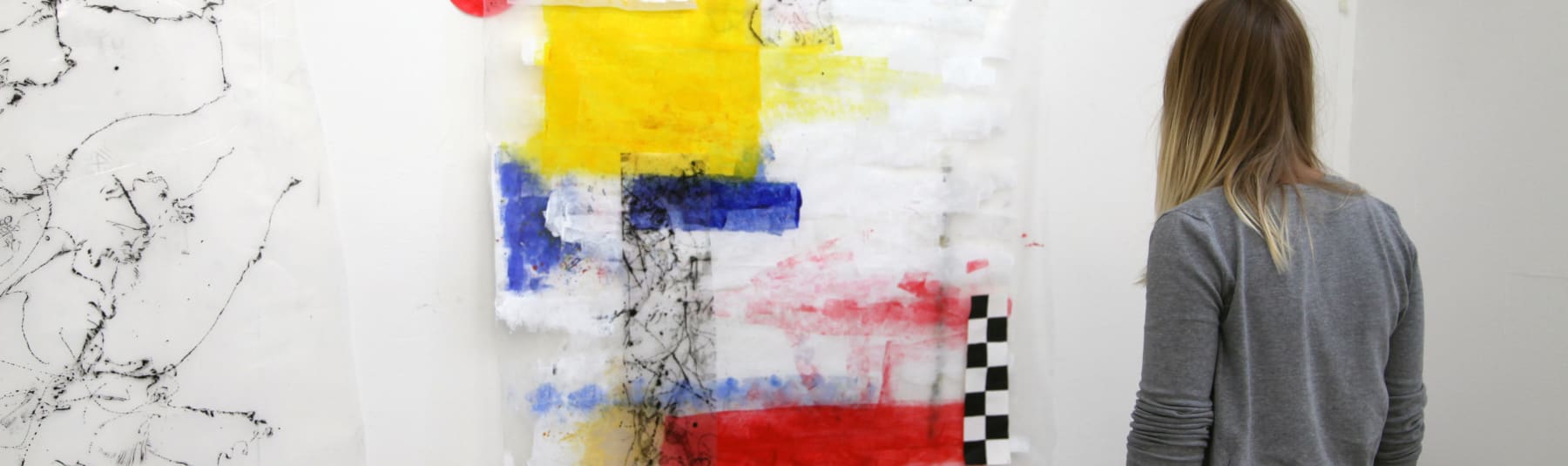
This short course explores the fundamentals of abstract painting, focusing on creating art that moves away from realistic representation.
During the course, you’ll engage in hands-on studio practice, guided experimentation, and live demonstrations to push your creative boundaries to develop your unique visual language in applying colour, gesture, scale, form, and line.
With tutor guidance, you’ll explore the principles of abstract painting, looking at key artists in the movement. This course incorporates references to both contemporary and historical abstract artists and their work to enhance your learning experience.
Who this course is for
This course is suitable for those with an understanding of painting who are looking to explore the limitless possibilities of abstraction in their work.
Great emphasis will be given to various methods of beginning an abstract work such as drawing into abstraction from source material, colour theory, and exploring a number of painting techniques such as glazing and overpainting.
Different methods of mark making and use of composition will also be demonstrated with critical advice offered throughout the day.
Key information
Topics covered
- Contextual analysis
- Mark-making and gesture
- Composition, tone and paint application
- Paint manipulation, colour and collage
- Texture and layering
- Reworking
Learning outcomes
- Learn to draw into abstraction using source references, such as photographs or still life objects
- Have a greater understanding of colour theory to bring out the desired outcome in your artwork
- Learn how to use different painting mediums and fully understand your tools, to create surface tension, depth and pictorial space
- Explore composition and the many ways to achieve convincing and impactful paintings
- Pick up practical techniques to enhance your painting process
- Digital badge and certificate of attendance
Materials
- A2 canvas board
- Selection of acrylic paints (including the primary colours, black, zinc or mixing white, raw umber, burnt sienna and yellow ochre)
- Acrylic paint retarder (to slow down drying)
- Acrylic flow medium
- Acrylic gel medium
- Flat paint palette (white or clear), or a palette pad- please ensure that this is not a watercolour palette
- Water pots
- Selection of brushes (preferably a mixture of soft and hard)
- Palette knife
- Apron or old shirt to protect your clothes
- Some examples of painters or paintings that inspire you or that you like
- While an A2 canvas board is recommended by the tutor, you are welcome to bring additional boards, canvases or other painting surfaces in your preferred size or shape
Please note: Students should make arrangements to take their work home at the end of the course. Any work that is left in the studio, during or after the course, is at a student's own risk. In such circumstances students should ensure that the work is clearly labelled with their name, course title and dates. Work will be kept for no longer than one month after the end of the course. Please note that we are unable to arrange for the delivery of your work but would be very happy to prepare this ready for collection should you wish to arrange for a courier.
Tutor
Enver Gürsev
Enver Gursev is a professional artist who has been working at UAL since 2006. Mentored by the late Eduardo Paolozzi he went on to graduate from Camberwell College of Arts. Enver is a Painter and Sculptor who has worked prolifically in the arts exhibiting nationally and internationally and was recently awarded the prestigious BP Shipping Centenary Collection commission.Book a course
Loading