Drawing Skills for Copying Online Short Course
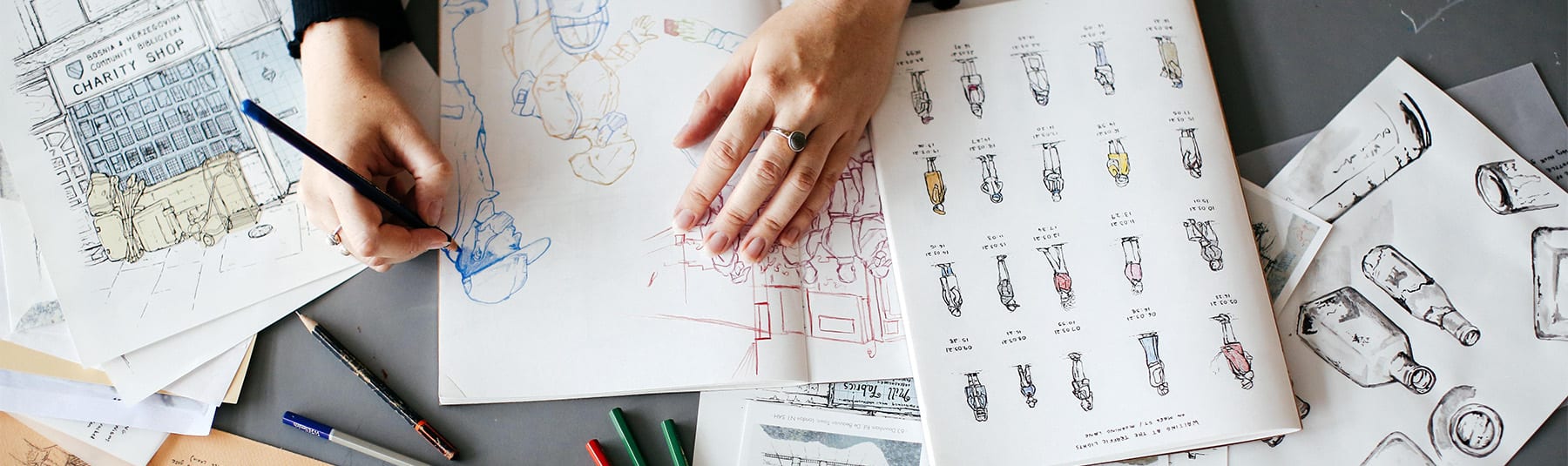
Course description
Course overview
This course will guide you through the steps necessary to complete the Graded Awards in Drawing 1 Copying Award, focusing on observing details, achieving accurate proportions and developing techniques.
The course explores a range of topics including observation, materials, techniques, proportion and detail. You'll gain an understanding of observational drawing and learn how to use materials for a polished look.
By the end of this course, you’ll be able to create a polished, detailed copy of an image and be prepared to meet the standards for Pass, Merit, or Distinction should you wish to take the Graded Award in Copying which can be purchased separately.
As a guide, the total commitment for this course is approximately 6 hours. This includes core materials and creative tasks.
Your personal learning time may vary depending on your pace, engagement, and how deeply you explore the materials.
Who this course is for
This course is for learners who would like to complete the Graded Awards in Drawing Copying Award.
This self-paced course is designed for students aged 11 years and up. To ensure a supportive learning environment, students will be placed into age-appropriate groups for forum access and peer-to-peer support. Grouping will be determined by the date of birth provided at the time of booking.
Key information
Topics covered
- Observation: developing strong observational skills to accurately capture the source material’s details, proportions, and overall essence. Observation is foundational to understanding and reproducing artwork accurately
- Accuracy: focusing on correct proportions, shapes, and alignment in your drawing to create a faithful representation of the original image. This includes attention to detail in form and structure
- Materials and techniques: learning and applying effective pencil control, shading, and texturing techniques. Developing using materials consistently and thoughtfully adds depth and realism to the drawing
- Preparation and planning: choosing and analysing the source image, breaking it down into manageable parts, and planning your approach. This ensures a methodical and organized start to the drawing
- Proportion and scale: ensuring that shapes and forms are balanced and proportionate, a vital aspect of creating an accurate, visually cohesive drawing
- Detail and finishing touches: adding fine details and making final adjustments that enhance the overall quality and completeness of the drawing, showing care and a high level of finish
- Self-reflection and evaluation: practicing regular self-assessment to identify strengths and areas for improvement, supporting continuous growth and meeting assessment criteria effectively
Learning outcomes
By the end of this course, students will be able to:
- Understand and apply the basics of observational drawing
- Recognise why observational skills are key for accurate copying
- Identify features of a high-grade copied drawing
- Select an image that matches their skill level
- Break down an image’s key shapes, lines and textures
- Practice spotting details and copying elements accurately
- Reproduce shapes and proportions effectively
- Map an image with correct spacing and form
- Control pencil techniques for clear, precise results
- Apply shading and line work for texture
- Use materials consistently for a polished look
- Add final details to enhance the drawing’s quality
- Make adjustments to prepare the drawing for submission
- Receive a digital badge and certificate of attendance
Materials
To successfully complete the course, you'll need the following materials and tools to support your drawing practice. Additionally, you may want to have a comfortable workspace with good lighting to enhance your observation and drawing process:
- Pencils (preferably a range of grades, from 2H to 6B, for varying line and shading techniques)
- Erasers (a kneaded eraser and a precision tip eraser for fine details)
- Paper (high-quality drawing paper, such as Bristol board or smooth texture for detailed work)
- Ruler (for straight lines and accurate measurements)
- Protractor (optional, for measuring angles if needed)
- Sharpener (a good pencil sharpener for maintaining pencil points)
- Blending tools (for smoothing and blending shading)
- Digital camera (for photographing your work during various stages for self-reflection and assessment)
- Grade 1 image sources (provided by the course, or your own selection that fits your skill level)
- Computer or tablet (for uploading and submitting images, as well as using any digital resources provided in the course)
Please see our Guide to taking online short courses.
Tutor
Joe Richardson
Joe Richardson is a multi-disciplinary artist working between painting, video, collage, audio and sculpture.
Richardson's works operate in the space between the performance of an action and its anticipated outcome, for example, the smashing of a glass, a character falling in a canal, a breakthrough in communication.
His works perform as double acts, facades, and stages 'that deconstruct everyday scenarios through repetition to the point of absurdity to produce purgatorial experiences of waiting, spaces of absurd nothingness, and the opportunity to navigate uncertainty'.
His recent projects include a solo exhibition at Cine-Window, Winsford, a duo show at FIVE YEARS, 'Pesaro Voeslauer' and a group show at London Lighthouse Gallery. Richardson also has a permanent display of video works available to view in the lobby of Universal Music, 4 Pancras Square (next to Central Saint Martins).
Alongside his professional art practice, Richardson is a freelance tutor at UAL Short Courses and City Lit, teaching painting, drawing, and collage.
Book a course
Loading