UAL’s global partnerships strengthened with Memorandums of Understanding
- Written byEmily Mulenga
- Published date 03 September 2026
Share story
In 2025, UAL signed a Memorandum of Understanding (MoU) with the University of the West Indies (UWI), and in 2026, Wimbledon College of Arts, UAL, signed an MoU with the School of Drama and Fine Arts, of the University of Calicut in Thrissur, India. These agreements have opened a space for UAL to engage in further dialogue, collaboration, and Knowledge Exchange with these partner institutions.
We look back at how these international partnerships were formed, and the exciting ways they are helping to facilitate new ways of working and learning.
MoU with the School of Drama and Fine Art, University of Calicut
Wimbledon College of Arts has been collaborating with the School of Drama and Fine Arts, University of Calicut in Thrissur, India for several years. Earlier this year, to formalise the partnership and the shared desire to continue working together, a Memorandum of Understanding (MoU) was agreed by both institutions. To mark this occasion and to further the existing exchange, Wimbledon College of Arts hosted Dr. Abhilash Pillai, Director of the School of Drama and Fine Arts in Thrissur during the week of the 2026 undergraduate Show at Wimbledon.
During his visit, Dr. Pillai met with Wimbledon staff, viewed the work in the Show and attended a student performance. He also delivered 2 workshops to first-year BA (Hons) Acting and Performance students. The practice-based workshops, titled ‘Digital Bodies, Fragmented Selves: Performance, Presence, and the Mobile Apparatus’ exploredhow contemporary performance is shaped by digital culture, mobile technologies, mediated presence, and changing relationships between body, identity, memory, and communication.
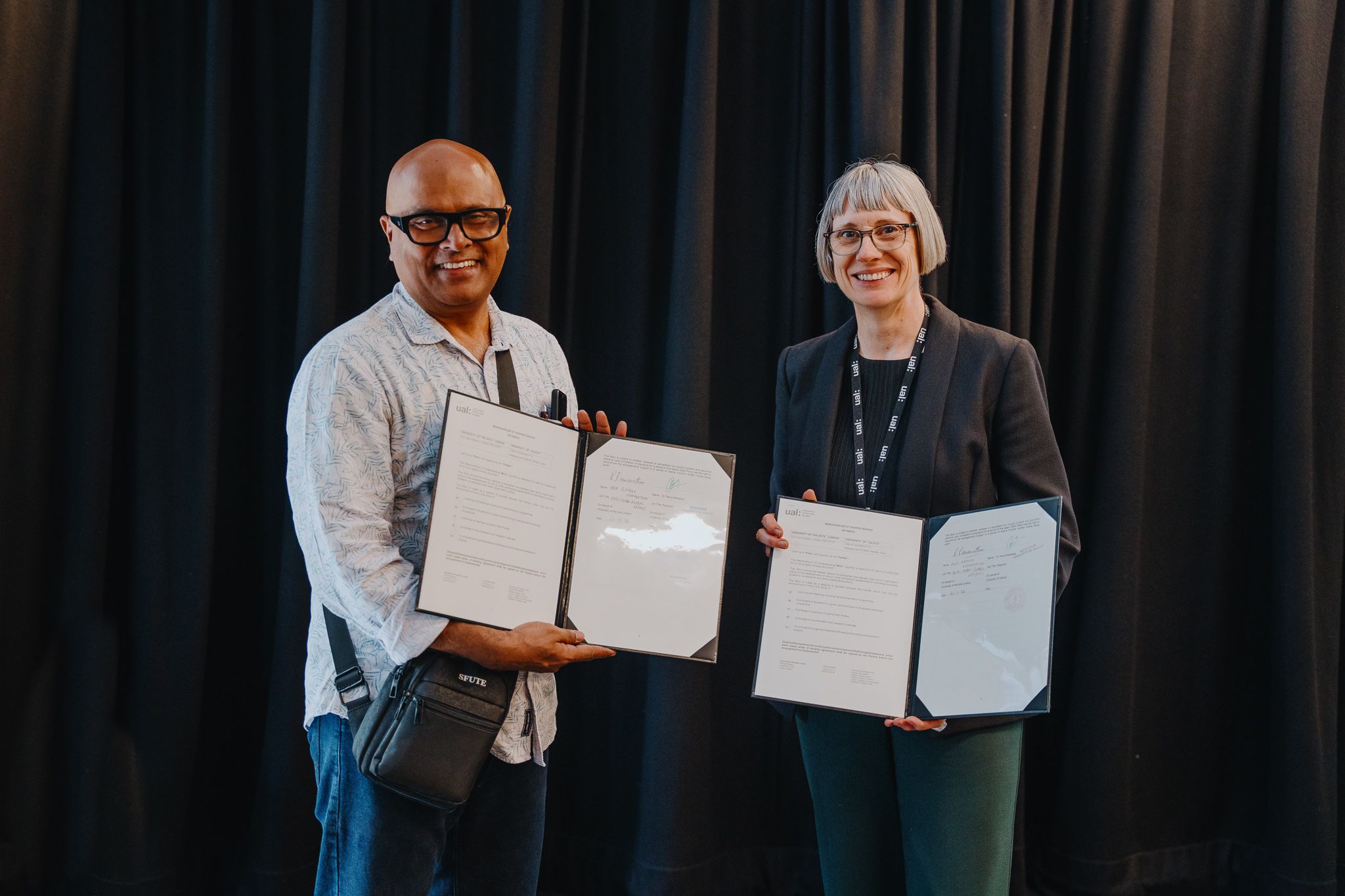
To celebrate the agreement of the MoU between University of the Arts London and the University of Calicut, Dr. Pillai also participated in an MoU signing ceremony with Wimbledon faculty and staff. During the ceremony, Jayne Knowles, Dean of Art and Performance at Camberwell, Chelsea and Wimbledon Colleges of Arts, spoke about the importance of the relationship to Wimbledon, whilst Dr. Pillai commented on the similarities between the two institutions in their approach to the performance discipline, and the desire to continue and deepen the relationship.
Prior to Dr. Pillai’s visit and the signing of the MoU, several faculty members from Wimbledon visited the School of Drama and Fine Arts. Through these visits, and with the support of UAL’s Global Seed Funding, University of Calicut and Wimbledon College of Arts developed an online site-specific workshop for students, conducted simultaneously in London and Kerala over 3 weeks in October 2024.
More recently, in January 2026, Naomi Kuyck-Cohen, Lecturer, BA (Hons) Theatre and Performance Design, visited Thrissur to attend the 2026 International Festival of Theatre Schools. During the visit, Kuyck-Cohen delivered a workshop on sustainable scenography practice, and a paper on supporting neurodivergence in scenography practice, as well as meeting with other global pedagogical practitioners in performance.
The partnership between Wimbledon College of Arts and the University of Calicut is an important opportunity for Wimbledon students and academics to deepen their understanding of performance practice from different perspectives and traditions. The continued exchange between our two institutions holds great potential for further student collaborative projects and joint research.
MoU with the University of the West Indies
Senior Educational Developer at Camberwell, Chelsea and Wimbledon Colleges of Arts, Jheni Arboine’s ‘Deep Conversations’ is the first collaborative research project in partnership with the University of the West Indies (UWI). Bringing together voices across continents, and touching on themes of shared history, teaching and learning, pedagogy, social justice, and climate change, the 3-year collaborative research project’s aim is to enable academics from both UAL and UWI to create a space for international Knowledge Exchange.
The project first began when Jheni went to Jamaica to visit her mum in 2022. This trip inspired her to reach out to the University of the West Indies, curious to learn about their academic enhancement practices and different ways of working. After an eager response, she later returned, visiting the Edna Manley Arts Institution and the University of the West Indies’ Mona Campus. Reflecting on the connections she made during her trip, Jheni highlighted the warmth of the students, who made her feel truly welcome. Staff also extended a warm welcome, with Jheni being gifted a secret recipe for a traditional Caribbean black Christmas cake during her second visit in 2024.
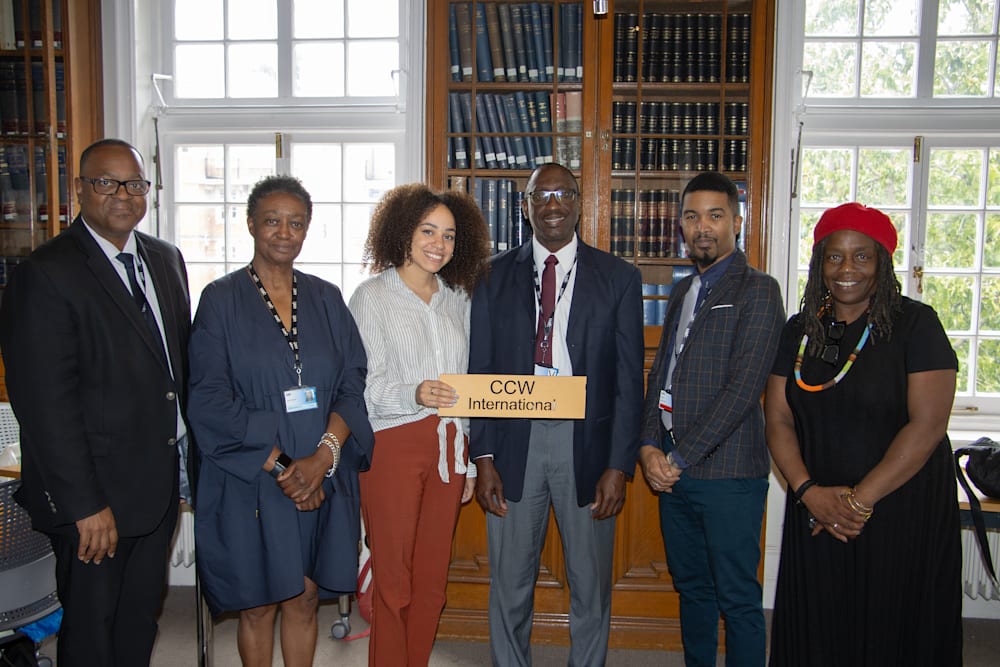
Amidst a growing partnership, UAL and UWI signed a Memorandum of Understanding on 7 July 2025, signifying a commitment to working towards a common goal and the commencement of a 3-year collaborative research project. Chelsea College of Arts hosted a special welcome event for 3 academic colleagues from UWI. This visit marked and formally consolidated a milestone in the relationship between UWI and UAL. The 3 colleagues from UWI also delivered a keynote at the UAL Education Conference on 1 July 2025 at London College of Fashion, where they presented their pioneering work, including Dr. Mervin Chisholm’s work on Caribbean Emancipatory Pedagogy (CEP).
Having fallen in love with learning through a new perspective, Jheni hopes that papers and journals from UWI and the Caribbean will one day be accessible at UAL, offering an exciting opportunity for everyone to engage with them.
We spoke to Jheni about how she plans to further foster a learning environment that is informed by current cultural issues and conversations.
What can UAL and UWI learn from each other in terms of responding to climate injustice?
On my visit to UWI in 2022, I met with a professor of marine science. Having never seen a Black, female professor of marine science before, I was in awe, but to them, she was just a professor of marine science. She told me about this seaweed called Sargassum – often seen as a threat to tourism. I learned that there are local scientists who are experimenting with this seaweed by trying to turn it into fabrics and other materials and even biofuel so it could run a car. What initially seems like a problem could become a blessing and a great alternative resource. I’d seen students at Wimbledon looking at the potential of alternative materials, including seaweed, and I thought there’s a mini project here.
The role of Caribbean Emancipatory Pedagogy (CEP) is to support the empowerment, recuperation, and resistance of Caribbean people. How do you see the CEP approach influencing learning at UAL?
After speaking with Dr. Mervin Chisholm at the Mona Campus at UWI and reading all the books that he’s referenced, I think it’s important for all of us who are working in education at UAL to read the (CEP) material first. That way, we can better understand how to really apply it to design, fine art, and pedagogy. I think it’s a long-term goal, that will require a lot of deep reading into CEP through an interdisciplinary lens. We need to identify our priorities as an arts institution, such as tackling the attainment and awarding gaps, and see what we can learn from CEP, in an ethical way, focusing on specific methodologies. I want this to be something that we co-design together as partner institutions; we can all learn individually, but it’s about how we make sure it’s done collaboratively, ethically and inclusively meeting each other at the same level.
What does a truly inclusive future in higher education look like to you?
I think the word inclusive should incorporate a blend of disciplines. I believe in the future, it’s about being interdisciplinary. It’s important that elements of science are incorporated into the curriculum, in a similar way to MA Art and Science at Central Saint Martins. We also need to work to embed collective resilience into our students and staff, whether this be first aid classes, mental health first aid awareness, emotional intelligence, critical awareness while leveraging AI, sewing, singing and baking sourdough bread; or teaching them how to set up a business or an enterprise and do their tax returns. This needs to be taught early on – not only in the final year.
Jheni would like to add a big thank you to Wendy, Yusuf and Charlotte from the International Team.
The UAL project team includes:
- Jheni Arboine, Senior Educational Developer- research project lead
- Femi Isiaq, Reader and Programme Director in Computer and Data Science (CCI)
- Carol Tulloch, Professor of Design
- Ocean Baulcombe-Toppin, Associate Lecturer, BA Fine Art, Chelsea College of Arts