Meet Sophie Kabangu: Uncovering the stories behind Black British protest
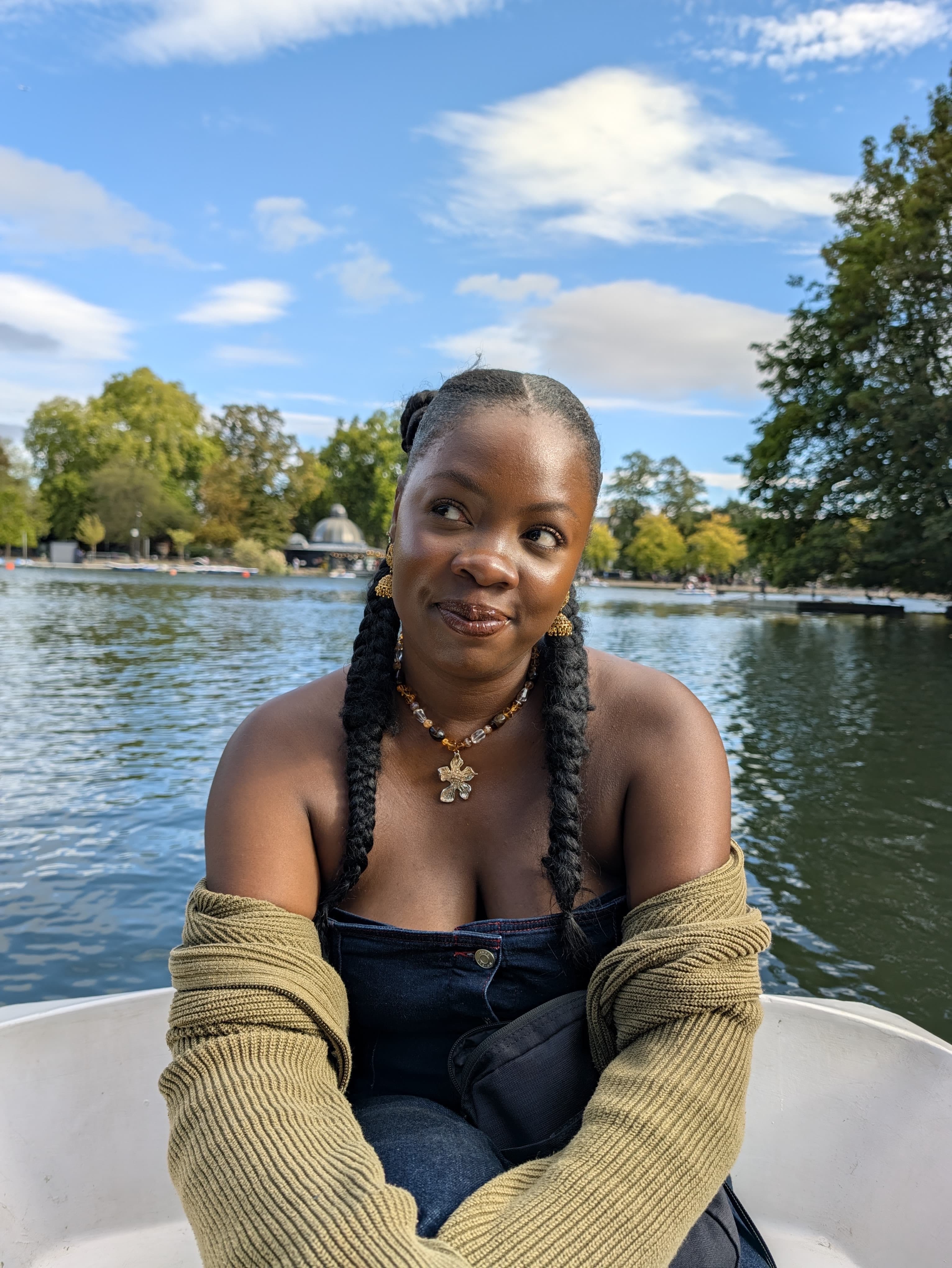
- Written byStudent Communications
- Published date 10 November 2026
Meet Sophie Kabangu, a third-year PhD student at Wimbledon College of Arts researching the history of Black British protest.
We spoke to Sophie about the people, collective care and behind-the-scenes organising that make protest possible, and why documenting these often-overlooked stories is essential to understanding histories of resistance and the communities that drive change.
This interview is in collaboration with Student Partnership Manager Jason Forrest, whose current MA in Academic Practice at UAL identifies the importance of cultural storytelling in shaping students' voices and communities in higher education.
Could you introduce yourself, tell us a bit about your creative practice and what you're currently studying at UAL?
Hi, my name is Sophie Kabangu. I'm a third-year PhD student at Wimbledon College of Arts. My PhD is in performing arts and my research explores Black British protest history.
Can you tell us more about your work and the ideas, themes or stories you're exploring through it?
My PhD is titled Organising Black British Protest: Infrastructures of Care, Labour and Assembly from the Black People’s Day of Action (1981) to Black Lives Matter (2020). I'm interested in all the things that happen behind the scenes of a protest that we don't often get to hear about.
When we see protest in art galleries or hear about it in the news, we usually see the demonstration itself: the crowds, the placards and people taking to the streets. But we don't often hear the stories of how those protests came to exist. Who brought people together? Who did the planning? Who made the placards, organised the logistics and looked after the people involved?
I think we often separate the organising from the actual protest, as though it's just the preparation for the main event. But I see the organising as the protest itself. It starts when people decide they've had enough and that something needs to change. It's about people coming together, figuring out what they can do and working collectively to make something happen.
I'm particularly interested in Black British protest and looking at the period between the Black People's Day of Action in 1981 and Black Lives Matter in 2020. I want to explore what we can learn from the people who organised these protests, how that knowledge gets passed down between generations and what happens when those stories and connections are lost or forgotten. For me, it's about recognising the people and collective work that make protest possible, rather than only remembering the moment everyone sees.
Are there particular people, places, experiences or cultural influences that have shaped your creative practice?
My work is inspired by the long history of Black British resistance, organising and creativity that we're so rarely taught about. Since starting my PhD, I've learned so much about the people, movements and communities that have shaped Black British history. I think there's so much value in sharing these stories because they're histories that I believe everyone would benefit from knowing.
A moment that really shaped my research was visiting Steve McQueen's Resistance exhibition, which explored 100 years of British protest history, from the militant suffragettes to the protests against the Iraq War. Among the photographs was one of the Black People's Day of Action in 1981, which took place following the New Cross fire, in which 13 young Black people died. When I looked at the photograph, it felt strangely familiar. It was a black-and-white image of people marching, with the names of the victims repeated across placards. But looking at it raised a question for me: how did this protest happen? Who organised it? How did all these people come together?
I decided to visit the George Padmore Institute to see what I could find, and that experience really changed things for me. I found records documenting the events following the New Cross fire, the meetings between organisers and the work that went into bringing people together. One piece of paper that really stayed with me described how John La Rose had walked through different areas of London encouraging people to attend the protest. I found that so powerful because it showed the amount of work that went into organising a demonstration of that scale, work that you would never necessarily know about just by looking at the photograph.
That experience really shaped the direction of my PhD. It made me realise how much of the story gets lost when we only focus on the protest itself, rather than the people and the organising behind it. I think what inspires me most is discovering just how much has happened before us and how much we can learn from the people who came before us. There are so many stories of people coming together, caring for one another and finding ways to resist injustice, often without the recognition they deserve.
I want to bring some of these stories to light, not just to look back at history, but to think about what it can teach us today. For me, it's about recognising that we're part of something much bigger than ourselves and making sure these histories are shared rather than forgotten.
How would you describe your creative process?
My process involves a lot of archival research and autoethnography, which means reflecting on my own experiences and using them to explore wider social and cultural questions.
I spend time looking through historical documents, photographs, newspapers and other materials to piece together stories of Black British protest and organising. I find it really interesting because you often come across things you weren't necessarily looking for, and those discoveries can completely change how you think about a particular moment in history.
Autoethnography is also an important part of my research because I draw on my own experiences of organising a Black Lives Matter protest in Colchester in 2020. It allows me to reflect on what it actually feels like to organise a protest, including the work, emotions and responsibilities that people don't always see. I can then bring those experiences into conversation with the histories I'm exploring in the archives.
For me, it's about bringing these different perspectives together: looking at historical records, reflecting on my own experiences and learning from other people. I'm particularly interested in what gets remembered, what gets left out and how we can uncover the stories of the people and collective work that make protest possible.
How does your personal background or lived experience influence your work?
My personal background definitely influences my work. Having organised protests myself, particularly the Black Lives Matter protest in Colchester in 2020, I know that there's so much that happens behind the scenes that people don't necessarily see. When we look at images of protests, we often see the crowds and the placards, but we don't see the work, the emotions, the responsibility or the people who make it all happen. Having experienced that myself, I became really interested in understanding what organising looks like beyond the demonstration itself.
My own experiences have also made me curious about the history of Black British protest and the people who came before us. I often think about what it would have been like to organise a protest in the 1980s, what knowledge people had access to and how they supported one another without the resources and technology we have today.
I think my lived experience has shaped the questions I ask in my research. It's made me realise how important it is to document these experiences and share these stories, because organising can be exhausting, emotional and sometimes quite isolating, but it can also be incredibly powerful. I want my research to recognise the people behind these movements and the collective effort it takes to bring people together for change.
How has studying at UAL influenced your development as a creative?
I love studying at UAL, but more importantly, I love the people I've met along the way. Being surrounded by people who encourage me, support my work and genuinely want to see me do well has been such an important part of my experience. I've had opportunities to meet people from different creative backgrounds, share ideas and have conversations that have helped me think about my research in new ways.
My PhD is also funded by a UAL studentship, which has honestly been life-changing. Having that support has given me the opportunity to dedicate myself to my research and explore something I'm really passionate about. Being able to pursue a PhD is such a privilege, and I'm really grateful to UAL for making that possible.
I think being part of a creative environment where people are exploring different ideas and challenging how we understand the world is really valuable, especially as my research sits between history, art, politics and lived experience. It's also been lovely to find people who are interested in similar questions and who encourage me to keep exploring them.
For me, studying at UAL has been about so much more than developing my research. It's been about finding community, building connections and having the support and space to pursue something that really matters to me.
What are you working on at the moment, and what's next for you creatively?
I'm currently curating a series of Long Table Talks called Behind the Protest. They're an opportunity for me to bring people together, including activists, artists, creatives, researchers and people involved in Black British protest across different generations, to talk about the things that happen behind the scenes of organising that we don't often get to hear about.
The series is made up of three discussions, each exploring a different aspect of organising. The first, Remembering Resistance, looks at Black British protest history, visibility and organising. The second, The Cost of Organising, explores the labour involved in anti-racist organising, including burnout and the pressures people experience. The final discussion, Recovery, Radical Joy and Collective Care, focuses on how we look after ourselves and one another, and what more sustainable ways of organising might look like.
I'm really excited about this project because it creates space for people to share their experiences, learn from one another and have conversations that don't always happen in public. It also allows me to bring my research out of the archives and into a space where people can contribute their own knowledge and experiences.
Looking ahead, I want to continue finding creative ways to share my research beyond academia. I want these histories and conversations to reach a wider audience because I think there's so much we can learn from the people who have organised before us and from one another about how we come together to create change.
Work by Sophie Kabangu
-
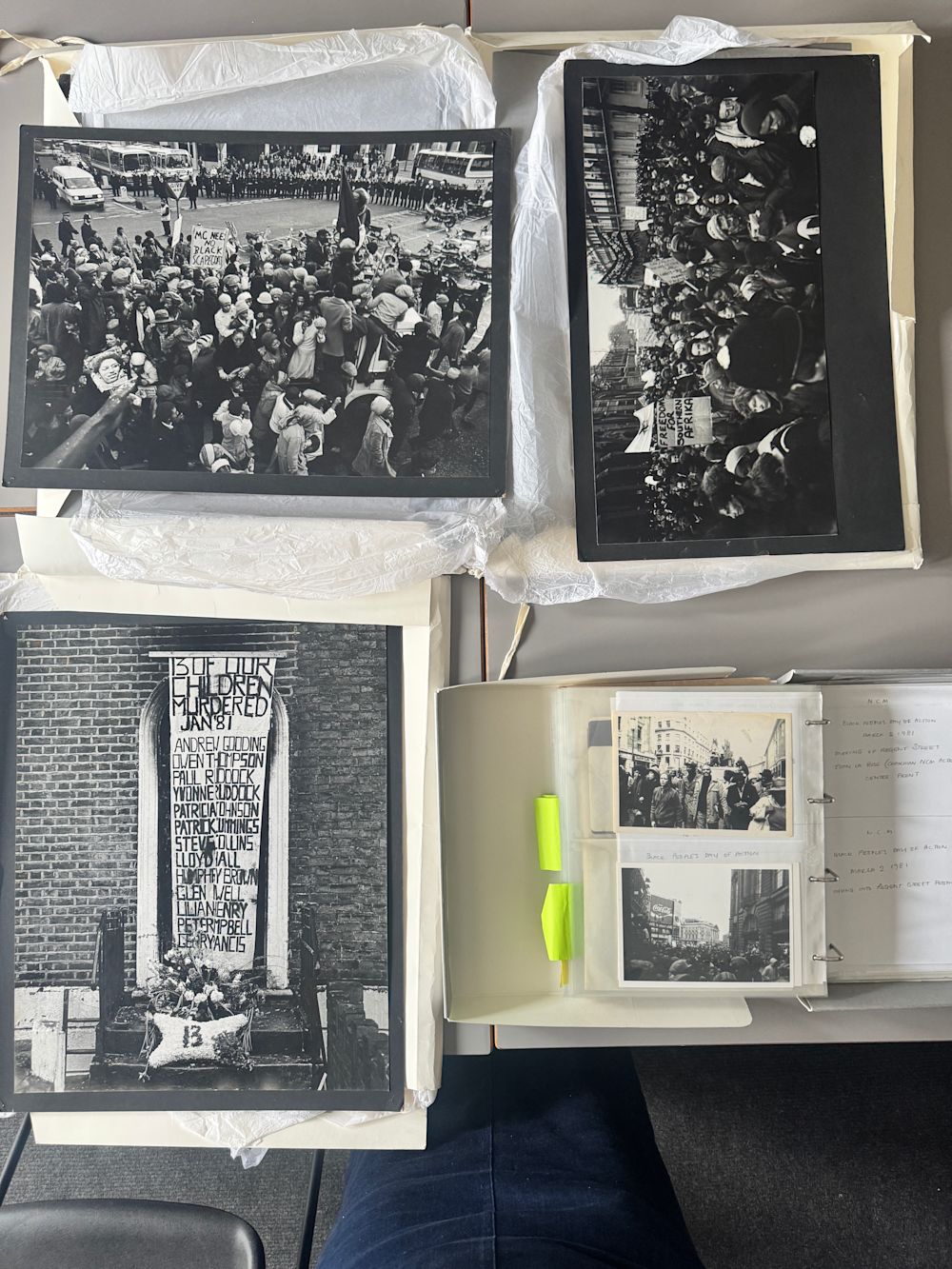
Sophie Kabangu : archival photographs and research materials
-
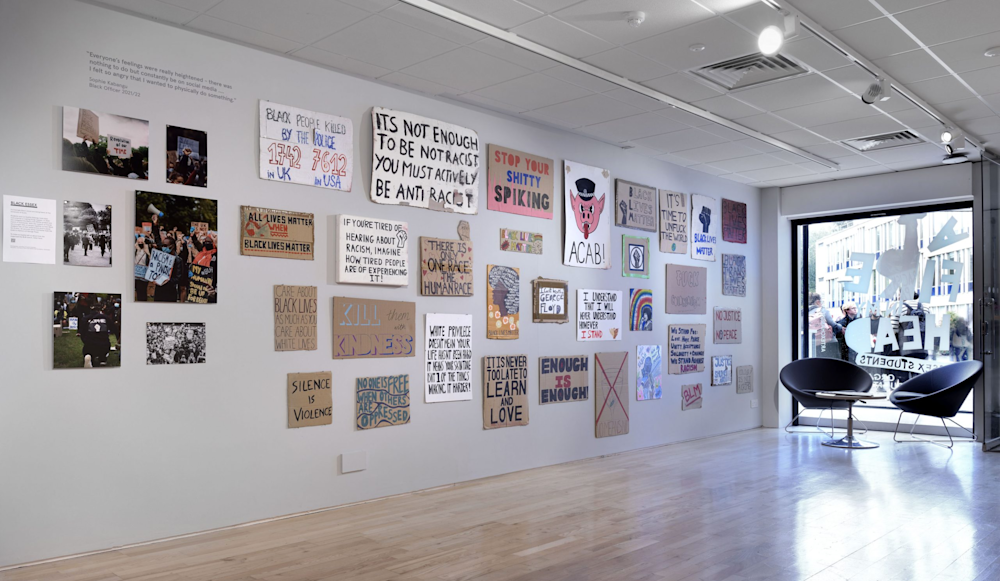
Sophie Kabangu artwork displayed as part of an exhibition.
-
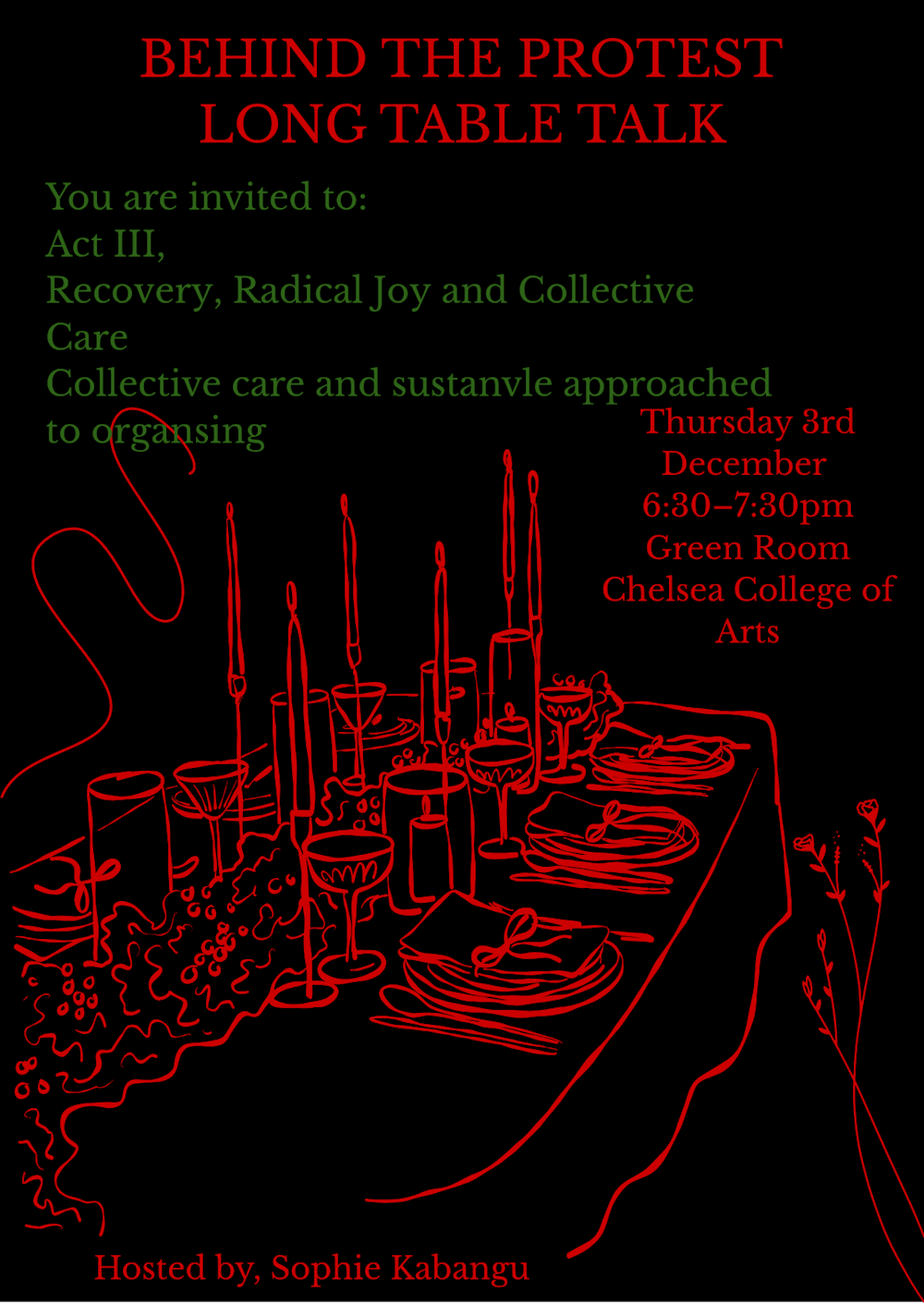
Sophie Kabangu: behind the Protest: Long Table Talk event poster.